


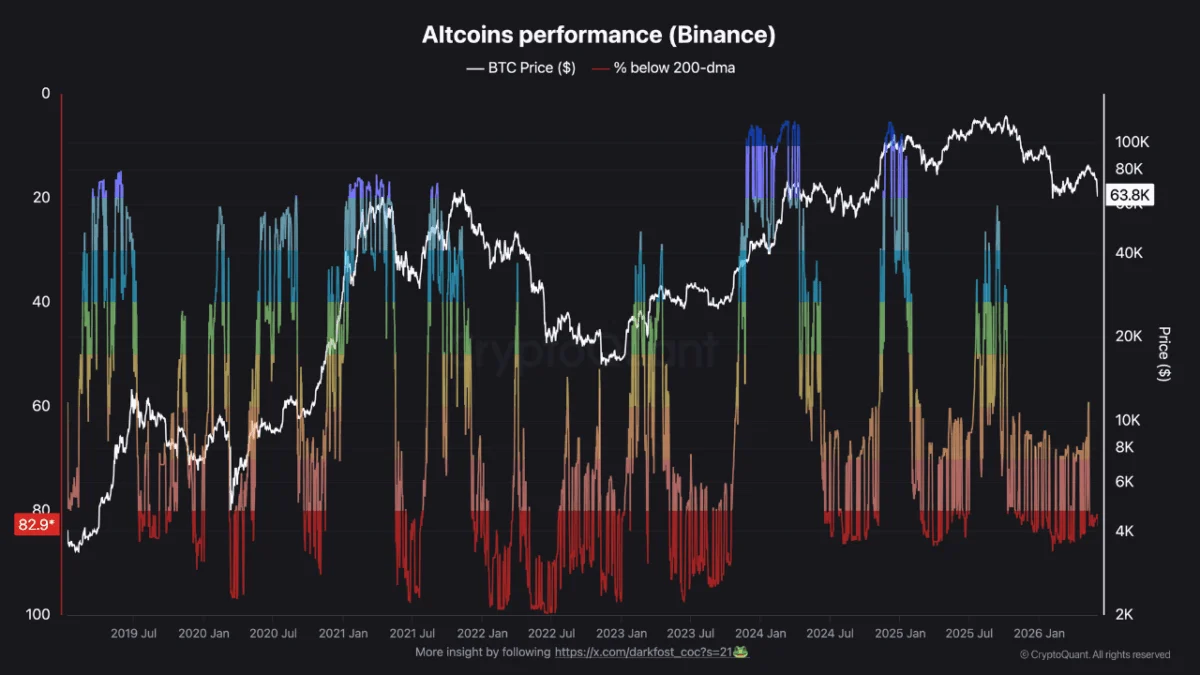
The global cryptocurrency market is currently navigating a period of intense structural weakness, with seasoned analysts warning that altcoins have entered a precarious position characterized by significant capital outflows and a breakdown in historical price correlations. Recent data from market analyst Darkfost indicates that the broader alternative cryptocurrency sector is suffering from a "deep-seated rust," failing to keep pace with Bitcoin’s relative resilience. This downturn is underscored by the startling revelation that 83% of all altcoins are now trading below their 200-day moving average (200DMA), a critical technical threshold that often separates long-term bullish trends from secular bear markets.
This localized crypto volatility coincides with a broader systemic shock in the traditional financial sector. On a recent Friday, often referred to by traders as a "Black Friday" for tech stocks, over $1 trillion in market capitalization was erased from US financial markets. This massive sell-off was primarily driven by deteriorating sentiment surrounding artificial intelligence (AI) and semiconductor equities, which had previously served as the primary engines of market growth. The contagion spread rapidly: the S&P 500 retreated by 2.6%, the Nasdaq plummeted by 4.7%, and Bitcoin—often viewed as a high-beta risk asset—fell by 4%. However, the damage to the altcoin sector has been disproportionately severe, leading to questions about the viability of the current "altcoin season" narrative.
The Technical Breakdown: The 200-Day Moving Average Crisis
The 200-day moving average is widely regarded by institutional and retail traders alike as the ultimate barometer of an asset’s long-term health. When an asset trades above this line, it is generally considered to be in a macro uptrend; conversely, remaining below it suggests a lack of buying pressure and a prevailing bearish sentiment. According to Darkfost’s analysis of CryptoQuant data, the current reading of 83% of altcoins trading below the 200DMA is one of the weakest recorded in the present market cycle.

Historically, since 2002, the percentage of assets in this category has fluctuated within a 60% to 90% range during periods of consolidation. However, the persistence of this low reading suggests that the current market is not experiencing a temporary dip, but rather a structural shift where capital is being concentrated almost exclusively in Bitcoin. This lack of "breadth expansion"—a term used to describe a rising tide that lifts all boats—indicates that the majority of the crypto market is currently starved of liquidity.
For many of these assets, the struggle began in late 2024. While Bitcoin reached new heights fueled by the success of spot ETFs and institutional adoption, altcoins failed to follow suit. This decoupling has left many investors underwater, as the "altcoins" (excluding Ethereum) have shown little to no correlation with Bitcoin’s upward movements, yet remain highly sensitive to its downward corrections.
The $520 Billion Evaporation: Analyzing the TOTAL3 Index
The financial impact of this underperformance is best illustrated by the TOTAL3 chart, a metric provided by TradingView that tracks the total market capitalization of all cryptocurrencies excluding Bitcoin and Ethereum. This index provides the clearest view of the "rest of the market," including mid-cap and small-cap altcoins.
Data shows that the TOTAL3 index has shed approximately $520 billion from its cyclical peak. From a high of nearly $1.2 trillion, the total valuation has contracted to approximately $670 billion. This massive flight of capital has effectively erased months of gains, returning the broader altcoin market to valuation levels not seen since November 2024.

The implications of this $520 billion loss are twofold. First, it suggests a "flight to quality," where investors are exiting speculative positions in favor of the perceived safety of Bitcoin or stablecoins. Second, it highlights the exhaustion of the retail investor base, which typically drives altcoin rallies. Without a fresh influx of retail capital, many of these projects are struggling to maintain the liquidity necessary to prevent cascading price drops.
A Chronology of Market Decline
To understand the current state of the market, one must look at the timeline of events leading to this contraction:
- March 2024 – Heightened Optimism: Nearly 90% of altcoins were trading above their 200DMA. This period marked the peak of "breadth expansion," where participation was high across all sectors, including DeFi, Memecoins, and Layer-1 protocols.
- September to October 2024 – The Great Decoupling: While Bitcoin began to stabilize and prepare for a year-end rally, the TOTAL3 index began to stagnate. The correlation between BTC and the broader altcoin market started to weaken.
- December 2024 – The Onset of Underperformance: Despite Bitcoin hitting significant milestones, altcoins failed to recapture their March highs. Analyst Darkfost notes this as the period where the "rust" began to set in.
- February 2025 – The Tech Sector Contagion: The sudden collapse of AI and semiconductor stocks in the US triggered a global "risk-off" event. This served as the catalyst for the current 4% drop in Bitcoin and the subsequent deep dive in altcoin valuations.
Market Sentiment and Institutional Shifts
The prevailing sentiment in the altcoin market is currently categorized as "extreme pessimism." However, contrarian analysts like Darkfost argue that these periods of maximum pain have historically provided the most lucrative entry points for long-term investors. The logic follows that when 90% of assets are above their 200DMA (as seen in early 2024), the market is overextended and "frothy," leaving little room for further upside. Conversely, when 83% of assets are below that line, the market may be approaching a "generational bottom."
Despite this silver lining, the institutional landscape has changed. The introduction of Bitcoin ETFs has created a "walled garden" effect, where institutional capital stays within the regulated confines of Bitcoin. Unlike previous cycles, where "Bitcoin profits" would naturally flow into Ethereum and then into smaller altcoins, that capital is now more likely to remain in BTC or be rotated back into traditional equities. This shift has left the altcoin market without its traditional engine of growth.

Broader Economic Implications and Future Outlook
The current crisis in the altcoin market is not happening in a vacuum. It is deeply tied to the broader macroeconomic environment, specifically the Federal Reserve’s stance on interest rates and the volatility of the US tech sector. As AI and semiconductor stocks—the darlings of the 2023-2024 bull run—face a reality check, the "speculative premium" is being stripped away from all markets.
If the US economy continues to show signs of a slowdown, "risk-on" assets like altcoins are likely to remain under pressure. For the altcoin market to see a meaningful recovery, several conditions must likely be met:
- A Return of Breadth: The percentage of altcoins above the 200DMA must begin to trend upward, indicating a wider distribution of capital.
- Stabilization of the Tech Sector: A recovery in the Nasdaq and S&P 500 is necessary to restore the general appetite for risk.
- Bitcoin Dominance Reversal: Bitcoin’s share of the total market cap must peak and begin to decline, signaling that investors are once again willing to move down the "risk curve" into smaller assets.
While the loss of $520 billion is a staggering blow to the ecosystem, it also serves as a purge of over-leveraged positions and weak projects. As the market navigates this period of structural weakness, the focus for many remains on whether the "altcoin season" of 2025 is merely delayed or if the very mechanics of the crypto market have permanently shifted in favor of a Bitcoin-centric economy. For now, the data suggests that until the 200-day moving average is reclaimed by a majority of the market, the path of least resistance for altcoins remains downward.














