The cryptocurrency landscape is currently witnessing a profound divergence between surface-level market sentiment and underlying transactional behavior, as new data suggests a sophisticated accumulation phase is underway within the altcoin sector. While the broader digital asset market appears trapped in a cycle of low volatility and declining interest, a specific subset of assets is experiencing a localized surge in exchange volume, signaling that institutional or high-conviction traders are positioning themselves for a potential shift in market leadership. According to recent on-chain analytics from CryptoQuant, this activity is concentrated in "non-major" altcoins—those excluding the top five assets by market capitalization—marking a distinct departure from the trend of Bitcoin dominance that has characterized the market for the past two years.
The current macro environment for digital assets has been defined by a palpable sense of exhaustion among retail participants. Following a brief period of optimism during a recovery attempt in early 2024, the market transitioned into a grueling sideways trend. This price action, combined with persistent macroeconomic headwinds such as fluctuating interest rate expectations and regulatory uncertainty, has driven overall trading volumes to multi-month lows. To the casual observer, the market feels stagnant; however, the CryptoQuant data identifies an anomaly that suggests the "smart money" is utilizing this period of quiet to build significant positions in smaller-cap assets.
The Divergence of Volume and Sentiment
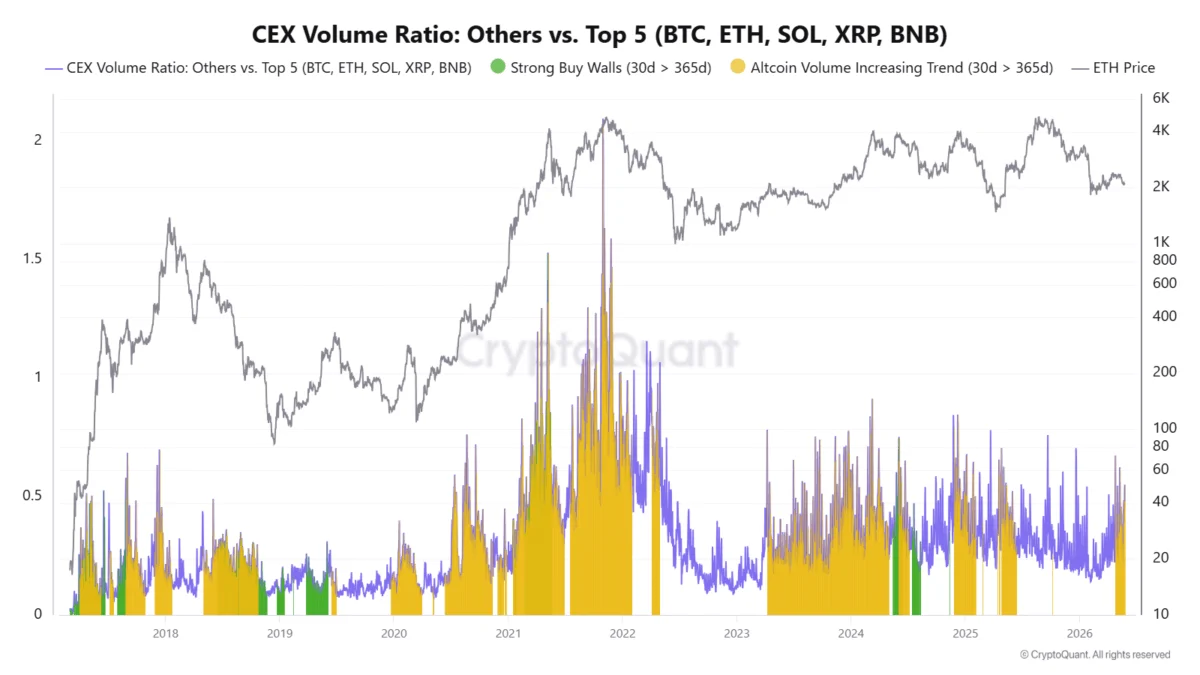
The core of this emerging thesis lies in the volume ratio between the top-tier cryptocurrencies and the broader altcoin market. Traditionally, Bitcoin (BTC), Ethereum (ETH), Solana (SOL), XRP, and BNB act as the primary liquidity sinks in the crypto ecosystem. When these assets see declining volume, it usually indicates a total market withdrawal. However, recent metrics show that while volume for these "Big Five" has stalled, the exchange volume for the "OTHERS" category—representing the thousands of smaller projects—has begun an upward trajectory.

This divergence is statistically significant because it occurs during a period of peak skepticism. In a typical bull market, rising altcoin volume is accompanied by exuberant social media sentiment and high retail participation. In contrast, the current rise in volume is happening while sentiment remains firmly in the "Fear" or "Neutral" zones of most sentiment indices. This suggests that the participants generating this volume are not reactive retail traders chasing a pump, but rather deliberate accumulators who are taking advantage of low prices and low competition for liquidity.
The CryptoQuant report emphasizes that this is not a flash-in-the-pan occurrence. The trend has shown persistence over several weeks, building session by session. In the world of technical analysis, such a "stealth" increase in volume during a price consolidation phase is often regarded as a precursor to a volatility breakout. When volume rises while prices remain flat or slightly down, it indicates that "absorption" is taking place—where large buy orders are soaking up the remaining sell pressure from exhausted holders.
Technical Stabilization of the OTHERS/BTC Ratio
To understand the potential impact of this accumulation, one must look at the OTHERS/BTC ratio, a critical metric that tracks the performance of the broader altcoin market against Bitcoin. For much of 2023 and 2024, this ratio has been in a persistent downtrend, reflecting Bitcoin’s role as the primary beneficiary of institutional inflows, particularly following the approval of spot Bitcoin ETFs in the United States.
However, the weekly chart for the OTHERS/BTC index is now showing the first signs of structural stabilization in over two years. After a period of aggressive decline that saw many altcoins lose 80% to 90% of their value against Bitcoin, the ratio has entered a prolonged sideways consolidation phase near the 0.12 region. While the index remains technically "bearish"—trading below the 50-week, 100-week, and 200-week moving averages—the rate of decline has flattened significantly.

Market analysts note that major trend reversals rarely happen in a "V-shape" on macro timeframes. Instead, they require a period of "basing," where the market finds a floor and sellers lose their momentum. The repeated defense of the 0.12 level suggests that a bottoming process is in effect. If the OTHERS/BTC ratio can successfully reclaim the 50-week moving average, it would provide the first technical confirmation of an "altcoin season" in years, potentially triggering a massive rotation of capital from Bitcoin back into the riskier, high-reward segments of the market.
A Chronology of Market Fatigue
The path to this current state of stagnation began in late 2023, as the market anticipated the launch of Bitcoin ETFs. While Bitcoin saw a massive surge toward new all-time highs in early 2024, the expected "trickle-down" effect into altcoins was notably muted compared to previous cycles.
- Q1 2024: The Bitcoin Peak and Altcoin Lag. Bitcoin reached record highs, but the liquidity remained siloed within the ETF ecosystem. Most altcoins failed to break their 2021 highs, leading to the first wave of investor frustration.
- Q2 2024: The Post-Halving Slump. Following the Bitcoin halving in April, the market entered a "sell the news" phase. Altcoins were hit disproportionately hard, with many returning to their 2023 lows.
- Q3 2024 – Q1 2025: The Consolidation Trap. For several months, the market moved sideways. Retail interest, measured by Google Search trends and exchange registrations, plummeted to levels not seen since the 2022 bear market.
- Present Day: The Behavioral Shift. While the "headline" prices remain uninspiring, the internal plumbing of the market (on-chain volume and exchange flow) shows that capital is being reallocated to smaller assets at an accelerating rate.
Institutional vs. Retail Perspectives
The current market dynamic highlights a growing gap between institutional strategy and retail sentiment. For retail investors, the memory of the "crypto winter" is still fresh, and the lack of immediate 10x gains in the altcoin sector has led to a total withdrawal from the space. Many have moved their capital into traditional equities or high-yield savings accounts, viewing crypto as "dead" or "broken."
Conversely, institutional players and "crypto-native" whales often view these periods of extreme boredom as the most profitable times to enter. By accumulating when liquidity is thin and sentiment is poor, they can build large positions without significantly moving the price against themselves. The rising volume in the "OTHERS" category is the footprint of this activity. These participants are likely betting on the eventual return of liquidity to the system, driven by potential interest rate cuts by the Federal Reserve or further clarity on crypto regulations in major jurisdictions.

Potential Implications and Market Impact
If the CryptoQuant analysis holds true and this accumulation phase leads to a breakout, the implications for the broader market are significant. A move back into altcoins would signal a return of "risk-on" sentiment, which has been missing from the crypto market for the better part of two years.
However, several risks remain. The technical structure of the altcoin market is still fragile. A significant "black swan" event in the global economy or a sharp correction in Bitcoin could easily invalidate the stabilization of the OTHERS/BTC ratio. Furthermore, the altcoin market is more fragmented than ever. In previous cycles, a "rising tide lifted all boats." In this cycle, we are seeing a more "bifurcated" market where certain sectors—such as Artificial Intelligence (AI) tokens, Real World Assets (RWA), and high-utility Layer 2 solutions—outperform, while older, legacy "zombie" coins continue to bleed value.
Conclusion: Watching the Moving Averages
As the market moves deeper into 2025, the focus for traders will be on whether the OTHERS/BTC ratio can break its multi-year shackles. The current consolidation near the 0.12 region is a battleground between the exhaustion of the old guard and the conviction of new accumulators.
The increasing exchange volume for smaller-cap assets is a leading indicator that the market is preparing for its next phase. While the "Big Five" continue to dominate the headlines, the real story of the next market cycle may be written in the quiet, deliberate accumulation of the "OTHERS." For those who can look past the current stagnation, the data suggests that the foundation for the next major altcoin rotation is being laid right now, session by session, in the silence of a disengaged market. The key remains the 50-week moving average; a weekly close above this level would be the clarion call that the "stealth" phase has ended and the public phase of the next altcoin cycle has begun.