



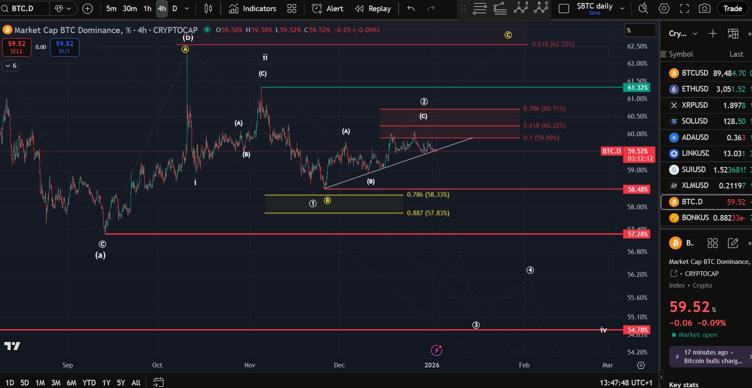
The cryptocurrency market is currently witnessing a significant structural shift as Bitcoin, the world’s largest digital asset by market capitalization, has broken below a critical long-term trendline. This technical breakdown, highlighted by market analyst Justcryptopays, suggests that the period of absolute Bitcoin supremacy may be entering a phase of consolidation, paving the way for a broader "altcoin season." As Bitcoin struggles to maintain its footing above the psychologically significant $90,000 mark, investors are increasingly reallocating capital into alternative digital assets, seeking higher beta returns in a diversifying market landscape.
The Technical Breakdown of Bitcoin’s Dominance
For much of the latter half of 2025, Bitcoin acted as the primary engine for the cryptocurrency sector, buoyed by institutional adoption and the success of spot exchange-traded funds (ETFs). However, the recent breach of a key support trendline indicates a loss of momentum. Technical analysts monitor these trendlines to gauge the health of a bull run; a break below suggests that the "buy the dip" mentality is being replaced by a "sell the rip" strategy among short-term traders.
As of early 2026, Bitcoin is trading at approximately $90,525, having repeatedly tested and failed to hold the $90,000 level as a firm support base. In the world of technical analysis, a failure to sustain price action above such a major psychological milestone often leads to a "rotation" of liquidity. This liquidity does not necessarily leave the crypto ecosystem but instead flows into large-cap altcoins like Ethereum (ETH) and Solana (SOL), which may offer more attractive entry points following the bearish exhaustion seen throughout 2025.
A Chronology of Market Dynamics: From 2025 Volatility to 2026 Rotation
To understand the current shift, it is essential to look at the timeline of the past 14 months. The year 2025 was characterized by extreme volatility and a predominantly bearish sentiment for altcoins. While Bitcoin reached new heights, many secondary tokens languished, losing up to 70% of their value against their BTC trading pairs.
- Q3 2025: Bitcoin dominance peaked as institutional inflows concentrated almost exclusively on BTC ETFs. Altcoins suffered from a lack of liquidity, with many projects struggling to maintain development milestones amidst a "risk-off" environment.
- Q4 2025: Bitcoin reached its all-time high but began showing signs of exhaustion. The Relative Strength Index (RSI) on the weekly chart showed a bearish divergence, signaling that the price was rising on weakening momentum.
- January 2026: The new year began with a decisive break below the primary ascending trendline that had supported Bitcoin since the previous year’s rally. This technical event served as a "starting gun" for the rotation into altcoins.
This transition marks a pivotal moment for bulls who are eager to shake off the stagnation of 2025. The current market structure suggests that while Bitcoin may move sideways or enter a period of controlled depreciation, the total market capitalization of the altcoin sector is poised for a breakout.
Supporting Data: Bitcoin Dominance and Capital Flow
The most telling metric in this transition is Bitcoin Dominance (BTC.D), which measures Bitcoin’s share of the total crypto market cap. Throughout 2025, BTC.D hovered near 60%, a level that historically precedes a massive rally in altcoins once it begins to decline. Recent data suggests BTC.D has started to tick downward, coinciding with a spike in trading volume for Ethereum and Solana.

Furthermore, on-chain data indicates that "whales"—large-scale investors—have begun moving Bitcoin to exchanges while simultaneously withdrawing stablecoins and mid-cap altcoins to private wallets. This behavior is a classic precursor to an altcoin rally. When Bitcoin’s price stabilizes or slightly declines, the "wealth effect" takes over: investors who profited from Bitcoin’s run to $90,000 take those profits and reinvest them into tokens with lower market caps, where smaller amounts of capital can drive much larger percentage gains.
The Catalysts for an Altcoin Awakening
Several fundamental factors are contributing to the renewed interest in altcoins beyond mere technical rotation. These include technological upgrades, regulatory clarity, and the expansion of the decentralized finance (DeFi) ecosystem.
Ethereum and the Layer-2 Expansion
Ethereum remains the primary beneficiary of any capital rotation. With the continued evolution of its Layer-2 scaling solutions, such as Arbitrum, Optimism, and Base, the network has significantly reduced transaction costs. This has revitalized the DeFi and NFT sectors, which were largely dormant during the 2025 bear cycle. Analysts suggest that if Ethereum can break its own resistance levels against Bitcoin (the ETH/BTC pair), it could trigger a massive influx of retail capital.
The Solana Ecosystem Growth
Solana has emerged as a formidable competitor, often dubbed the "Ethereum Killer" due to its high throughput and low fees. Its ability to host memecoin frenzies and high-frequency trading applications has made it a favorite for retail speculators. As Bitcoin stalls, Solana’s native token (SOL) has shown resilience, often moving inversely to Bitcoin’s downward stumbles.
Regulatory Clarity for XRP and Cardano
Assets like XRP and Cardano (ADA) are also positioned for a resurgence. Following years of legal scrutiny, the regulatory landscape in 2026 appears more settled. Clarity regarding the classification of these assets has allowed institutional custodians to offer them to a broader range of clients, providing a fundamental floor for their valuation that did not exist in previous cycles.
Institutional Reactions and Market Sentiment
Financial institutions and research firms are closely monitoring these developments. Reports from Binance Research have suggested that an altcoin rally might be in sight, citing the "cyclical nature of crypto markets." Historically, crypto bull markets occur in three distinct phases:
- Phase 1: Bitcoin leads the market, absorbing all available liquidity.
- Phase 2: Ethereum follows Bitcoin’s lead, often outperforming it in the mid-to-late stages of the cycle.
- Phase 3: "Alt-Season" begins, where capital trickles down into mid-caps, small-caps, and eventually memecoins.
Industry insiders suggest that we are currently transitioning from Phase 1 to Phase 2. While retail sentiment remains cautious after the "bearish momentum of 2025," the underlying infrastructure of the market is much stronger than it was in previous cycles. The presence of regulated stablecoins and sophisticated hedging instruments allows for a more "orderly" rotation of capital, reducing the likelihood of a total market crash even if Bitcoin faces a correction.
Broader Implications and Strategic Positioning
The shift toward a more balanced market has profound implications for both short-term traders and long-term investors. For traders, the increase in altcoin volatility presents numerous opportunities for "swing trading" and capturing gains in sectors like AI-integrated blockchain projects, Web3 gaming, and decentralized physical infrastructure networks (DePIN).
For long-term holders, the current environment serves as a reminder of the importance of diversification. While Bitcoin remains the "digital gold" and a premier store of value, the utility and innovation occurring in the altcoin space cannot be ignored. The struggle for Bitcoin to hold $90,000 is not necessarily a sign of failure for the asset class, but rather a sign of maturity. It indicates that the market is no longer a monolith and that different assets can decouple based on their own unique value propositions.
Analysis of Potential Risks
Despite the optimistic outlook for altcoins, risks remain. The primary threat is a "liquidity crunch" in the traditional financial markets. If global macroeconomic conditions—such as interest rate hikes or geopolitical instability—force investors into a "cash-only" position, both Bitcoin and altcoins will likely suffer.
Additionally, the "altcoin resurgence" is highly dependent on Bitcoin remaining relatively stable. If Bitcoin were to experience a "flash crash" below $80,000, it would likely drag the entire market down with it, regardless of the individual merits of specific altcoins. Investors must remain vigilant, as the transition from a Bitcoin-led market to an altcoin-led market is often accompanied by spikes in volatility that can wipe out over-leveraged positions.
Conclusion: A New Chapter for Digital Assets
As the market navigates the opening months of 2026, the narrative is clearly shifting. The break below the key trendline for Bitcoin and its difficulty in reclaiming the $90,000 level are the clearest signals yet that the "Bitcoin-only" phase of this cycle may be concluding. This evolution toward a more diversified market where Ethereum, Solana, XRP, and emerging DeFi tokens gain prominence suggests a healthy maturation of the ecosystem.
For the vigilant investor, this period of capital rotation represents a strategic window. By monitoring Bitcoin dominance, on-chain flows, and key technical support levels, market participants can position themselves to benefit from the potential altcoin resurgence. While the shadows of the 2025 bearish trend still linger, the technical and fundamental data points toward a more balanced and vibrant market in the months ahead.














