


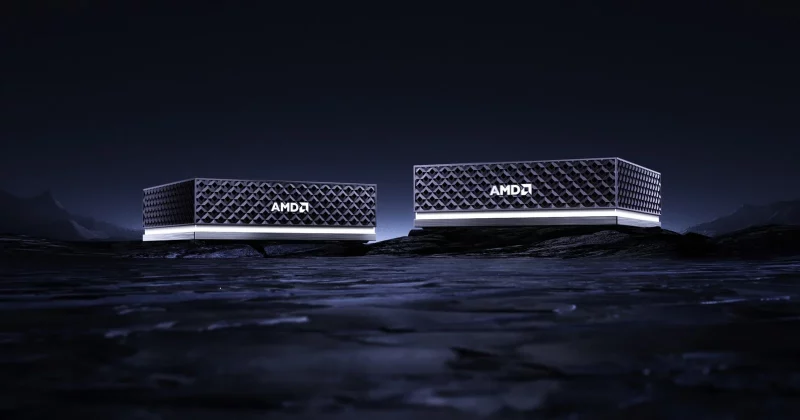
AMD has dramatically entered the burgeoning AI workstation market with the introduction of the Ryzen AI Halo, a compact desktop system designed to empower developers with substantial on-premises AI model processing capabilities, effectively challenging the cloud-centric paradigm. Unveiled at CES 2026, this mini-PC promises to bring the power of large AI model execution directly to developers’ desks, circumventing the need for costly and time-consuming cloud subscriptions.
At the heart of the Ryzen AI Halo lies AMD’s advanced Ryzen AI Max+ processors, a configuration capable of supporting up to a formidable 128GB of unified memory. This generous allocation, coupled with an impressive 60 TFLOPS of GPU compute power, positions the Halo as a potent contender for demanding AI workloads. The system is engineered for immediate developer productivity, offering out-of-the-box compatibility with both Windows and Linux operating systems. Crucially, it features the ROCm software stack, meticulously optimized for AI development, and ships pre-loaded with a suite of AI applications tailored for developers. This comprehensive package aims to streamline the setup and deployment process, allowing for rapid iteration and experimentation.
AMD’s Strategic Play in the Developer Workstation Arena
The Ryzen AI Halo can be best understood as AMD’s direct response to NVIDIA’s DGX Spark, a product occupying a remarkably similar market segment. Both are designed as compact, high-performance machines intended for desktop deployment, enabling developers to prototype, fine-tune, and execute AI models locally. The fundamental divergence, however, lies within the distinct ecosystems each platform integrates with.
NVIDIA’s DGX Spark firmly anchors developers within its proprietary CUDA software framework. CUDA has achieved widespread adoption, becoming the de facto industry standard for GPU-accelerated computing, fostering a robust ecosystem of libraries, tools, and community support. In contrast, AMD’s Ryzen AI Halo operates on ROCm, an open-source alternative. This open-source approach offers a significant advantage for developers prioritizing flexibility, particularly those engaged in building cross-platform tools or aiming for hardware agnosticism. The ability to develop and deploy models without being tethered to a single vendor’s proprietary ecosystem holds considerable appeal in a rapidly evolving technological landscape.
Furthermore, the Ryzen AI Halo incorporates AMD’s XDNA 2 NPU (Neural Processing Unit). This dedicated AI accelerator is engineered to efficiently handle AI inference tasks, a crucial distinction for modern AI applications. In practical terms, this means a specialized chip is integrated to optimize the execution of already-trained AI models, operating independently of the main GPU. The proliferation of AI workloads beyond pure training and into real-time inference, especially at the edge, underscores the increasing importance of such dedicated silicon. This dedicated NPU ensures that inference tasks are handled with maximum efficiency, freeing up the GPU for more intensive training or computational processes.
While AMD has not officially confirmed pricing, industry speculation suggests a retail price point of approximately $3,999. This figure would position the Ryzen AI Halo as a highly competitive offering within the developer workstation market. The final pricing is anticipated closer to the product’s targeted Q2 2026 launch window. Even at this estimated price, the Halo presents a compelling alternative for AI practitioners who wish to avoid the ongoing costs associated with renting GPU time from cloud providers or the substantial capital investment required for rack-mounted server hardware. This pricing strategy is likely aimed at democratizing access to powerful AI development tools, making them more attainable for a broader range of individuals and organizations.
Implications Beyond Traditional AI Development
The significance of a $3,999 machine boasting 128GB of unified memory and 60 TFLOPS of compute power extends far beyond the confines of Silicon Valley’s machine learning engineers. This development carries substantial implications for emergent sectors such as cryptocurrency and the Web3 space.
Decentralized compute networks, which are being actively developed by projects aiming to establish distributed GPU marketplaces, inherently require affordable and powerful hardware at the node level. A compact workstation like the Ryzen AI Halo is ideally suited to serve as a node within these networks. It can efficiently execute AI inference tasks for decentralized applications without demanding the infrastructure of an entire server closet. This distributed approach to AI computation could significantly lower the barrier to entry for participation in these networks, fostering greater decentralization and resilience.
Moreover, on-premises AI model inference is becoming increasingly vital for privacy-focused applications. In an era of escalating regulatory scrutiny surrounding data handling, the capability to run AI models locally, rather than transmitting sensitive data to external cloud providers, represents a tangible competitive advantage. Web3 projects dedicated to building privacy-preserving AI tools would find a machine like the Ryzen AI Halo particularly beneficial. This localized processing ensures that sensitive data remains within the user’s control, mitigating risks associated with data breaches and unauthorized access.
The integration of the open-source ROCm stack further amplifies the Halo’s appeal. Decentralized AI projects that prioritize hardware agnosticism—that is, avoiding complete reliance on a single vendor’s proprietary software—have historically encountered challenges navigating the pervasive CUDA monoculture. AMD’s provision of a viable, open-source alternative, conveniently packaged within a turnkey workstation, has the potential to accelerate adoption within this segment of the market. This could foster greater innovation and competition by reducing vendor lock-in and promoting interoperability.
The economic argument for ownership versus rental is also becoming increasingly persuasive. Cloud GPU costs have been on an upward trajectory, driven by the surging demand for AI compute power. For individual developers or small teams engaged in regular inference workloads, a one-time hardware investment of approximately $4,000 could yield a significant return on investment, potentially recouping its cost within a matter of months when compared to equivalent cloud compute expenditures. This financial calculus becomes even more attractive for crypto-native builders who, by their very philosophy, lean towards self-sovereignty and minimizing reliance on centralized infrastructure. This aligns with the core tenets of Web3, promoting user autonomy and control over digital assets and resources.
Key Considerations for Investors and Builders
The Ryzen AI Halo represents AMD’s most assertive declaration to date regarding its commitment to competing with NVIDIA in the AI developer hardware arena. However, the transition from strategic intent to market execution is often a complex undertaking. NVIDIA’s CUDA ecosystem benefits from years of established library support, extensive community documentation, and deep enterprise integration, creating a formidable incumbent advantage. While ROCm has demonstrated significant progress, the gap in software maturity and breadth of developer support remains a tangible challenge that AMD must continue to address.
The projected Q2 2026 launch timeline means the Ryzen AI Halo will enter a market characterized by rapid innovation. NVIDIA is almost certain to introduce its own iterations of compact AI hardware, potentially with enhanced capabilities and further integration into its established ecosystem. Concurrently, Apple’s M-series chips continue to gain considerable traction among machine learning developers, particularly within the Apple ecosystem, offering a compelling alternative for certain use cases. Furthermore, cloud providers are actively engaged in price competition, continuously adjusting their offerings to remain competitive with the allure of local hardware purchases. For AMD to successfully attract developers away from established workflows, the Ryzen AI Halo must not only meet impressive specifications on paper but also deliver a seamless and productive developer experience that justifies the migration.
From the perspective of the cryptocurrency sector, a critical indicator to monitor will be the extent to which decentralized compute networks begin to certify or optimize their operations for AMD hardware. Leading projects such as Akash, Render, and io.net have, by and large, been architected around NVIDIA GPUs. If the Ryzen AI Halo’s price-to-performance ratio proves to be genuinely competitive, it could pave the way for a dual hardware strategy within these networks. This diversification would not only reduce single-vendor risk across the decentralized compute landscape but also potentially drive down costs and increase accessibility for node operators.
The unified memory architecture of the Ryzen AI Halo warrants particular attention. With 128GB of memory shared between the CPU and GPU, the Halo is exceptionally well-positioned to load and process larger AI models without encountering the memory bottlenecks that often plague systems with segregated memory pools. For running complex large language models locally, this unified architecture is not merely a convenience; it can be the decisive factor between a model’s successful execution and its outright failure. This architectural advantage can significantly expand the scope of models that can be feasibly run on a desktop workstation.
AMD’s underlying strategy with the Ryzen AI Halo is clear: to make powerful AI hardware accessible, open, and affordable enough to entice developers to choose local ownership over renting NVIDIA GPUs in the cloud. The ultimate success of this initiative hinges less on the impressive hardware specifications, which appear robust, and more on the ability of the ROCm software ecosystem to mature and compete effectively with the established CUDA framework. The Ryzen AI Halo is undeniably a compelling piece of silicon; the pivotal question remains whether ROCm can evolve into a compelling enough reason for developers to migrate away from the deeply entrenched CUDA ecosystem. The coming months and years will reveal whether AMD’s ambitious gambit pays off in this highly competitive and rapidly evolving market.














