



The landscape of artificial intelligence is rapidly evolving, moving beyond conventional chatbot interfaces towards more autonomous and versatile AI agents. Among these, Hermes stands out as a prominent open-source platform, boasting over 134,000 GitHub stars and a burgeoning community dedicated to expanding its capabilities. While many of its skills are designed for serious, enterprise-level applications—such as streamlining GitHub PR workflows, automating research pipelines, or optimizing developer operations—a new wave of creative and non-traditional functionalities is emerging. These innovative skills demonstrate that AI agents are not merely tools for increased productivity but can also serve as sources of entertainment, personal insight, and even digital counter-intelligence, offering users a deeply personalized and engaging experience that commercial AI providers often cannot match.
The advent of AI agents marks a significant paradigm shift in human-computer interaction. Unlike static chatbots that respond to queries within predefined parameters, AI agents are designed to perceive their environment, process information, make decisions, and execute actions autonomously to achieve specific goals. This transformative capability positions them as potential architects of the next era of the internet, where individuals can generate bespoke applications tailored precisely to their needs, circumventing the limitations of traditional app stores and centralized platforms. Hermes, as an open-source agent, epitomizes this democratization of AI, empowering users to configure the AI to their exact specifications, free from the inherent biases or restrictions imposed by proprietary systems like ChatGPT or Claude. This freedom has fostered a vibrant ecosystem where developers and enthusiasts are exploring the playful and unconventional facets of AI, leading to the creation of skills that are as intriguing as they are useful.
The Rise of AI Agents and the Open-Source Advantage
The concept of an "AI agent" represents a leap forward from earlier AI iterations. Historically, AI systems were largely reactive, processing input and generating output based on pre-programmed rules or trained models. Modern AI agents, however, integrate multiple AI components, including large language models (LLMs) for reasoning, memory modules for retaining context, and tool-use capabilities for interacting with external systems and data. This allows them to tackle complex, multi-step tasks with a degree of autonomy previously unseen.

The open-source nature of platforms like Hermes is crucial to this diversification of use-cases. While commercial AI models often come with stringent guardrails and content policies designed to prevent misuse and maintain brand integrity, open-source agents provide an unconstrained environment for experimentation. Developers can build and deploy skills without needing approval from a corporate entity, fostering a rapid pace of innovation and allowing for the creation of tools that cater to niche interests or challenge conventional norms. This ethos of user-driven development is precisely what allows for skills like a personalized fortune-teller or a scammer-disruptor to flourish alongside more mundane business applications. The community-driven development model, visible in repositories like awesome-hermes-agent, indicates a collective desire to explore the full spectrum of AI’s potential, both serious and whimsical.
Here are three non-work-related skills that exemplify the fun and innovative side of Hermes, transforming the AI agent experience into something far more personal and enjoyable.
1. Zoltar: The Algorithmic Oracle of Ancient Wisdom
Inspired by the iconic coin-operated fortune-telling machine from the 1988 film "Big," the Zoltar skill for Hermes transcends mere chatbot mimicry, presenting itself as a sophisticated divination engine rooted in real calculation libraries and traditional practices. This is not an AI "playing dress-up" as a mystic; it’s a meticulously engineered tool that merges ancient esoteric knowledge with cutting-edge computational power.
When a user requests a natal chart, for instance, Hermes orchestrates the execution of Kerykeion, a robust Python library that itself is built upon the Swiss Ephemeris. The Swiss Ephemeris is a highly accurate astronomical calculation standard, trusted by professional astrologers and astronomical software developers for decades, providing precise planetary positions. Users provide their date of birth, time, and city, and Zoltar meticulously calculates and returns every planetary position by sign and degree, house placements using the widely recognized Placidus house system, an intricate aspect grid detailing planetary relationships, a breakdown of elemental and modality balances, and even flags for retrograde planets.
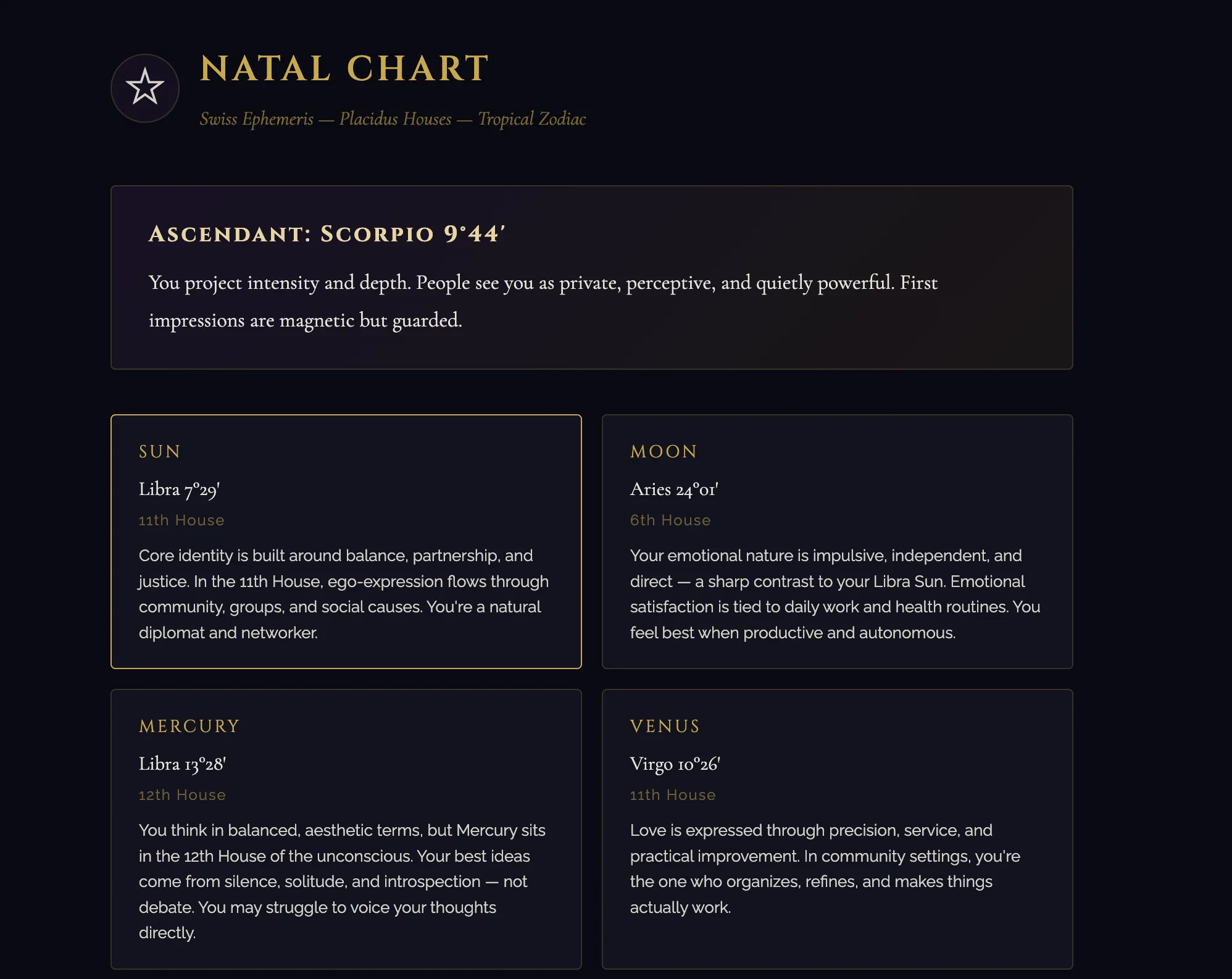
The subsequent interpretation is far from generic. Instead of vague pronouncements, Zoltar cites specific planetary placements and aspects to justify each statement. For example, a user might receive an interpretation like: "With Mars in Aries in the 10th house square Pluto, your drive is intense, but your relationship with authority will create recurring friction." This level of detail resonates deeply with those familiar with astrological theory and often surprises skeptics with its uncanny accuracy, or at least its compelling specificity, in mirroring personal experiences. The debate on the "reality" of astrology may precede the internet, but Zoltar’s definitive accuracy in computation and adherence to traditional interpretations is verifiable.
Beyond natal charts, Zoltar offers a diverse array of divination modes:
- Daily Horoscopes: These are dynamically pulled live from the Ohmanda API, a free public endpoint that provides professionally written daily readings for each zodiac sign, ensuring fresh and relevant insights.
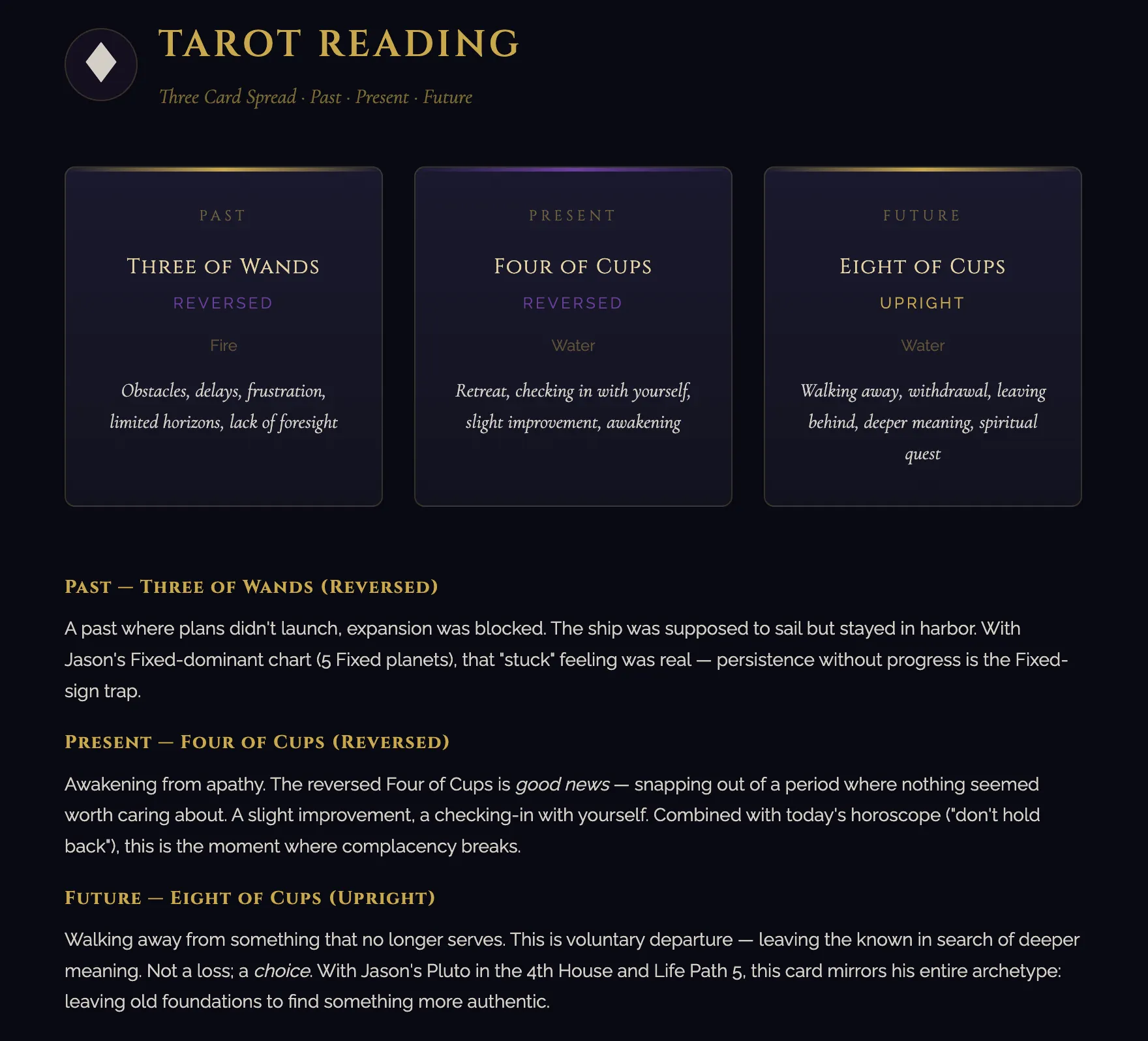
- Tarot: Drawing from a structured 78-card dataset adhering to the popular Rider-Waite-Smith tradition, Zoltar can perform single card draws, three-card Past/Present/Future spreads, or the comprehensive 10-position Celtic Cross. Each card’s traditional meaning is cited, offering a rich interpretative experience.
- I-Ching: Utilizing a Python implementation of the ancient coin-casting method, the skill returns the hexagram by its number and name, and provides interpretations of the "Judgment" and "Image" texts specific to that hexagram, avoiding generalized wisdom in favor of precise, traditional guidance.
- Numerology: The full Pythagorean system is implemented, calculating and interpreting core numbers such as Life Path, Expression, Soul Urge, Personality, Birthday, and Maturity numbers from scratch, based on the user’s birth date and name.
- Rune Casting: This mode draws from an Elder Futhark dataset encompassing all 24 runes, including their merkstave (reversed) positions. A notable detail is its accurate caveat: symmetric runes like Gebo and Isa, which cannot be reversed, are correctly excluded from merkstave interpretations.
For a comprehensive experience, Zoltar can generate a beautifully styled HTML document summarizing a full reading report, which can be saved to the user’s desktop. The quality is so high that one could plausibly present it as a paid, professionally generated report, blurring the lines between AI and human expertise. Installing Zoltar is straightforward: users simply drop the SKILL.md file from the Zoltar folder into their ~/.hermes/skills/ directory, and Hermes automatically detects it in the next session. Alternatively, Hermes can install the skill directly given the GitHub URL. The ability to integrate with platforms like Telegram, allowing users to receive voice-memo-responsive fortune readings at odd hours, adds a uniquely modern, yet oddly personal, touch to an ancient practice. This blend of technical rigor and spiritual exploration highlights AI’s capacity to engage with complex human interests in novel ways.
2. Antiscammer: Disrupting Digital Fraud with Digital Wit
In the age of pervasive digital communication, scam messages are an unfortunate constant. From fake inheritance schemes and dubious job offers to fraudulent bank alerts and crypto recovery scams, these solicitations prey on vulnerability. While conventional wisdom dictates ignoring and blocking, the Antiscammer skill for Hermes offers a more proactive and delightfully mischievous approach to combatting these digital threats. This skill transforms Hermes into a digital vigilante, turning the tables on fraudsters through strategic time-wasting and comedic disruption.
The Antiscammer skill operates in two primary modes, each designed to inflict maximum inconvenience on the scammer’s operational efficiency.
- Chat Flooding: For scams conducted over chat platforms like WhatsApp Web, Telegram Web, or Discord, Hermes leverages its browser control capabilities to inundate the scammer’s chat window with the complete screenplay of a chosen animated film. The default options are the entire 3,679 lines of "Shrek" or, for a slightly quicker (but no less annoying) experience, the 1,371 lines of the "Bee Movie" script. Each line is sent as a separate message, creating a continuous, overwhelming stream of incoming text. Users can also input any custom text, transforming virtually any literary work into an instrument of digital revenge.
The logic behind this seemingly absurd tactic is rooted in the economic realities of scamming. Fraud operations thrive on volume, requiring scammers to process a high number of potential targets quickly to identify the few who might fall victim. By tying up a scammer’s chat for the duration of a full movie script – approximately 15 minutes to half an hour of uninterrupted incoming messages – Hermes engages in a subtle yet effective act of operational sabotage. Every minute a scammer spends watching lines like "Somebody once told me the world is gonna roll me" trickle in is a minute they are prevented from deploying their malicious scripts on genuinely vulnerable individuals. This method, while ethically debated by some, is a digitized evolution of "scambaiting," a long-standing internet meme embraced by tech-savvy users who derive catharsis from disrupting fraudulent activities. Hermes automates this process, making it accessible to a wider audience without requiring programming expertise.
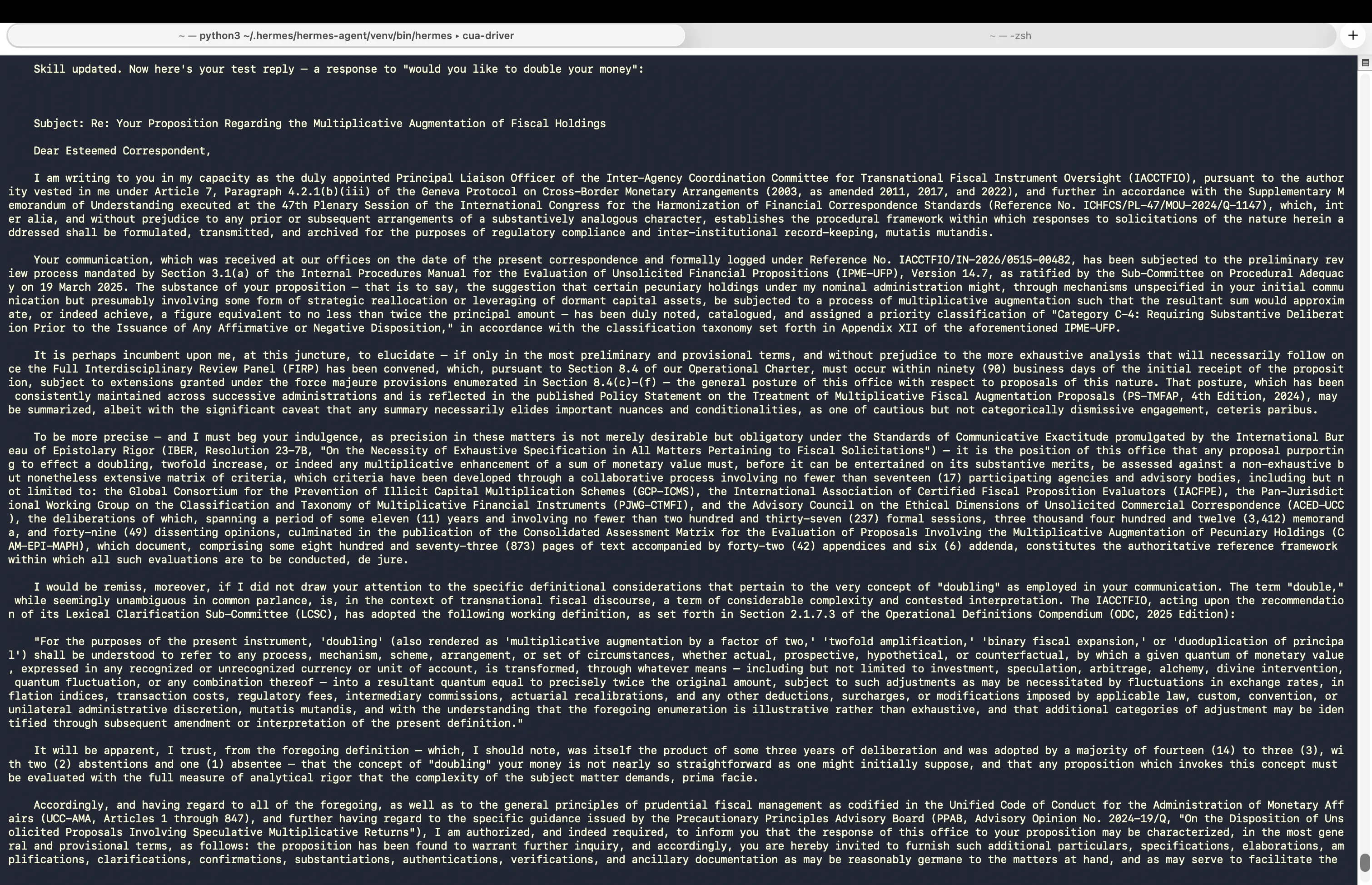
- Email Scambaiting: For email-based scams, particularly those infamous "Nigerian Prince" or fake lottery schemes, the Antiscammer skill adopts a different, yet equally effective, strategy. It generates extremely verbose, bureaucratically convoluted replies. These responses are crafted in the style of a 19th-century British solicitor, often spanning five pages, referencing non-existent legal frameworks, and demanding an absurd number of forms and deeply specific documentation about the deceased prince’s estate or the purported gold coffin. The skill includes a detailed email style guide in its references folder, meticulously outlining word-choice patterns and structural approaches for maximizing time-wasting efficacy.
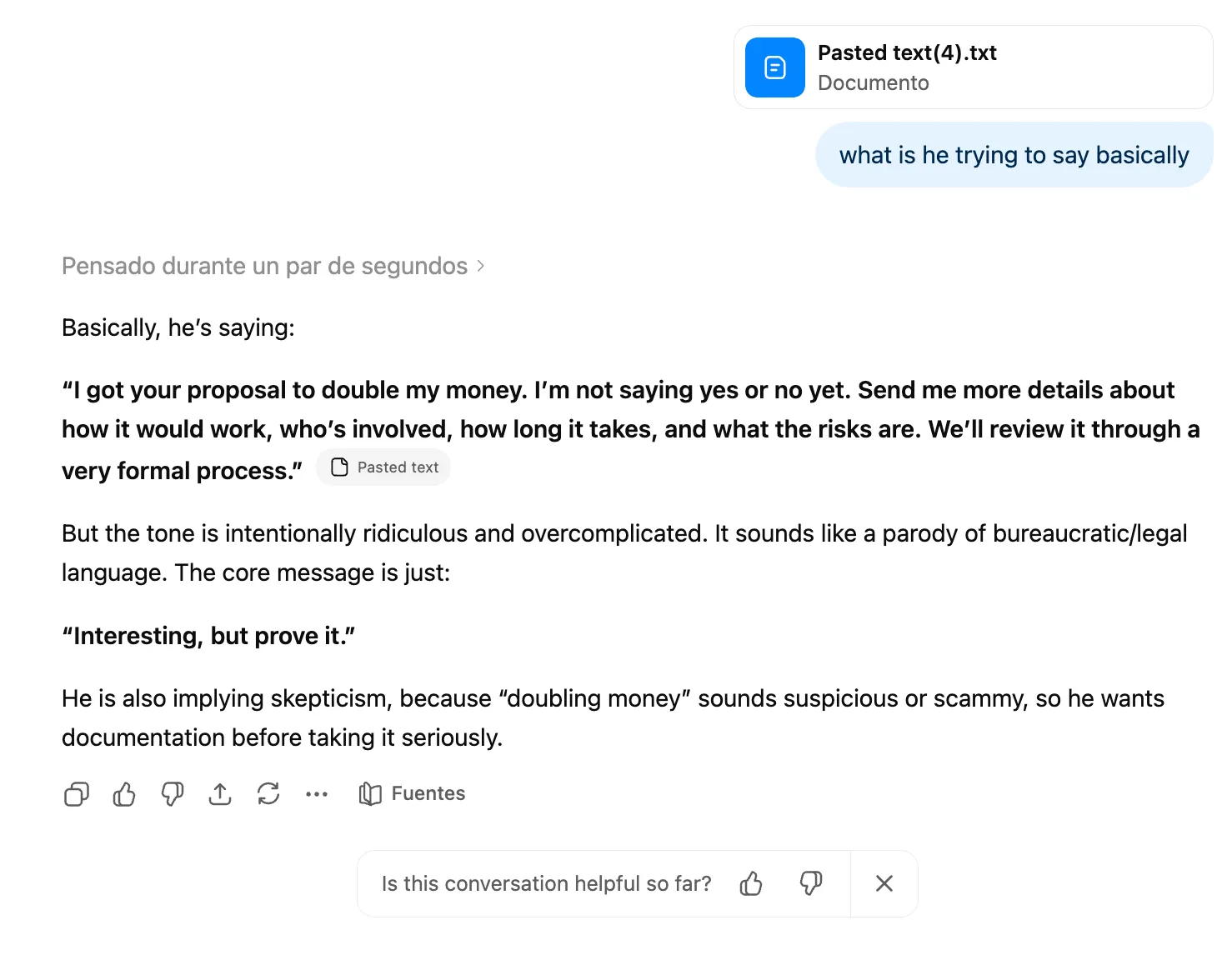
In a test, when presented with an email promising half a million dollars for a modest coffin transportation fee, Hermes generated a reply that was an intricate tapestry of legal jargon and preposterous requests. This type of response forces scammers to invest significant time and effort into crafting follow-up replies, often leading them to abandon the target due to the perceived high effort-to-reward ratio.
A crucial word of caution accompanies this skill: it is expressly designed for mass-market, low-sophistication scams. It should not be used to engage with advanced phishing attempts that target live accounts, real credentials, or involve sensitive personal information. For the ubiquitous inheritance emails, fake bank alerts, and generic crypto recovery scams, however, Antiscammer provides a legitimate and cathartic form of digital counterintelligence. Installation is identical to Zoltar: copy the SKILL.md from the antiscammer folder into ~/.hermes/skills/ and start a new session. Users can then invoke it directly with /antiscammer and paste the offending message, allowing Hermes to take over the digital battlefield.
3. Book-Mirror: The Personalized Literary Reflection
The Book-Mirror skill is perhaps the most quietly profound of the trio, lacking the theatrical flair of Zoltar or the disruptive humor of Antiscammer, yet offering a transformative reading experience. Based on a concept articulated by Garry Tan, president and CEO of Y Combinator, Book-Mirror redefines how individuals interact with written material, turning passive consumption into active, personalized reflection.
This skill takes any book—whether a PDF, EPUB, URL, or even just a title (for which Hermes will search public domain sources like Project Gutenberg or Archive.org)—and produces a meticulously organized, two-column, chapter-by-chapter analysis.
- Left Column: This column meticulously summarizes what the author actually wrote. It includes specific stories, factual statistics, direct quotes, named frameworks, and exact numbers. The level of detail is so comprehensive that, in theory, one could grasp the substance of the original book without having to read it in its entirety. This provides an invaluable distillation of knowledge.
- Right Column: This is where the true innovation lies. This column dynamically applies the concepts and insights from the left column directly to the user’s actual life. This isn’t generic self-help advice; it’s deeply personalized. Before initiating the analysis, Book-Mirror constructs a detailed "context pack" from Hermes’s memory. This pack includes the user’s name, role, key relationships (by name), recurring emotional patterns inferred from past session history, active projects, current stressors, and specific quotes from the user’s own words. If Hermes’s memory is insufficient, it intelligently prompts the user with targeted questions to fill the informational gaps.
The instructions guiding the generation of the right column are deliberately specific: "Name real people from their life, reference real dates, real situations, real decisions they made. Read like a therapist who knows them by writing notes in the margins." This directive ensures that the application of the book’s themes is intimately connected to the user’s personal narrative. The skill utilizes PyMuPDF for PDFs and ebooklib for EPUBs to extract and segment text by chapter markers. Crucially, it processes chapters sequentially rather than in parallel. This methodical approach allows Hermes to build context progressively, meaning insights gleaned from Chapter 3 can inform and enrich its mirroring of Chapter 7, creating a cohesive and evolving personal commentary.
The richness and accuracy of the right column directly correlate with the depth of Hermes’s accumulated memory of the user. An AI agent that has been interacting with a user for several months will have inferred patterns, implicit desires, and unspoken challenges that a user might not have explicitly articulated. This accumulation of contextual understanding is precisely what Book-Mirror is designed to leverage, turning it into a powerful tool for self-discovery and personal development.
Imagine feeding it a business book you’ve procrastinated on, a philosophical text that never quite resonated, or a novel that deeply moved you but whose impact you couldn’t quite articulate. The right column will illuminate why it stuck, often naming the specific person or situation in your life that the text subtly addresses. Book-Mirror transforms reading into an introspective dialogue, making knowledge acquisition an active, highly personal, and profoundly impactful journey. The skill resides in the book-mirror folder and is installed similarly to the others. For longer works (over 20 chapters), users are advised to allow ample time, as Hermes performs genuine, chapter-by-chapter reading and analysis, not superficial skimming.
The Evolving Landscape and Broader Implications
The three skills—Zoltar, Antiscammer, and Book-Mirror—while seemingly disparate and unconventional, collectively illuminate a critical pattern in the evolution of AI agents. They demonstrate that the true power of these autonomous systems extends beyond mere automation of business processes. Each skill engages with information in a fundamentally different way:
- Zoltar: Encourages users to interact with ancient knowledge systems through a rigorous, fact-based computational lens, blending the mystical with the methodical.
- Antiscammer: Deploys AI’s inherent strengths—patience, consistency, and plausible text generation—to tackle a real-world problem (online fraud) in a genuinely useful and novel manner, showcasing AI’s potential for proactive digital defense.
- Book-Mirror: Bridges the gap between abstract knowledge and personal application, transforming passive consumption into active, contextually rich self-reflection, hinting at the future of personalized learning and mentorship.
The rapid adoption and growth of Hermes, evidenced by its quick ascent to over 100,000 GitHub stars within its first 10 weeks and now exceeding 134,000, underscore the intense interest in agentic AI. This trajectory suggests that if AI agents truly represent the next frontier in the AI revolution, the community will likely witness an explosion of increasingly diverse, imaginative, and user-centric skills.
This trend signifies a broader shift towards the democratization of AI. By providing an open-source platform, Hermes empowers individuals to move beyond being passive consumers of AI services offered by large corporations. Instead, they become active participants, able to customize, extend, and even invent AI functionalities that cater to their unique needs and desires. This fosters an unprecedented level of personalization and control over digital tools, fundamentally altering the nature of human-AI interaction. Users are no longer confined to the use-cases envisioned by developers; they can shape their AI companions to reflect their own interests, values, and even quirks.
While the underlying complexity of developing and maintaining these skills remains, the accessibility of installation and the intuitive interaction methods provided by Hermes indicate a future where sophisticated AI capabilities are within reach for a wider audience. These three skills, available in the jaldps/hermes-skills repository, are not just entertaining diversions; they are pioneering examples of how AI agents can enrich personal lives, empower individuals against digital threats, and foster deeper self-understanding, all while highlighting the boundless potential of open-source innovation in the AI era.














