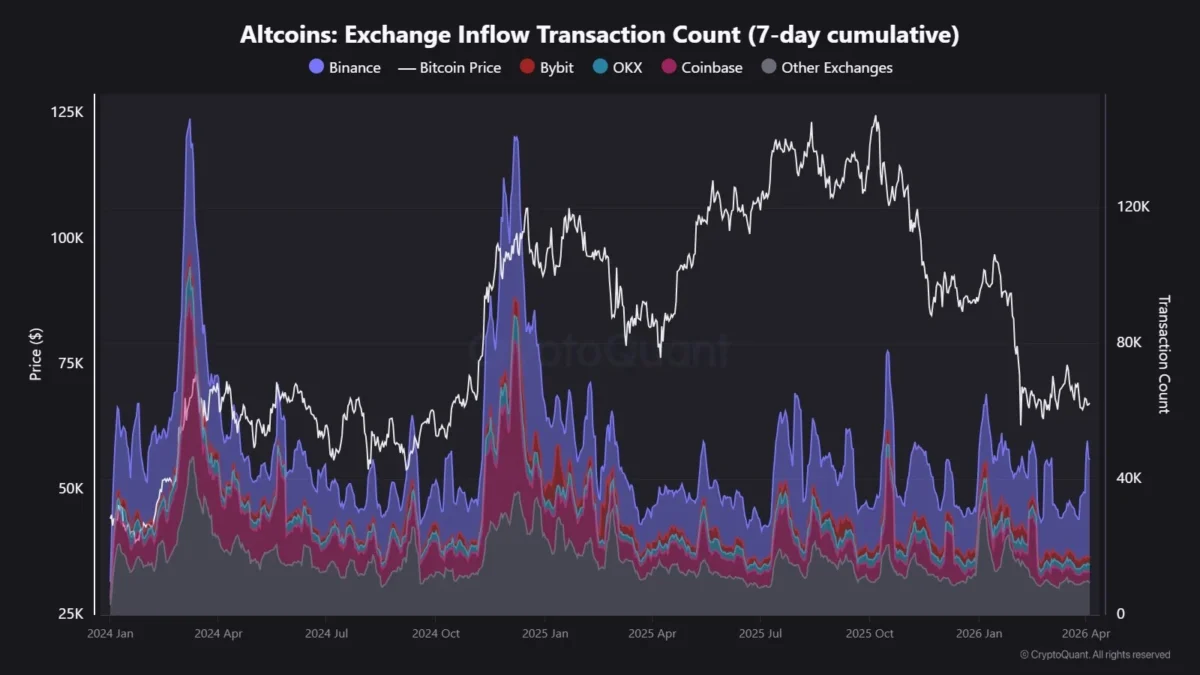
The global cryptocurrency market is currently navigating a period of heightened volatility and structural transition, marked by a significant anomaly observed on the world’s largest digital asset exchange. On April 2, a massive surge in altcoin inflow transactions occurred exclusively on Binance, an event that has caught the attention of on-chain analysts and market participants alike. Data indicates that altcoin inflow transactions jumped to approximately 34,000 on that day, reaching a level not seen in nearly three months. Crucially, this spike was entirely isolated to Binance, with no corresponding activity recorded on other major trading venues such as Coinbase, Bybit, or OKX. This lack of synchronization across the broader exchange landscape suggests that the movement was not driven by a generalized resurgence in altcoin demand, but rather by a platform-specific catalyst that redirected capital flows within the Binance ecosystem.
Analysis provided by Maartunn, a prominent contributor to the on-chain data platform CryptoQuant, identifies the specific driver behind this concentrated activity. The surge followed exactly twenty-four hours after Binance expanded its suite of derivative products to include traditional finance (TradFi) instruments, specifically futures contracts tied to West Texas Intermediate (WTI) crude oil and natural gas. These additions join an existing array of commodity-linked tickers, including gold and silver, which have increasingly gained traction among crypto-native traders. The timing of the inflow spike suggests that traders were moving altcoin liquidity into their Binance accounts not to trade other digital assets, but to gain exposure to the high-volatility commodity markets during a period of significant macroeconomic and geopolitical sensitivity.
Chronology of the April Inflow Anomaly
The sequence of events leading to the April 2 spike provides a clear roadmap of how speculative capital is currently behaving. Throughout the first quarter of the year, altcoin markets remained largely range-bound, struggling to find a definitive catalyst for a sustained breakout. On April 1, Binance officially integrated WTI crude oil and natural gas futures into its trading interface. These instruments allow users to trade commodity price movements using stablecoins or other crypto assets as collateral, bridging the gap between decentralized finance and traditional energy markets.
By April 2, the market responded with a massive influx of transactions. The 34,000 inflow count represents a three-month high and stands in stark contrast to the relatively flat activity levels seen on competing exchanges. In a typical market-wide altcoin rally, inflow spikes are distributed across all major platforms as retail and institutional investors alike move assets from cold storage to exchanges to capitalize on price movements. The isolation of this event to Binance confirms that the attraction was the unique product offering—commodity futures—rather than a fundamental shift in the valuation of altcoins themselves.

The data suggests a migration of "risk-on" capital. Traders who historically sought volatility in mid-cap and small-cap altcoins appear to be pivoting toward traditional commodities that offer similar or higher levels of price action due to global supply chain disruptions and shifts in monetary policy. This internal migration within the Binance platform indicates that while the liquidity remains within the crypto ecosystem, its utility is being redefined.
The Convergence of Crypto Liquidity and Traditional Commodities
The integration of commodity futures on a major cryptocurrency exchange represents a significant milestone in the evolution of digital asset platforms. Historically, crypto exchanges were silos for blockchain-based tokens. However, the recent trend—led by Binance—shows a move toward becoming "everything exchanges," where users can manage a diversified portfolio of digital and physical assets under a single collateral management system.
The success of gold and silver tickers on Binance provided the initial proof of concept. These traditional safe-haven assets have become top-tier volume pairs on the platform, often sitting alongside market leaders like Bitcoin and Ethereum. The addition of energy commodities like WTI and natural gas targets a different demographic: the high-frequency speculative trader. Energy markets are notoriously volatile and sensitive to real-time news, making them an attractive alternative for traders who find the current altcoin market to be stagnant or unpredictable.
From a structural perspective, this shift is significant. When a trader sells an altcoin or uses an altcoin as collateral to trade oil futures, they are effectively withdrawing support from the altcoin’s price floor. This "liquidity drain" means that even if the total value locked on an exchange remains high, the specific demand for altcoins as speculative vehicles is diluted. The April 2 data is the first clear quantitative footprint of this migration, showing that the "altcoin season" many investors are waiting for is being challenged by the accessibility of traditional asset classes.
Technical Analysis of the Altcoin Market Structure
While Binance sees a localized spike in activity, the broader altcoin market cap is exhibiting signs of structural exhaustion. The "OTHERS" chart, which tracks the total cryptocurrency market capitalization excluding the top ten largest assets, provides a sobering view of the current landscape. As of early April, this aggregate market cap is hovering near the $172 billion mark, a significant decline from the mid-2025 peaks.

The weekly timeframe reveals a classic "lower high" structure, a bearish technical signal indicating that each successive recovery attempt is met with stronger selling pressure at lower price levels. In mid-2025, the altcoin market failed to sustain momentum above the $300 billion threshold, leading to a distribution phase where long-term holders began offloading assets to late-cycle buyers. This rejection triggered a sustained downtrend that saw the market cap break below the 50-week moving average (MA), a critical indicator of medium-term trend health.
Currently, the altcoin sector is testing the 200-week moving average, which often serves as the "line in the sand" for long-term bull markets. While a recent bounce from the $150 billion support zone provided temporary relief, the recovery has lacked the volume and conviction necessary to reclaim the 100-week MA. All three primary moving averages—the 50, 100, and 200—are now beginning to flatten or trend downward. This alignment suggests that the market has transitioned from an expansionary phase into a range-bound or corrective phase.
Volume Patterns and Investor Sentiment
The divergence between the Binance inflow spike and the general altcoin market performance is further explained by volume profiles. On-chain data shows that selling pressure has been consistently more aggressive during market downturns than buying pressure has been during rallies. This asymmetry is a hallmark of capital rotation. Investors are not necessarily "cashing out" to fiat currency in a panic; instead, they are selectively moving capital into assets with clearer fundamental drivers.
In the current environment, those drivers are geopolitical and macroeconomic. With inflation concerns persisting and regional conflicts impacting energy supplies, commodities like oil and gold offer a narrative-driven volatility that many altcoins currently lack. The "speculative premium" that once drove altcoin prices to astronomical heights is being reallocated to these TradFi instruments.
For the altcoin market to regain its structural strength, it would likely need to see a sustained reclaim of the $200 billion level on the OTHERS chart. Until then, the market remains in a state of "liquidity fragmentation," where the available capital is spread thin across an ever-increasing number of tokens and new derivative products.

Implications for the Future of Crypto Exchanges
The events of April 2 serve as a case study for the future of the exchange business model. As the regulatory landscape for cryptocurrencies matures, exchanges are seeking to diversify their revenue streams and retain users by offering a broader array of financial products. By hosting commodity futures, Binance is effectively competing with traditional brokerage firms, but with the added advantage of 24/7 trading and lower barriers to entry for international users.
However, this evolution poses a challenge for the altcoin ecosystem. Altcoins rely heavily on "reflexivity"—the idea that rising prices attract more buyers, which in turn drives prices higher. When a significant portion of an exchange’s user base shifts their attention to oil or gold, the reflexivity of the altcoin market is dampened. The "bid-side liquidity" that supports altcoin prices becomes thinner, making these assets more susceptible to sharp corrections on low volume.
The migration of capital toward commodity futures on Binance is not a neutral event for the crypto industry. It signifies a maturation of the trader base, moving from purely "crypto-native" speculation to a more sophisticated, macro-aware trading strategy. While this may lead to a more stable and professionalized exchange environment, it suggests that the explosive, broad-based altcoin rallies of previous cycles may become increasingly rare as capital finds more diverse outlets.
Conclusion and Outlook
The 34,000-transaction spike on Binance on April 2 stands as a pivotal data point in the 2024-2025 market cycle. It confirms that the platform’s strategic expansion into commodity futures has successfully captured the attention of its most active traders. However, it also highlights the precarious position of the altcoin market, which is seeing its traditional liquidity pools diverted toward more established asset classes.
As the market cap for smaller digital assets continues to test multi-year support levels, the focus will remain on whether altcoins can generate a new value proposition to lure back speculative interest. If the $160–$170 billion range fails to hold on the OTHERS chart, the market could see a further slide toward the $130 billion level. Conversely, the continued success of commodity trading on crypto platforms may encourage other exchanges to follow Binance’s lead, further accelerating the convergence of traditional and decentralized finance. For now, the signal is clear: the money is moving, but it isn’t necessarily moving into the next big token—it’s moving into the next big barrel of oil.