The global cryptocurrency market is currently navigating a period of profound structural transformation, characterized by high volatility and a growing sense of uncertainty among retail and institutional participants alike. On April 2, a significant statistical anomaly occurred on Binance, the world’s largest cryptocurrency exchange by trading volume, that has caught the attention of on-chain analysts and market strategists. Data indicates a massive surge in altcoin inflow transactions to the platform—a phenomenon that was notably absent from other major exchanges such as Coinbase, OKX, and Bybit. This isolated event has sparked a deeper investigation into the changing behavior of speculative capital and the evolving role of centralized exchanges in the broader financial landscape.
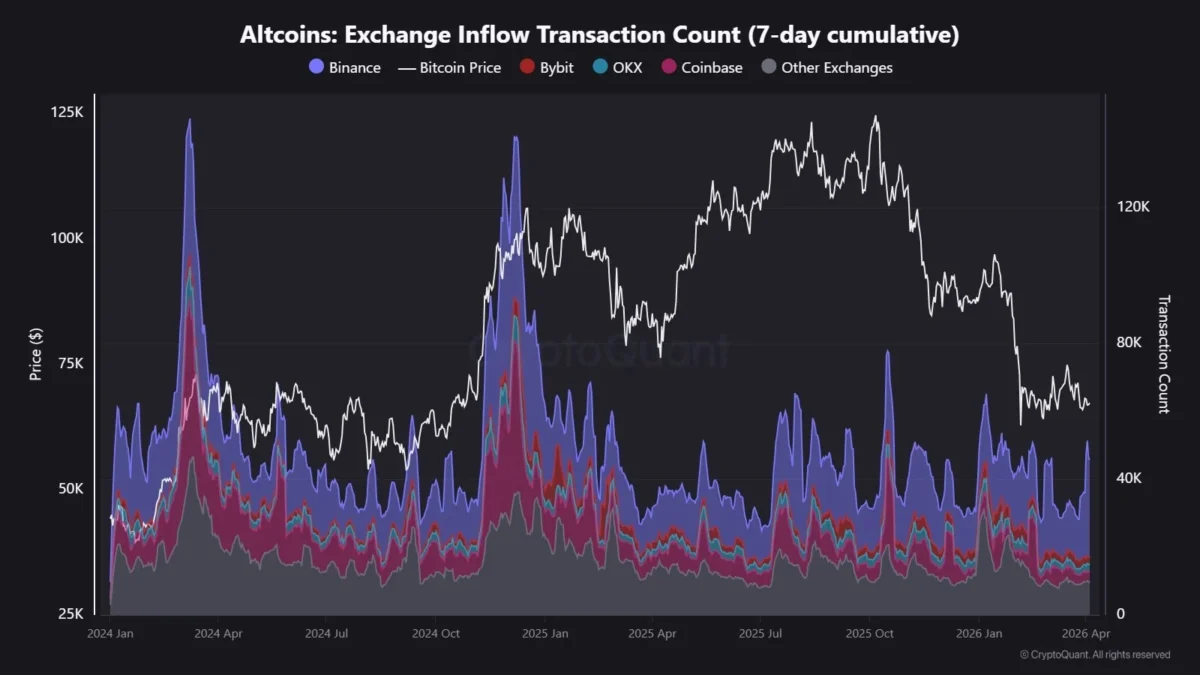
According to a detailed report from Maartunn, an analyst at the on-chain analytics firm CryptoQuant, altcoin inflow transactions to Binance jumped to approximately 34,000 on April 2. This figure represents the highest reading observed in nearly three months. Under normal market conditions, a spike of this magnitude would typically signal a generalized return of interest in the altcoin sector. Historically, when traders move assets onto exchanges at scale, it suggests a preparation for increased trading activity, liquidity provision, or a rotation into new positions. However, the fact that this activity was localized almost exclusively to Binance suggests that the driver was not a broad-based recovery of the altcoin market, but rather a platform-specific catalyst.
The Catalyst: Integration of Traditional Finance Instruments
To understand the sudden concentration of activity on Binance, analysts point to a significant product launch that occurred just 24 hours prior to the transaction spike. On April 1, Binance expanded its suite of derivative offerings by rolling out new futures contracts tied to major global commodities, specifically Natural Gas and West Texas Intermediate (WTI) Crude Oil. These instruments joined an existing array of traditional finance (TradFi) tickers on the platform, including gold and silver.
The timing of the inflow spike strongly suggests that the 34,000 transactions were not a vote of confidence in the underlying technology of altcoins, but rather a logistical movement of capital. Traders likely moved their altcoin holdings onto the exchange to serve as collateral or liquidity to trade the newly listed commodity futures. This represents a fundamental shift in how speculative capital is being utilized within the crypto ecosystem. Instead of rotating from Bitcoin into smaller-cap "gems," investors are increasingly moving from crypto-native assets into tokenized or derivative versions of real-world assets (RWAs) and commodities that respond to global macroeconomic and geopolitical drivers.

Analyzing the Chronology of the Inflow Event
The sequence of events leading to the April 2 anomaly provides a clear picture of how quickly liquidity can migrate when new opportunities arise.
- Late March: The altcoin market experiences a period of consolidation with declining volumes across most major venues. The "OTHERS" index, which tracks the total market capitalization of cryptocurrencies excluding the top 10 assets, begins to show signs of technical exhaustion.
- April 1: Binance officially launches Natural Gas and WTI Crude Oil futures. These pairs immediately begin to see traction, appearing in the platform’s top volume rankings alongside flagship assets like Bitcoin (BTC) and Ethereum (ETH).
- April 2: On-chain data records 34,000 altcoin inflow transactions to Binance. Comparable metrics on Coinbase and Bybit remain flat, confirming the event is tied to Binance-specific features.
- April 3–7: Technical analysis of the broader altcoin market reveals a "lower high" structure, confirming that the inflow did not result in a price breakout for altcoins, but rather a continued distribution phase.
This timeline illustrates a "migration of capital" rather than an "infusion of capital." The liquidity did not necessarily exit the crypto ecosystem into fiat currency; instead, it shifted internally. The same pool of high-risk, speculative capital that once fueled the altcoin cycles of 2021 and 2024 is now being redirected toward commodities that offer volatility linked to current global events, such as energy supply shocks and inflationary pressures.
Technical Deterioration of the Altcoin Market Cap
While Binance sees a flurry of internal activity, the broader altcoin market is showing signs of structural weakness. The total crypto market capitalization excluding the top 10 assets is currently hovering near the $172 billion mark. However, a closer look at the weekly charts reveals a troubling trend for altcoin bulls.
The market has formed a clear "lower high" after failing to maintain momentum above the critical $300 billion threshold reached in mid-2025. This failure to reclaim previous highs suggests that the market has transitioned from an expansionary phase to a distribution phase, where larger holders are gradually offloading positions to smaller retail participants.
Key technical indicators further support this bearish outlook:

- Moving Averages: The altcoin market cap has broken below the 50-week moving average and has recently tested the 200-week moving average. All three primary moving averages (50, 100, and 200-week) are beginning to flatten or trend downward. This alignment typically precedes a prolonged period of range-bound trading or a deeper corrective cycle.
- Support Levels: The $150 billion to $160 billion zone is currently acting as a primary support level. While the market saw a minor bounce from this area recently, it lacked the volume necessary to reclaim the 100-week moving average.
- Volume Asymmetry: Selling pressure during market downturns has consistently outpaced buying volume during recovery attempts. This suggests that the "buy the dip" mentality is fading, replaced by a "sell the rip" strategy among professional traders.
If the current support range fails to hold, analysts warn of a potential slide toward the $130 billion level. To invalidate this bearish structure, the altcoin market cap would need a sustained weekly close above $200 billion, signaling a return of organic demand.
The Impact of Liquidity Rotation on Market Depth
The migration of traders from altcoin pairs to commodity futures has significant implications for market liquidity. Every unit of capital that moves into a WTI Crude Oil contract is a unit of capital that is no longer providing "bid-side liquidity" for altcoins. Bid-side liquidity is essential for maintaining price stability; without it, even small sell orders can cause outsized price drops.
This "liquidity drain" creates a feedback loop. As altcoin prices become more volatile and less liquid due to capital rotation, they become less attractive to risk-averse traders, further accelerating the move toward more established instruments like commodity futures. Binance’s decision to integrate these TradFi tickers effectively turns the exchange into a "super-app" for trading, where the distinction between a crypto trader and a traditional commodities trader becomes increasingly blurred.
Broader Implications and Industry Reactions
The industry’s reaction to this shift is mixed. Some analysts view the integration of commodities as a sign of maturity for the cryptocurrency industry, proving that blockchain-based platforms can compete directly with traditional brokerages by offering a wider array of financial products. This could lead to a future where centralized exchanges (CEXs) serve as the primary gateway for all forms of speculative trading, regardless of the underlying asset class.
Conversely, crypto purists argue that this trend dilutes the original purpose of the ecosystem. If the primary use case for altcoins becomes acting as collateral for trading oil and gas, the "utility" of these tokens is called into question. This shift may force many altcoin projects to re-evaluate their value propositions in a market where they are no longer the only game in town for high-volatility trading.

From a regulatory perspective, the blurring of lines between crypto and commodities may invite further scrutiny. As Binance and other platforms offer instruments that mirror traditional markets, they may find themselves subject to the same rigorous oversight as traditional futures commission merchants (FCMs) and commodities brokers.
Conclusion: A New Era for Speculative Capital
The events of early April on Binance serve as a microcosm of a larger trend in the digital asset space. The 34,000 inflow transactions were a "footprint" of a sophisticated trader class that is no longer content with the idiosyncratic risks of the altcoin market. By seeking exposure to global commodities within a crypto-native interface, these participants are signaling a preference for assets with clear macroeconomic correlations.
For the altcoin market to regain its footing, it will likely need to move beyond speculative hype and demonstrate tangible economic value that can compete with the allure of traditional markets. Until then, the "lower high" structure on the charts and the internal migration of liquidity suggest that the "altcoin season" many investors are waiting for may be delayed, as capital finds a new, more globally relevant home in the world of commodities. The path forward for altcoins now depends on their ability to reclaim structural strength above $200 billion, a task that becomes increasingly difficult as the bid-side liquidity continues to evaporate.