



Binance, the world’s largest cryptocurrency exchange by trading volume, experienced a dramatic surge in stablecoin netflows on May 14, registering a positive swing exceeding $1.5 billion in a single 24-hour period. This significant inflow marks a sharp reversal from several consecutive days of substantial outflows, most notably a nearly -$1.3 billion net outflow recorded just two days prior on May 12. The sudden turnaround has prompted market observers to assess a potential shift in investor sentiment and liquidity positioning, largely attributed to a perceived easing of broader macroeconomic tensions that had previously weighed on risk assets, including cryptocurrencies.
The Reversal: A Deep Dive into Stablecoin Dynamics
The impressive +$1.5 billion net inflow on May 14 represents a pivotal moment in Binance’s recent liquidity trends. Prior to this influx, the exchange had been grappling with a period of sustained net outflows, indicating a prevailing cautious stance among investors who were either de-risking by converting crypto holdings into stablecoins and withdrawing them, or shifting their assets to other platforms. The -$1.3 billion outflow on May 12, for instance, underscored a significant withdrawal of capital, signaling heightened apprehension or profit-taking within the market. The subsequent nearly $3 billion swing from deep negative to strong positive within a 48-hour window is a testament to the highly reactive nature of the cryptocurrency market, particularly concerning liquidity flows on major exchanges.
A granular analysis of the May 14 inflows reveals that the overwhelming majority of the capital originated from ERC20 USDT transfers onto the Binance platform. Tether (USDT), the largest stablecoin by market capitalization, operates on multiple blockchain networks, with ERC20 (Ethereum-based) and TRC20 (Tron-based) being the most prominent. On the same day, on-chain data indicated only a marginal $99 million in TRC20 USDT outflows. This distinct pattern strongly suggests that the positive netflow was not merely a result of internal rebalancing between different USDT networks by existing users, but rather a genuine influx of fresh capital or a strategic repositioning of assets from external wallets and potentially other exchanges onto Binance. The preference for ERC20 USDT in this scenario might reflect institutional preferences, higher liquidity availability on Ethereum-based decentralized finance (DeFi) protocols, or simply where a large portion of stablecoin holdings are concentrated. This genuine directional shift in stablecoin demand often serves as a precursor to increased trading activity on the exchange.
Macroeconomic Headwinds and Their Easing
The "easing macro tensions" cited as a potential catalyst for this liquidity shift typically refer to developments in the global economic landscape, particularly those emanating from the United States. During the period leading up to mid-May, market participants were keenly awaiting crucial economic data, most notably the U.S. Consumer Price Index (CPI) for April. High inflation figures historically lead to more hawkish stances from central banks, such as the Federal Reserve, which often translates into higher interest rates, strengthening of the U.S. dollar (DXY), and a general flight from riskier assets like cryptocurrencies.
However, the release of the April CPI data on May 15, which showed a slight moderation in inflation, provided a much-needed sigh of relief for financial markets. Although the data was released a day after the significant Binance inflows, market participants often anticipate such releases and position themselves accordingly. The underlying sentiment that inflation might be cooling, coupled with nuanced statements from Fed officials hinting at a more measured approach to monetary policy, could have contributed to a perceived reduction in immediate systemic risks. A weaker U.S. dollar and a slight decline in bond yields often correlate with increased appetite for risk assets, making cryptocurrencies more attractive. This broader macroeconomic context is crucial for understanding why investors might suddenly decide to bring stablecoins onto exchanges, signaling a readiness to deploy capital into volatile assets.
Chronology of Liquidity Shifts and Market Reactions
The timeline leading up to May 14 paints a clear picture of shifting market dynamics. The days preceding May 12 were characterized by a general sense of caution, with analysts observing consistent, albeit smaller, stablecoin outflows from major exchanges. This trend likely reflected ongoing concerns about persistent inflation, geopolitical uncertainties, and a lack of significant bullish catalysts following Bitcoin’s halving event in April. The -$1.3 billion outflow on May 12 underscored a peak in this cautious sentiment, suggesting that a substantial portion of investors were either cashing out into fiat or moving their stablecoin holdings off-exchange, perhaps to earn yields in DeFi protocols or simply to hold them in self-custody.

CryptoQuant analyst Darkfost notably highlighted this period of dominant outflows before the dramatic reversal. Darkfost’s observations underscored the erratic nature of demand, noting that investors seemed to react swiftly when Bitcoin’s price neared the $82,000 mark, indicating potential selling pressure or profit-taking at resistance levels. Conversely, they appeared to pull back just as quickly when BTC dipped below $80,000, suggesting opportunistic buying at perceived support levels. This reactive behavior, characterized by rapid inflows and outflows in response to short-term price movements, signifies a market operating with a degree of uncertainty, where participants are quick to capitalize on minor fluctuations rather than committing to long-term positions. The sudden $1.5 billion inflow, therefore, could be interpreted as a collective market response to a temporary window of perceived stability or opportunity, possibly triggered by a combination of a slight dip in Bitcoin’s price making it attractive and the aforementioned easing of macro concerns.
Transaction Volume: A Broader Participation Metric
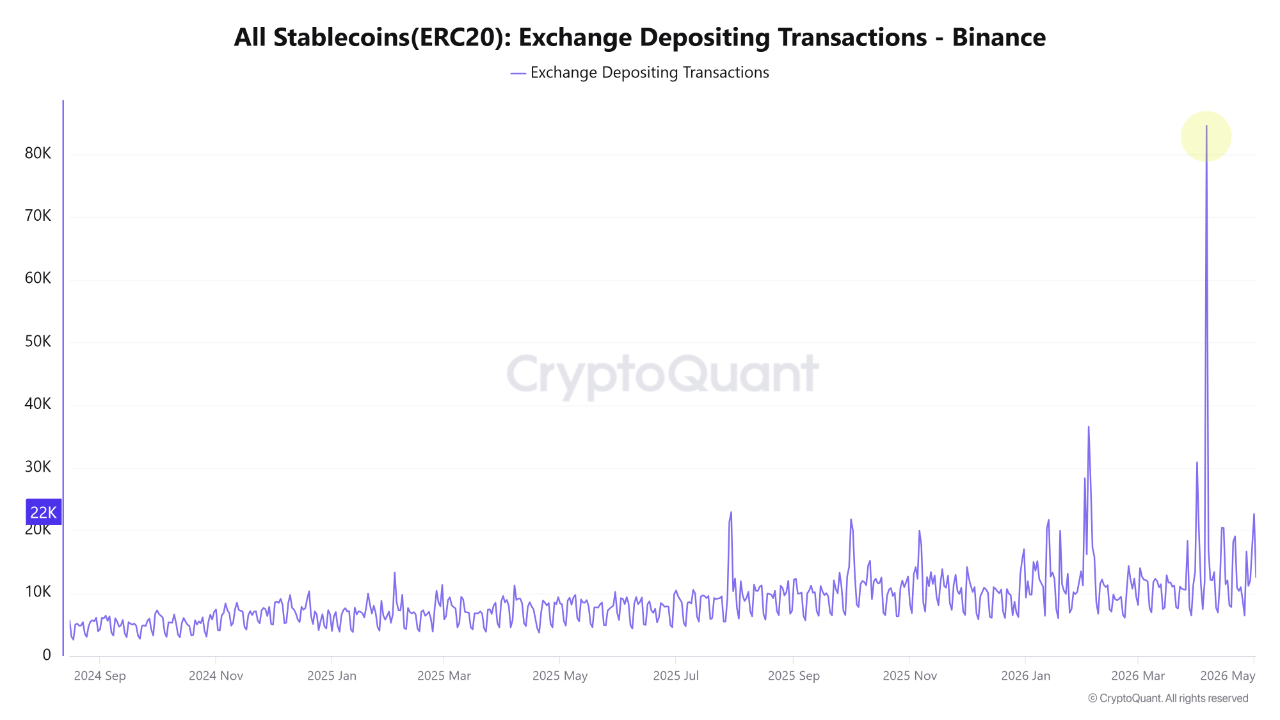
Beyond the sheer dollar volume of stablecoin inflows, the number of individual deposit transactions also provides critical insights into market participation. According to CryptoQuant researcher Rei Researcher, the count of ERC20 stablecoin deposit transactions on Binance soared to nearly 85,000 in a single day around the same period. This metric, which tracks individual transfer orders rather than their aggregate monetary value, points to a broad-based increase in the number of distinct wallets actively moving funds onto the exchange.
A high transaction count, particularly during periods of market volatility or uncertainty, often indicates heightened activity across various participant types. This includes retail investors making smaller deposits for spot trading or portfolio adjustments, as well as institutional players segmenting larger orders into multiple transactions for strategic reasons or risk management. The surge suggests that both smaller and larger players are responding to prevailing price conditions, preparing for potential trading opportunities, or positioning collateral for derivatives markets. Even in what might be considered a relatively "slow" or consolidating market, this elevated level of activity confirms a sustained interest in deploying liquidity. The confluence of high inflow volume and a significant increase in transaction count collectively indicates that capital is not merely sitting idle but is actively being positioned for deployment, underscoring the dynamic nature of the cryptocurrency ecosystem.
Analyst Perspectives on Market Sentiment
Market analysts continue to meticulously monitor these stablecoin flows as a crucial proxy for understanding the direction of capital within the crypto market. As Darkfost pointed out, for this recent positive trend to carry substantial weight and signify a more enduring shift, stablecoin netflows would need to maintain a consistently positive trajectory over an extended period. A single day of robust inflows, while noteworthy, does not inherently confirm a structural change in overall market behavior or a sustained accumulation trend.
Experts suggest that sustained positive flows would be a more reliable indicator of genuine, long-term buying interest, potentially foreshadowing a broader market uptrend. Until such consistency is observed, the current pattern largely reflects short-term sentiment, characterized by rapid responses to price action and macro news. Analysts at various firms also frequently highlight that stablecoin movements into exchanges often precede significant market activities, including spot purchases of cryptocurrencies, engagement in derivatives trading, or the strategic positioning of collateral for leveraged positions. By tracking these flows, analysts can gain a clearer, more immediate picture of where capital is congregating and how swiftly it might be deployed, offering valuable insights into short-to-medium term market directionality. The consensus among many observers is that while encouraging, the current inflows require further confirmation to signal a definitive shift towards a prolonged bullish phase.
The Role of Stablecoins in Crypto Market Health
Stablecoins are foundational to the operational fluidity and health of the broader cryptocurrency market. They act as critical bridges between the volatile crypto ecosystem and traditional fiat currencies, enabling traders to quickly enter and exit positions without incurring the high fees and delays associated with traditional banking rails. Furthermore, stablecoins serve as the primary trading pair for a vast array of cryptocurrencies on centralized exchanges, offering a stable reference point for price discovery and liquidity.
Their utility extends beyond simple trading. In periods of high volatility, stablecoins often act as a safe haven, allowing investors to temporarily de-risk their portfolios without fully exiting the crypto space. They are also indispensable as collateral in the rapidly expanding decentralized finance (DeFi) sector and in centralized derivatives markets, where they underpin leveraged trading positions. Consequently, a substantial inflow of stablecoins onto major exchanges like Binance is often interpreted as an increase in "dry powder" – capital ready to be deployed. This indicates a potential for heightened trading activity, increased liquidity, and a readiness among market participants to engage with the market, whether through buying dips, taking advantage of upward momentum, or hedging existing positions. The depth of stablecoin liquidity directly correlates with the market’s capacity to absorb large orders and maintain efficient price discovery.
Implications for Bitcoin and the Broader Market
The recent influx of stablecoins onto Binance carries several significant implications for Bitcoin (BTC) and the wider cryptocurrency market. In the immediate term, the presence of substantial "dry powder" could provide a crucial support buffer for Bitcoin’s price, particularly if it continues to trade within its established range. If investors act on their positioning, these stablecoins could translate into spot purchases, potentially driving BTC towards the higher end of its trading corridor, or at least preventing sharp downturns.
For altcoins, stablecoin inflows often precede a "spillover effect." As Bitcoin’s price stabilizes or shows signs of upward momentum, investors frequently reallocate profits or fresh capital from stablecoins into altcoins, seeking higher returns. Therefore, sustained positive stablecoin flows could signal an impending increase in altcoin trading volumes and prices. However, the current "reactive" demand pattern observed by analysts suggests that any upward movements might be short-lived, with investors quick to take profits. This means that while temporary rallies are possible, a sustained bull run would require a more fundamental shift in investor conviction beyond short-term opportunistic trading.
Looking Ahead: Sustained Flows as a Key Indicator
The overarching message from this analysis is the critical need for sustained positive stablecoin flows to confirm a structural change in market behavior. While the $1.5 billion inflow on May 14 is a strong indicator of renewed liquidity interest and a potential easing of immediate selling pressure, its true significance will be determined by subsequent flow patterns. Should Binance continue to record positive netflows over the coming weeks, it would provide a much more robust signal of genuine buying interest and accumulation, potentially laying the groundwork for a more prolonged bullish trend.
Conversely, if the inflows prove to be an isolated event, followed by a return to outflows or negligible activity, it would reinforce the notion that the market remains highly reactive and susceptible to short-term sentiment shifts rather than driven by a confident, long-term accumulation strategy. Market participants and analysts will, therefore, continue to closely monitor these vital metrics, understanding that stablecoin movements on major exchanges like Binance offer one of the most direct insights into the collective intent and positioning of capital within the dynamic cryptocurrency landscape. The convergence of macro-economic stability and consistent capital inflows remains the ideal scenario for a healthier, more predictable market environment.
Binance’s Strategic Position and Liquidity Management
As the world’s largest cryptocurrency exchange, Binance occupies a strategic position at the epicenter of global crypto liquidity. Its ability to handle massive capital movements, both inflows and outflows, underscores its operational robustness and critical role in the market. The infrastructure required to process nearly 85,000 ERC20 stablecoin deposit transactions in a single day, alongside billions of dollars in volume, highlights the exchange’s capacity to facilitate high-frequency trading and substantial capital deployment.
The monitoring of stablecoin flows by exchanges is not just for external analysis; it’s also crucial for internal liquidity management, risk assessment, and ensuring market stability. Binance’s ability to maintain deep liquidity pools across various trading pairs, even amidst significant flow fluctuations, is paramount for efficient price discovery and minimizing slippage for traders. The recent surge, therefore, is not only a market indicator but also a testament to the ongoing operational scale and significance of major centralized exchanges in the evolving digital asset ecosystem.














