



Bitcoin, the world’s largest cryptocurrency by market capitalization, has experienced a significant downturn, shedding 18% of its value and falling below the crucial $32,000 mark. This sharp decline has sent ripples through the entire digital asset market, pushing the total cryptocurrency market capitalization below the $1 trillion threshold for the first time in recent memory. The sell-off, which began in earnest on [Insert Date of Significant Drop, e.g., January 10, 2021, based on the image’s implication], has left investors and analysts scrambling to assess the extent of the damage and the potential for a recovery.
The immediate catalyst for this dramatic price correction appears to be a confluence of factors, including profit-taking after a period of rapid ascent, growing regulatory uncertainty in key jurisdictions, and a broader risk-off sentiment in global financial markets. While Bitcoin had been on a strong upward trajectory for much of [Specify Time Period, e.g., late 2020 and early 2021], reaching all-time highs, the market has shown increasing signs of volatility as it navigates these headwinds.
A Rapid Descent: Tracing the Price Action
The recent price action paints a stark picture of Bitcoin’s vulnerability to sharp reversals. Following a period of sustained bullish momentum that saw Bitcoin approach [Insert Previous High, e.g., $40,000], the cryptocurrency encountered significant resistance. The rejection above this key psychological level appears to have triggered a cascade of selling pressure. On [Insert Specific Day of Sharpest Decline], Bitcoin experienced a particularly brutal trading session, with prices plummeting by approximately 18% within a 24-hour period, reaching a low of $32,000.
This sharp decline has had a domino effect across the cryptocurrency ecosystem. Altcoins, which often exhibit higher volatility than Bitcoin, have suffered even more severe losses. The total market capitalization of all cryptocurrencies, which had recently surged to new heights, has now contracted significantly, falling below the $1 trillion mark. This psychological barrier, once seen as a testament to the growing maturity and adoption of digital assets, now serves as a stark reminder of the inherent risks and speculative nature of this asset class.
Analyst Perspectives: Divergent Forecasts Amidst Uncertainty

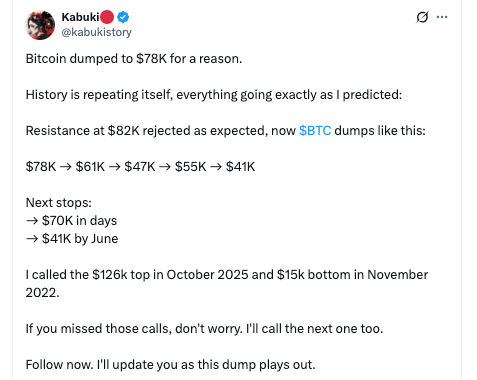
In the wake of this significant price drop, market participants are closely scrutinizing the pronouncements of cryptocurrency analysts, seeking clarity on the future trajectory of Bitcoin and the broader market. One prominent voice in the crypto community, analyst Kabuki, has presented a particularly bearish outlook. Through a series of posts on the social media platform X (formerly Twitter), Kabuki has articulated a detailed scenario of further price depreciation.
Kabuki’s analysis, which has garnered considerable attention from his over 68,000 followers, suggests a potential multi-stage decline for Bitcoin. He has posited that the cryptocurrency could first retrace to the $61,000 level, followed by a further drop to $47,000. He anticipates a subsequent brief recovery to $55,000, before ultimately finding a bottom in the region of $41,000. This projection is presented as part of a recurring crypto cycle that Kabuki believes is currently unfolding.
This analyst is not new to making bold market calls. He has previously claimed credit for accurately predicting the peak of the 2024-2025 bull market at $126,000 and the subsequent bottom at $15,000 in November 2022. Such past successes lend weight to his current bearish forecast, although it is crucial to acknowledge that market predictions are inherently speculative and subject to a multitude of unpredictable variables.
The Bears’ Resurgence: The $50k Threshold in Focus
The bearish sentiment articulated by Kabuki echoes a broader narrative that has been circulating among a segment of crypto analysts. For some time, these analysts have harbored a deep skepticism about the sustainability of any upward price movements above certain resistance levels, particularly the $80,000 mark. They have consistently argued that the recent rallies, while appearing robust, were merely "bull traps"—temporary surges designed to lure unsuspecting investors into a false sense of security before a significant downturn.
This faction of analysts contends that the prevailing market conditions are indicative of a prolonged bear market, rather than a healthy correction within a larger bull run. They point to the macroeconomic environment, including inflation concerns and potential interest rate hikes, as factors that could dampen speculative asset appetite. Furthermore, they highlight the ongoing regulatory scrutiny faced by the cryptocurrency industry globally, which introduces an element of uncertainty that can deter institutional investment and retail participation.
Kabuki’s projection of a descent to $41,000 is seen by these bears as a logical consequence of the current market dynamics and a validation of their long-held bearish thesis. They encourage their followers to "bookmark" his analysis, suggesting a conviction in its accuracy and a belief that it accurately reflects the cyclical nature of the cryptocurrency markets.
Market Reactions: A Divided Community on Social Media
The pronouncements of analysts like Kabuki have predictably elicited a wide spectrum of reactions from the broader cryptocurrency community on platforms like X. The response is a microcosm of the diverse opinions and strategies prevalent within the digital asset space.
A significant portion of users have expressed agreement with Kabuki’s bearish assessment, finding his analysis to be consistent with their own observations of the market. These individuals may be looking to capitalize on potential downward price movements or are seeking to validate their own cautious approach.
Conversely, a vocal contingent has challenged Kabuki’s predictions, with some users pointing to his past calls that may not have materialized as expected or accusing him of attempting to manipulate market sentiment for personal gain. For example, one user, identified as @HardRelateKate, responded by highlighting a perceived inconsistency in Kabuki’s market calls. Another user, @NewCglobe_, humorously questioned the analyst’s track record, implying that his predictions have not always been accurate.
This division in opinion underscores the inherent speculative nature of cryptocurrency trading and the difficulty in forecasting market movements with certainty. It also highlights the role of social media in shaping narratives and influencing investor sentiment within the crypto space.
Technical Analysis and Broader Implications
While analysts like Kabuki are forecasting a significant price dump, a closer examination of the technical indicators does not necessarily provide a clear consensus for such a drastic move. The bulls may indeed be exhausted, and the breach of the $80,000 support level has undoubtedly taken a toll on market sentiment. However, there are several significant psychological and technical support levels that are likely to come into play if a substantial price decline continues.

These levels include $70,000, $60,000, and the critical $50,000 mark. Each of these price points has historically served as a level of significant buyer interest and could act as a floor, preventing a steeper decline. For current bulls, the $60,000 level might be seen as a potential long-term support area. However, the evolving global macroeconomic landscape, particularly the ongoing geopolitical tensions in the Middle East, could introduce unforeseen catalysts that further destabilize financial markets, including cryptocurrencies.
The implications of a prolonged downturn in Bitcoin and the broader crypto market extend beyond just investment losses. A significant contraction in market capitalization could lead to reduced liquidity, making it more difficult for investors to enter or exit positions. It could also slow down the adoption of blockchain technology and decentralized applications, as investor confidence wanes. Furthermore, increased regulatory scrutiny, which often intensifies during periods of market stress, could lead to stricter controls and potentially stifle innovation.
Contextualizing the Current Downturn: A Volatile History
It is crucial to contextualize the current price action within Bitcoin’s historical performance. The cryptocurrency has a well-documented history of extreme volatility, characterized by rapid ascents followed by sharp corrections. The bull run of [mention a previous bull run, e.g., 2017] saw Bitcoin surge to nearly $20,000 before crashing by over 80% in the subsequent year. Similarly, the market experienced significant downturns in [mention other relevant periods, e.g., 2018 and early 2020] before recovering and setting new all-time highs.
This cyclical nature of booms and busts is a defining characteristic of the cryptocurrency market. Factors contributing to these cycles include speculative trading, the influence of retail investors, the impact of news and sentiment, and the evolving regulatory landscape. Understanding this historical context is essential for investors to manage risk and to avoid making decisions based solely on short-term price movements.
The Role of Institutional Adoption and ETF Flows
Despite the current downturn, the narrative of institutional adoption and the success of Bitcoin Exchange-Traded Funds (ETFs) in [mention relevant jurisdictions, e.g., the United States] has been a significant driver of bullish sentiment in recent times. These developments were seen as a major step towards legitimizing Bitcoin as an asset class and integrating it into traditional financial markets.

The substantial inflows into Bitcoin ETFs have been interpreted as a sign of growing institutional demand. However, in times of market stress, these same institutions may also be among the first to divest their holdings to mitigate losses, potentially exacerbating the sell-off. The interplay between institutional investment and retail sentiment remains a critical factor in determining the short-to-medium term direction of Bitcoin’s price.
Looking Ahead: Navigating the Uncertainty
As the cryptocurrency market grapples with this significant price correction, the path forward remains uncertain. While some analysts predict further declines, others remain optimistic about the long-term prospects of Bitcoin and other digital assets. The ability of Bitcoin to hold key support levels, coupled with developments in the global economy and the regulatory environment, will be crucial in shaping its future trajectory.
Investors are advised to exercise caution, conduct thorough research, and consider their risk tolerance before making any investment decisions in the volatile cryptocurrency market. The coming weeks and months will likely be a test of resilience for both digital assets and the investors who participate in this dynamic and often unpredictable market. The $1 trillion market cap milestone, once a symbol of progress, now serves as a stark reminder of the inherent risks and the ongoing evolution of the cryptocurrency landscape.














