



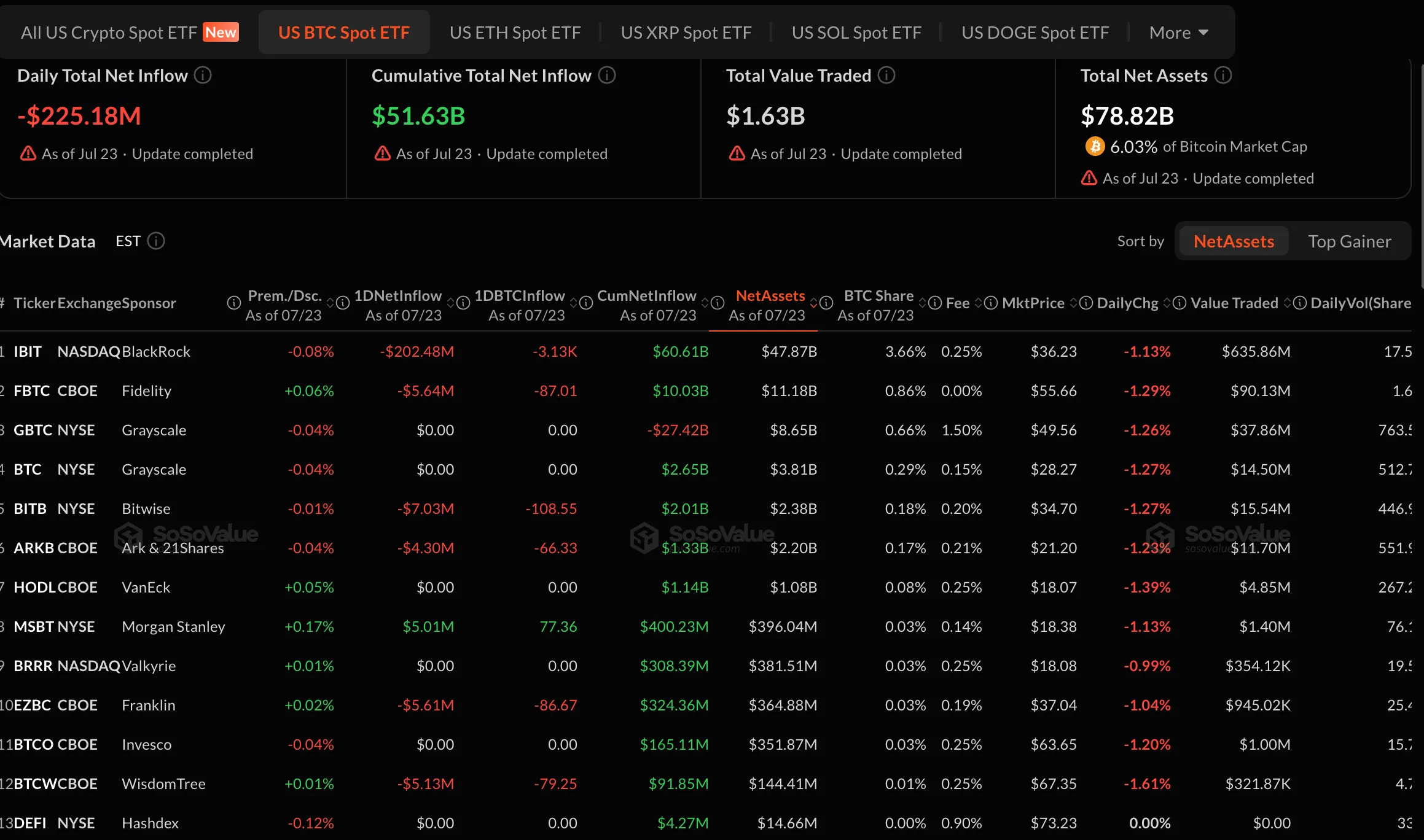
U.S.-listed spot Bitcoin Exchange-Traded Funds (ETFs) concluded a notable seven-session streak of net inflows on Thursday, July 25, 2024, recording their first day of net outflows since July 13. The aggregate outflow of $225.2 million signaled a temporary shift in investor sentiment, coming on the heels of a period that had attracted nearly $1 billion in fresh capital to the nascent investment vehicles. This reversal reflects a nuanced market reacting to both specific digital asset dynamics and broader global economic and geopolitical pressures.
A Streak Snapped: Details of Thursday’s Outflows
The recent bullish run for Bitcoin ETFs, which began after a protracted period of significant withdrawals, saw approximately $979 million flow into these funds over seven consecutive trading days. This positive momentum was abruptly interrupted on Thursday, with investors withdrawing more capital than they committed. A net outflow occurs when the total value of shares redeemed by investors exceeds the value of new shares purchased, compelling the fund manager to sell a corresponding amount of the underlying asset, in this case, Bitcoin, to meet these redemptions.
While Thursday’s outflow of $225.2 million was substantial, it did not erase the gains accumulated during the prior week. For the five trading sessions leading up to and including Thursday, the funds collectively still closed with a net positive inflow of roughly $274 million, underscoring the volatility and rapid shifts in investor behavior characteristic of the cryptocurrency market.
Breaking down the performance of individual funds, BlackRock’s IBIT, one of the largest and most prominent spot Bitcoin ETFs, bore the brunt of the outflows, shedding an estimated $202.5 million. This single fund accounted for the vast majority of the day’s negative activity. Other major players also reported smaller but notable losses, including Fidelity’s FBTC, Bitwise’s BITB, ARK 21Shares’ ARKB, Franklin Templeton’s EZBC, and WisdomTree’s BTCW. In a display of resilience against the prevailing trend, Morgan Stanley’s MSBT was the sole fund to register a net inflow, albeit a modest one, adding $5 million to its assets under management.
Geopolitical Headwinds and Bitcoin’s Price Dip
The timing of these outflows was not coincidental, aligning with a broader downturn in global financial markets. U.S. equities experienced declines on Thursday as escalating geopolitical tensions, specifically the ongoing military exchange between the U.S. and Iran, continued to weigh heavily on investor confidence. This conflict, which has persisted for over five months, has had a tangible impact on global commodity markets, particularly keeping oil prices elevated and fueling concerns about inflation and economic stability.

In this environment of heightened risk aversion, Bitcoin, often perceived as a high-beta asset, saw its price dip below the psychologically significant $65,000 threshold. The cryptocurrency briefly touched a price point of $64,600, a level that analysts noted coincided with the formation of a "death cross" on its technical charts. A death cross is a widely recognized technical analysis pattern that occurs when a short-term moving average (typically the 50-day moving average) crosses below a long-term moving average (often the 200-day moving average). This pattern is generally interpreted by traders as a bearish signal, suggesting that momentum is shifting downwards and potentially indicating the onset of a bear market or a more prolonged period of price depreciation. While not a definitive predictor, its appearance often intensifies selling pressure and heightens market anxiety.
The correlation between traditional financial markets and Bitcoin’s performance has grown increasingly pronounced, especially since the introduction of spot Bitcoin ETFs. These investment vehicles bridge the gap between conventional finance and the digital asset space, making Bitcoin more susceptible to macro-economic shifts, geopolitical events, and traditional market sentiment.
Market Sentiment Indicators: A Slide into "Fear"
Reflecting the shift in market sentiment, the Crypto Fear & Greed Index registered a notable decline on Thursday. This index, a composite measure that tracks various market factors including momentum, volatility, trading volume, dominance, and social sentiment, is designed to gauge the prevailing emotional state of cryptocurrency investors. It scores the market on a scale from 0 (extreme fear) to 100 (extreme greed). On Thursday, the index dropped three points, settling at 28. This score places it firmly within "fear" territory and represents the most panic-steered sentiment observed throughout the entire month, indicating a significant increase in investor apprehension.
Periods of "fear" often precede market bottoms or provide opportunities for contrarian investors, but they also highlight a pervasive lack of confidence among a large segment of market participants. The rapid decline in this sentiment gauge underscores how quickly geopolitical events and price movements can influence the collective psychology of the crypto market.
Historical Context and Analyst Perspectives
The recent seven-day inflow streak, though impressive, followed a challenging period for Bitcoin ETFs. Prior to this resurgence, the funds endured eight brutal weeks that saw more than $8.2 billion drained from their coffers. This sustained period of outflows was described by CoinShares’ Head of Research, James Butterfill, as the "largest run of outflows we’ve ever seen" in the relatively short history of these investment products. This historical context is crucial for understanding the current market dynamics; the recent inflows were a welcome reprieve, but the market remains sensitive to reversals.
Bloomberg Intelligence ETF analyst Eric Balchunas has offered a perspective that frames the Bitcoin ETF cycle through the lens of gold ETFs’ 22-year track record. He has consistently predicted a pattern of "two steps forward, one step back" for Bitcoin funds. This analogy suggests that the adoption and growth of novel investment products like spot Bitcoin ETFs are rarely linear. Instead, they typically experience periods of strong growth interspersed with corrections, consolidations, and even significant outflows, as market participants adjust to the new instrument, its volatility, and its place within broader investment portfolios. The gold ETF experience, which saw initial excitement followed by periods of doubt and eventual widespread acceptance, provides a potential blueprint for Bitcoin ETFs. This long-term view suggests that short-term fluctuations, while noteworthy, are part of a larger, more complex adoption curve.
Ethereum’s Divergent Performance and Implications
While Bitcoin ETFs faced headwinds, Ethereum-based funds demonstrated a divergent trend, shrugging off the broader market mood. These funds recorded net inflows of $26.3 million on Thursday, extending their streak of positive inflows to five consecutive days. This split performance suggests a potential "rotation within crypto," rather than a wholesale exit from the digital asset space.
Such a rotation indicates that investors may be reallocating capital within the cryptocurrency ecosystem, perhaps seeking different risk-reward profiles or responding to specific narratives surrounding Ethereum. Factors contributing to Ethereum’s relative strength could include ongoing anticipation for potential future spot Ethereum ETFs, continued development and adoption of its ecosystem for decentralized applications (dApps) and NFTs, or a perception of it being a more fundamentally robust asset in certain market conditions compared to Bitcoin. This nuanced behavior suggests that institutional and retail investors are becoming more sophisticated in their approach to digital asset allocations, differentiating between various cryptocurrencies based on their individual characteristics and market outlooks.
The Road Ahead: Federal Reserve Meeting and Macro Outlook
Looking forward, Bitcoin’s immediate trajectory and the broader sentiment around digital assets are poised for a significant test with the upcoming Federal Reserve meeting scheduled for July 28-29. The central bank’s decisions regarding interest rates and its forward guidance on monetary policy will play a critical role in shaping the near-term macroeconomic picture.
Higher interest rates typically make riskier assets, including cryptocurrencies, less attractive by increasing the cost of borrowing and offering more competitive returns on safer investments like government bonds. Conversely, a more dovish stance or indications of rate cuts could inject liquidity into the market and encourage investment in risk assets. The Fed’s policy decisions have historically exerted a powerful influence over global financial markets, and Bitcoin, increasingly integrated into the traditional financial landscape through products like ETFs, is no exception. Market participants will be scrutinizing every statement for clues about inflation, economic growth, and the future path of monetary policy, understanding that these factors will significantly influence capital flows into and out of digital assets. The interplay between geopolitical stability, central bank policy, and evolving investor sentiment will define the next chapter for Bitcoin ETFs and the broader cryptocurrency market.














