
The persistent question of Bitcoin’s demise, a narrative that has shadowed the cryptocurrency since its inception, is once again echoing through financial markets, amplified by a significant surge in Google searches for the phrase "Bitcoin is dead." This trend coincides with a period of heightened volatility within the broader cryptocurrency landscape, prompting reflection on the resilience and future trajectory of the digital asset. The resurgence of this morbid refrain is not entirely unexpected, as noted by prominent figures in the crypto space, but its current intensity warrants a closer examination of the underlying market dynamics and investor sentiment.
Historical Context of the "Bitcoin is Dead" Narrative
The assertion that "Bitcoin is dead" is a recurring theme that has punctuated the cryptocurrency’s history. Since its whitepaper release in 2008 and its subsequent launch in 2009, Bitcoin has faced numerous existential crises and pronouncements of its impending failure. These have often been triggered by price crashes, regulatory uncertainty, security breaches, or technological limitations. For instance, following significant price drops in early 2014, numerous articles declared Bitcoin’s demise. Similarly, the Mt. Gox exchange collapse in February 2014, which saw hundreds of thousands of Bitcoins disappear, led to widespread skepticism and renewed "death" pronouncements.
The narrative has also resurfaced during periods of intense market corrections. The FTX collapse in November 2022, a seismic event that shook the foundations of the crypto industry, saw a palpable increase in negative sentiment and a corresponding spike in "Bitcoin is dead" searches. This period was marked by a loss of trust in centralized exchanges and a broader re-evaluation of risk within the digital asset ecosystem. Bitcoin’s monthly low of $15,599 in November 2022, reached amidst the FTX fallout, served as a stark reminder of the asset’s volatility and the fragility of investor confidence.
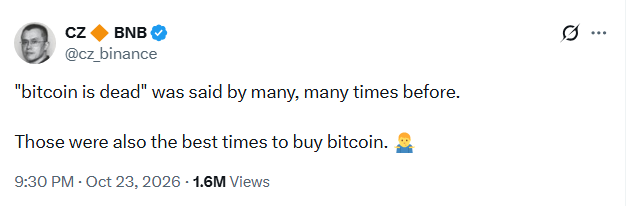
Binance founder Changpeng Zhao, commonly known as CZ, recently highlighted this historical pattern. On a Saturday, CZ reminded the capital market that the phrase "Bitcoin is dead" has been uttered numerous times throughout the digital currency’s existence. His comments implicitly suggest that such periods of extreme negative sentiment, while unsettling, have historically presented opportunities for savvy investors. This perspective, shared by many seasoned market participants, posits that the current surge in negative searches might, paradoxically, signal a potential buying opportunity rather than an indicator of inevitable collapse.
Current Market Dynamics Fueling Negative Sentiment

The contemporary surge in "Bitcoin is dead" searches is intrinsically linked to a confluence of factors currently impacting the cryptocurrency market. With the close of October, the digital asset space is experiencing elevated levels of uncertainty. Bitcoin, the flagship cryptocurrency, has recently experienced significant price retracements, falling below key psychological and technical levels. This downturn has been attributed to a combination of institutional outflows, a wave of leveraged liquidations, and a broader market sell-off that has eroded investor confidence.
Google Trends data offers a compelling quantitative perspective on this phenomenon. Worldwide searches for the phrase "Bitcoin is dead" have indeed reached all-time highs, mirroring or even surpassing the levels observed during previous market downturns, including the aftermath of the FTX collapse. This indicates a heightened public awareness and concern regarding Bitcoin’s current performance and its long-term viability. The intensity of these searches suggests a significant portion of the public is grappling with the possibility of Bitcoin’s failure, reflecting a palpable level of anxiety within the broader investor community.
Geopolitical Tensions and Macroeconomic Headwinds
Adding to the market’s precarious state are escalating geopolitical tensions and broader macroeconomic concerns. Recent events, including heightened geopolitical instability between major global powers, have triggered a flight to perceived safe-haven assets, often at the expense of riskier investments like cryptocurrencies. Specifically, a significant escalation in tensions between the United States and Iran reportedly contributed to a sharp decline in Bitcoin’s price on a recent Saturday. This geopolitical shockwave led to massive cryptocurrency liquidations, totaling approximately $841 million within a 24-hour period, with long positions bearing the brunt of the impact.
The cryptocurrency market is also contending with persistent macroeconomic headwinds. Recent inflation figures released by the United States have exceeded expectations, reigniting concerns that the Federal Reserve might be compelled to maintain or even increase interest rates for a prolonged period. Higher interest rates typically make riskier assets less attractive, as investors can achieve higher returns with less risk in traditional fixed-income instruments. This macroeconomic backdrop creates a challenging environment for growth-oriented assets like Bitcoin, potentially dampening speculative interest and contributing to downward price pressure.
Technical Indicators and Market Analysis
Despite a recent bounce back, Bitcoin’s price action remains under scrutiny. While the cryptocurrency has managed to trade above a certain threshold, it is currently hovering below its 50-day moving average. This technical indicator is often viewed by traders as a gauge of the short-to-medium term trend. Trading below this average can suggest that the immediate momentum is bearish and that further volatility or a sustained downturn could be on the horizon.
The broader cryptocurrency market is reflecting this heightened uncertainty. The collective market capitalization of digital assets has experienced significant fluctuations, mirroring Bitcoin’s trajectory. Altcoins, which are typically more volatile than Bitcoin, have often seen sharper declines during periods of market stress, exacerbating investor losses and contributing to the overall negative sentiment. The interconnectedness of the crypto market means that Bitcoin’s performance often dictates the sentiment and price action of a vast array of other digital assets.
The Role of Scalability in Bitcoin’s Long-Term Viability
While immediate market pressures are driving current sentiment, the long-term viability of Bitcoin has always been intrinsically linked to its ability to scale. The foundational architecture of Bitcoin, while robust and secure, was designed with a limited transaction throughput. This inherent limitation means that the network can only process a certain number of transactions per second, which can lead to higher fees and longer confirmation times during periods of high network congestion.
The development of layer-two scaling solutions, such as the Lightning Network, has been a crucial endeavor to address these scalability challenges. The Lightning Network allows for off-chain transactions, enabling faster and cheaper payments, thereby enhancing Bitcoin’s utility as a medium of exchange. Without continuous innovation and the successful implementation of such scaling solutions, Bitcoin’s ability to compete with traditional payment systems and to accommodate a growing global user base would be severely hampered. The ongoing development and adoption of these technologies are critical for ensuring Bitcoin’s relevance and continued growth in the long run.
Expert Perspectives and Historical Precedents
The current surge in "Bitcoin is dead" searches, while alarming to some, is viewed by many seasoned observers as a cyclical phenomenon. Historical data suggests that periods of extreme negative sentiment, characterized by widespread fear and panic, have often preceded significant market recoveries and subsequent bull runs. These moments of capitulation, where weak hands are shaken out of the market, can create fertile ground for renewed growth.
The remarks by Binance founder CZ serve as a reminder of this historical pattern. His assertion that extreme negative sentiment has historically been the "best time to buy BTC" reflects a contrarian investment philosophy that has proven successful for many in the volatile cryptocurrency markets. This perspective suggests that while the present may seem bleak, the underlying fundamentals and the long-term potential of Bitcoin, coupled with ongoing technological advancements, may still hold significant promise.

Analyzing the Implications of "Bitcoin is Dead" Searches
The surge in "Bitcoin is dead" searches carries several implications for the cryptocurrency market and its participants. Firstly, it indicates a heightened level of public interest and concern, even if that interest is framed negatively. This increased attention, while potentially driven by fear, can also lead to greater research and a deeper understanding of Bitcoin’s technology and market dynamics.
Secondly, these searches reflect a sentiment of doubt and uncertainty among investors. This can lead to a decrease in buying pressure and an increase in selling pressure, potentially exacerbating price declines. For retail investors, such widespread negative sentiment can be particularly influential, leading them to make emotional decisions rather than data-driven ones.
However, for more experienced investors and those with a long-term conviction in Bitcoin’s potential, these periods of extreme negativity are often seen as opportunities. The cyclical nature of market sentiment suggests that the current wave of pessimism will eventually give way to optimism, especially if Bitcoin can navigate the current challenges and continue to demonstrate its value proposition.
The Path Forward: Resilience and Innovation
The resilience of Bitcoin has been a defining characteristic throughout its history. Despite numerous predictions of its demise, the cryptocurrency has consistently rebounded from significant downturns, driven by technological innovation, growing adoption, and the persistent belief in its potential as a decentralized store of value and a medium of exchange.
The current market environment, marked by volatility and negative sentiment, presents a critical juncture for Bitcoin. Its ability to overcome these challenges will depend on several factors, including the continued development and adoption of scaling solutions, the evolution of regulatory frameworks, and the broader macroeconomic landscape. While the "Bitcoin is dead" narrative may continue to resurface, its historical inaccuracy and the ongoing efforts to enhance its functionality suggest that the digital asset is far from being obsolete. The cryptocurrency market remains a dynamic and evolving space, and Bitcoin’s journey is a testament to its enduring capacity to adapt and persist in the face of adversity. The current surge in negative searches, while notable, may ultimately prove to be another chapter in the long and often dramatic history of Bitcoin’s survival and potential resurgence.