


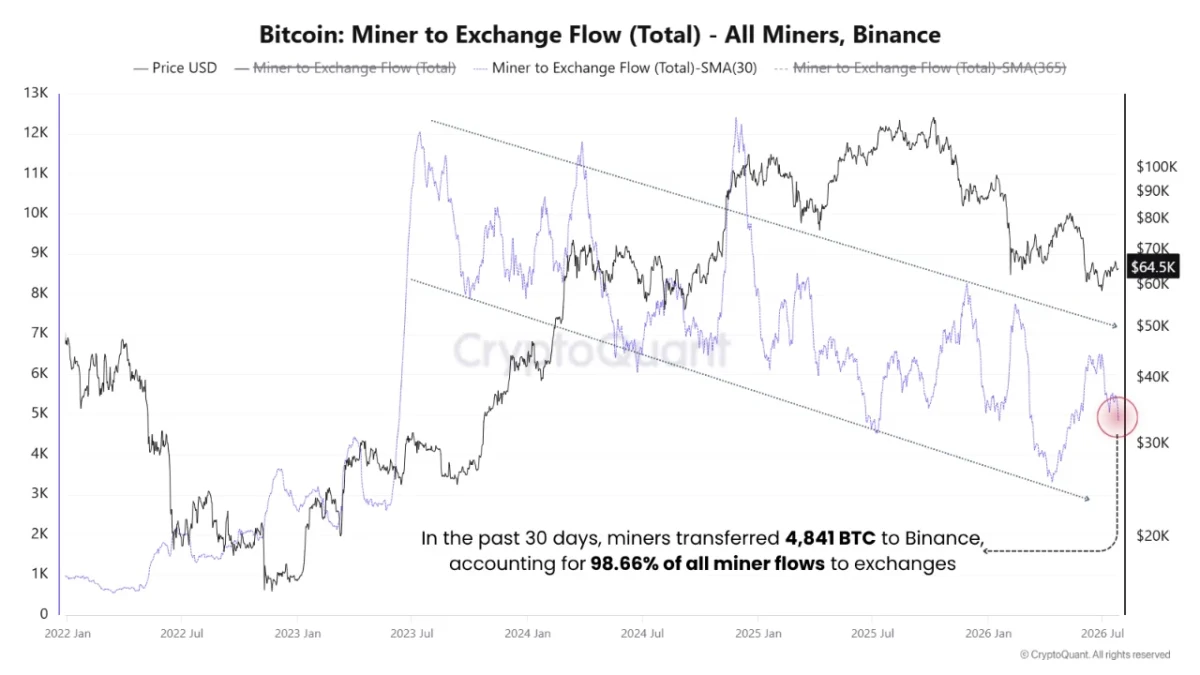
On-chain analytics reveal a significant and persistent contraction in Bitcoin miner selling activities, with the supply of newly mined BTC flowing to exchanges maintaining a clear descending trend observed since mid-2023. The latest data indicates that Bitcoin miners collectively transferred a mere 4,841 BTC to Binance over the past 30 days, a figure that astonishingly accounts for 98.66% of all miner-initiated transfers to public exchanges during the same period. While recent transfers show a slight rebound from their absolute lows, the overarching trend firmly points towards a sustained reduction in selling pressure originating from the mining sector, a development with considerable implications for Bitcoin’s market dynamics. This shift suggests a decrease in fresh supply entering the spot market, even as Bitcoin navigates price fluctuations below its recent all-time highs. However, market analysts caution that this signal, while constructive, must be interpreted alongside a broader suite of on-chain indicators to derive comprehensive insights into market sentiment and supply-demand equilibrium.
The Persistent Downtrend in Miner Flows and Its Significance
The observed decline in miner-driven selling is not a recent phenomenon but rather the continuation of a well-established pattern that has taken root over the past year. Since the middle of 2023, Bitcoin miners’ transfers to exchanges have consistently followed a descending channel, characterized by lower highs and lower lows in their outflow volumes. This trend underscores a structural shift in how miners manage their accumulated Bitcoin, moving away from immediate liquidation of newly minted coins. The concentration of these transfers, with nearly 99% directed to Binance, highlights the exchange’s pivotal role as a primary liquidity hub for mining operations, suggesting a streamlined approach to offloading assets when necessary.
Historically, miner outflows have served as a critical barometer for potential selling pressure. Large, sustained transfers to exchanges often precede periods of increased market volatility or price corrections, as they indicate a readiness from a significant supply-side participant to sell. Conversely, reduced outflows typically signal a more stable or even bullish outlook from miners, who opt to hold their assets in anticipation of higher prices or to manage operational costs through alternative financing. The recent fluctuation, where flows temporarily recovered from approximately 3,500 BTC to around 6,000 BTC before quickly fading, illustrates the ongoing balancing act miners perform. This short-lived increase likely represented tactical sales to cover immediate operational expenses, especially during periods of Bitcoin price rebound, yet it failed to disrupt the broader, long-term downtrend, reinforcing the narrative of diminishing systemic selling pressure from this sector. Comparing these figures to historical peaks, such as those observed during the 2021 bull run or immediately following previous halvings, reveals a stark difference in current miner disposition. In prior cycles, miners often capitalized on market rallies by offloading significant portions of their holdings, sometimes contributing to market tops. The current subdued selling indicates a departure from this historical pattern.
The Transformative Impact of the 2024 Bitcoin Halving
A primary driver behind this long-term decline in miner selling is unequivocally the 2024 Bitcoin halving, which occurred in April. This programmatic event, embedded within Bitcoin’s protocol, reduces the reward for mining a new block by 50% approximately every four years. The most recent halving saw the block reward decrease from 6.25 BTC to 3.125 BTC. This reduction naturally halves the rate at which miners produce new Bitcoin for the same amount of computational work and energy expenditure. Consequently, a lower volume of newly minted BTC inherently translates to fewer coins available for immediate transfer to exchanges.
It is crucial to contextualize this outcome: while lower exchange transfers might intuitively suggest stronger confidence among mining companies, this interpretation must be tempered by the direct mathematical consequence of the halving. Miners are simply generating less Bitcoin, leading to a proportional decrease in their potential sell-side supply. However, the persistent descending channel of transfers, rather than just a proportional reduction, indicates a more complex interplay of factors beyond mere production shrinkage. The halving event traditionally introduces a period of significant stress for less efficient miners, as their revenue is abruptly cut in half while operational costs (electricity, hardware, maintenance) remain constant or even increase. This often forces some miners to sell existing holdings to remain solvent or exit the market altogether. The current data, however, suggests that the sector, at least among the surviving and dominant players, is adapting without resorting to large-scale liquidations that would break the established downtrend. The hash rate, a measure of the total computational power dedicated to mining, saw an initial dip post-halving but has largely recovered, indicating that efficient miners have successfully navigated the transition, albeit under tighter margins.

Evolving Financial Strategies and Structural Changes in the Mining Sector
Beyond the halving’s direct impact, the declining trend in miner selling also reflects profound structural changes within the Bitcoin mining industry. The sector has matured significantly over the past few years, moving away from a predominantly speculative, retail-driven activity towards a more institutionalized and sophisticated industry. Larger mining companies, many of which are publicly traded or backed by institutional capital, now possess a broader array of financing options that were largely unavailable to smaller, independent miners in previous cycles.
These advanced financial instruments include access to traditional debt markets, allowing them to secure loans collateralized by their mining equipment (ASICs) or future Bitcoin production. Public equity offerings provide capital without requiring immediate liquidation of their Bitcoin holdings. Furthermore, production hedging strategies, such as forward contracts or futures, enable miners to lock in a future selling price for a portion of their anticipated Bitcoin output, thereby stabilizing revenue streams and mitigating price volatility risk. Private liquidity arrangements with over-the-counter (OTC) desks or institutional buyers also offer discreet channels for larger block sales, bypassing public exchanges and reducing their impact on spot market prices. This diversification of funding sources allows operators to cover operational expenses, invest in new infrastructure, and manage their balance sheets without the immediate necessity of selling newly mined Bitcoin on public exchanges, thereby reducing a consistent source of sell-side pressure. The ability to secure financing means miners are less beholden to short-term price movements to meet their financial obligations, fostering a more resilient and less reactive selling behavior.
Depleted Inventories and Market Maturation
Another critical factor contributing to the subdued miner selling is the state of their available Bitcoin inventories. Many miners, particularly those who have been operating for several years, strategically accumulated significant portions of their mined Bitcoin during previous market downturns or held onto them through various cycles. During the fervent bull markets of 2020-2021, and subsequent rallies, many of these operators capitalized on elevated prices to distribute substantial portions of their holdings, realizing profits and shoring up their balance sheets.
This strategic selling in previous rallies has, for many, resulted in significantly lower current Bitcoin reserves. With fewer coins in their treasuries that are readily available for sale, the capacity for large-scale miner-driven liquidations is naturally diminished. This depletion of inventories, coupled with the reduced post-halving production, means that the potential fresh supply from miners is inherently limited. This scenario points to a more mature industry that is less dependent on constant spot market selling to sustain operations. Instead, miners are increasingly becoming long-term holders, viewing their Bitcoin production as a strategic asset rather than merely a commodity to be immediately converted to fiat. This shift has profound implications for Bitcoin’s overall market structure, as it removes a significant and historically consistent source of supply, potentially contributing to tighter market conditions when demand remains stable or increases.
Broader Market Implications and Expert Perspectives
The continued decline in Bitcoin miner selling is widely regarded by market analysts as a constructive development for the broader Bitcoin ecosystem. By limiting one of the most consistent sources of new supply entering the market, this trend can help to ease selling pressure, especially during periods when investor demand remains robust. While reduced miner distribution does not, by itself, guarantee higher prices, it certainly removes a potential overhang that could otherwise suppress upward price movements.
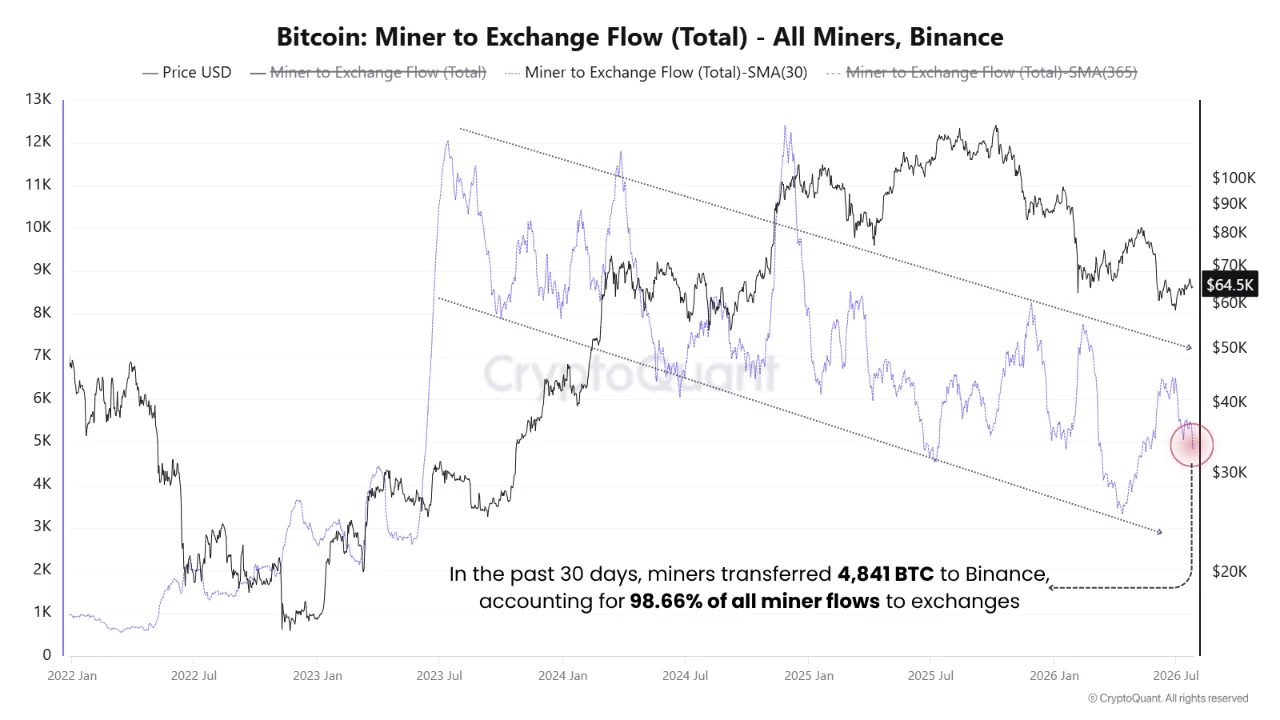
Analysts frequently emphasize that the significance of this signal is amplified when viewed in conjunction with other on-chain metrics, particularly miner reserves. If miner reserves—the total amount of Bitcoin held in wallets controlled by mining entities—stabilize or even increase while exchange transfers remain subdued, it would strongly suggest that miners are actively choosing to hold a larger share of their production. Such a pattern would indicate a collective long-term bullish sentiment among miners, reinforcing the supply-side constraint. Conversely, a reversal of the current trend would warrant close attention. A sudden breakout above the established descending channel for exchange transfers, especially if accompanied by a noticeable decline in overall miner reserves and occurring amidst weaker Bitcoin prices, would signal renewed financial pressure across the mining sector. Such a scenario could force operators to increase their exchange deposits to cover mounting expenses or service debt, thereby introducing fresh selling pressure back into the market. This could be particularly impactful if a large number of less efficient miners face insolvency post-halving, leading to a cascade of asset liquidations.
The Energy Cost and Profitability Landscape
The profitability of Bitcoin mining is intrinsically linked to the price of Bitcoin, the network’s hash rate, the mining difficulty, and the cost of electricity. Post-halving, the immediate reduction in revenue per block means that miners’ break-even points have effectively doubled in terms of Bitcoin price required to cover costs. This necessitates either higher Bitcoin prices, lower operational costs, or increased efficiency. The sustained low selling pressure suggests that many miners are either operating profitably at current Bitcoin price levels, have access to extremely low-cost energy, or are employing sophisticated financial strategies to defer selling.
The global energy landscape and regulatory scrutiny on energy consumption for mining also play a role. Miners are constantly seeking out cheaper and more sustainable energy sources, often relocating to regions with abundant renewable energy or flared natural gas. These strategic decisions directly impact their cost structures and, consequently, their need to sell Bitcoin. The ongoing difficulty adjustments, which recalibrate every two weeks to ensure blocks are mined roughly every 10 minutes, reflect changes in the total hash rate. A rising difficulty, while indicative of a healthy and growing network, also increases the computational challenge for miners, potentially squeezing margins further.
Looking Ahead: Sustainability and Market Equilibrium
For the foreseeable future, Bitcoin miner selling continues to track its broader downward trajectory, a trend that has persisted despite the inherent market volatility. The latest on-chain data unequivocally suggests that miners, as a collective entity, remain under less immediate pressure to distribute their newly acquired coins through public exchanges. This current disposition contributes to a more balanced overall market structure, as a historically significant source of sell-side pressure is significantly muted. Investors and analysts will continue to monitor this trend closely, as its persistence or reversal will offer crucial insights into the underlying health of the mining industry and its ongoing influence on Bitcoin’s supply-demand dynamics. The interplay of a maturing mining industry, sophisticated financial management, and the fundamental impact of the halving has reshaped miner behavior, potentially paving the way for a more resilient and supply-constrained Bitcoin market in the long term.














