



In a notable shift of his long-term price projection for Bitcoin, Arthur Hayes, co-founder of BitMEX and CEO of Maelstrom, has revised his 2026 target for the flagship cryptocurrency. Previously a staunch advocate for a $500,000 valuation by that year, Hayes has now recalibrated his outlook, forecasting a more conservative $125,000 by 2026. This adjustment, revealed during a recent interview with a cryptocurrency journalist, stems from Hayes’ evolving perspective on the primary drivers of Bitcoin’s price action, particularly his emphasis on global liquidity.
Hayes, who has historically been vocal with bold cryptocurrency predictions, explained that his previous optimism was predicated on the assumption of sustained and significant increases in global liquidity. However, he now posits that without a substantial inflow of new capital into the market, Bitcoin’s price trajectory is likely to be constrained, potentially leading to stagnation or underperformance. This view contrasts with the more commonly held belief within the crypto community that technological advancements and network effects are the primary catalysts for price appreciation.
"What does Bitcoin need to go higher? More money printing," Hayes stated during the interview, underscoring his belief that monetary policy and the availability of capital are paramount to Bitcoin’s ascent. At the time of his remarks, Bitcoin was trading in the vicinity of $78,000, having recently struggled to maintain its footing above the $80,000 mark. This price action suggests that Bitcoin, the largest cryptocurrency by market capitalization, is currently facing significant resistance levels, making a rapid surge towards Hayes’ revised target of $125,000 appear challenging in the immediate future.
This latest revision from Hayes is not the first time his predictions have garnered significant attention, nor the first instance where his forecasts have been adjusted. His history of making ambitious claims, while contributing to his profile as a prominent figure in the crypto space, has also led to scrutiny when those predictions do not materialize as anticipated. His current emphasis on global liquidity as the linchpin for Bitcoin’s price performance, even as global liquidity has seen notable increases over the past few years, has led some observers to question the direct correlation and its impact on Bitcoin’s actual market performance.
The Interplay of Global Liquidity and Bitcoin’s Price Dynamics
The relationship between global liquidity, often measured by aggregate measures like M2 money supply, and Bitcoin’s price has been a subject of intense debate and analysis. Historically, periods of quantitative easing and expansive monetary policies by central banks have often coincided with rallies in risk assets, including cryptocurrencies.

Historical Data Analysis:
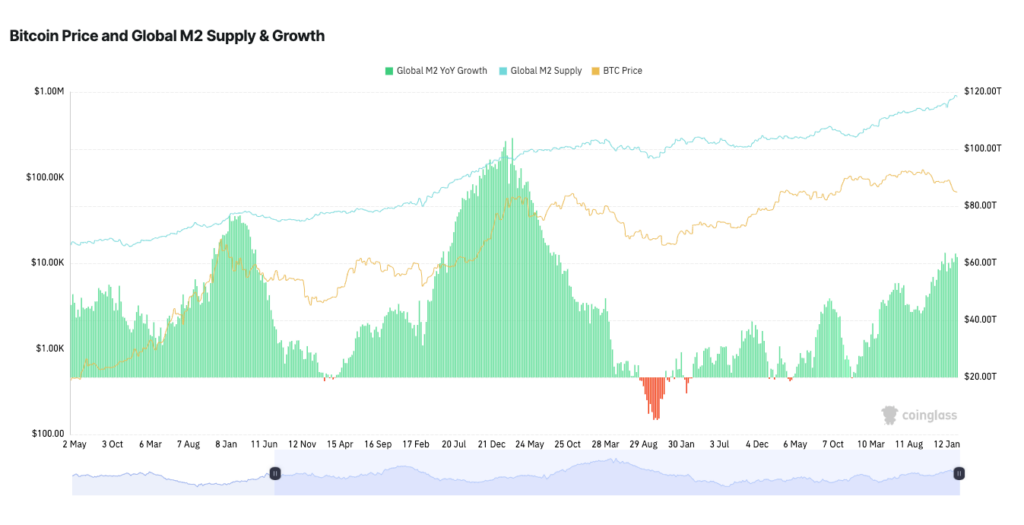
Examining the price relationship of global M2 liquidity and Bitcoin’s price index over the last decade reveals a discernible pattern. During periods of significant monetary expansion, such as the global response to the COVID-19 pandemic in 2020-2021, both global liquidity and Bitcoin’s price experienced substantial surges. This era saw Bitcoin reach unprecedented all-time highs, fueled in part by the unprecedented injection of liquidity into financial markets worldwide.
A visual representation of this correlation, often depicted through comparative charts, typically shows Bitcoin’s price movements mirroring the trends in global M2 growth. When liquidity expands, the purchasing power of fiat currencies potentially diminishes, leading investors to seek alternative stores of value or speculative assets. Bitcoin, with its finite supply, has often been posited as a digital gold, benefiting from such inflationary pressures and a search for yield.
However, the recent past has presented a more complex picture. While global liquidity has seen a resurgence in certain economies, Bitcoin’s price has not always kept pace with the same velocity as observed in previous cycles. This divergence has led to a recalibration of expectations and has prompted figures like Hayes to re-evaluate their models. The implication is that while liquidity remains a crucial factor, other market forces, including regulatory sentiment, technological developments, and macroeconomic headwinds, may be playing a more significant role in tempering Bitcoin’s immediate price action.
The Impact of Deflationary Forces and AI:
Hayes also touched upon broader macroeconomic trends, including the impact of artificial intelligence (AI) on the economy. He attributed the volatility and potential downturns observed in the first quarter of the stock market to what he termed "AI panic." According to his analysis, the aggressive money printing initiatives by central banks are proving insufficient to counteract the potent deflationary forces unleashed by rapid advancements in AI.
Hayes’ argument suggests that AI-driven automation and efficiency gains could be suppressing wage growth and dampening consumer demand across various sectors. This, in turn, creates a deflationary environment that even substantial monetary stimulus may struggle to overcome. If this thesis holds true, it could have profound implications for all asset classes, including cryptocurrencies, as the effectiveness of traditional monetary policy tools might be diminished. The challenge for Bitcoin, in this context, would be to find a narrative and price drivers that are less dependent on overt monetary expansion and more resilient to deflationary pressures.

Regulatory Headwinds and Market Resilience
Despite Hayes’ revised outlook and his emphasis on liquidity, it is crucial to acknowledge the persistent influence of regulatory actions on the cryptocurrency market. In recent times, the industry has faced increased scrutiny from regulatory bodies across major economies. These actions, which have included enforcement actions against major exchanges and proposed new frameworks for digital asset regulation, have injected an element of uncertainty and caution into the market.
These regulatory pressures can act as a drag on price momentum, irrespective of liquidity levels. Investors, particularly institutional ones, often adopt a more conservative approach when faced with regulatory ambiguity. The fear of non-compliance or sudden policy shifts can lead to reduced investment and increased selling pressure. Therefore, while Hayes focuses on liquidity as the primary lever for Bitcoin’s price, the prevailing regulatory landscape represents a significant external factor that cannot be ignored.
The resilience of Bitcoin’s price, even amidst these regulatory challenges and mixed liquidity signals, can be interpreted in several ways. It might suggest a growing maturity of the market, with a more established base of long-term holders less swayed by short-term regulatory noise. Alternatively, it could indicate that underlying demand drivers, perhaps related to Bitcoin’s perceived role as an inflation hedge or a decentralized alternative to traditional finance, are robust enough to absorb some of the negative sentiment.
Community Reactions and the Nature of Crypto Predictions
Arthur Hayes’ pronouncements have consistently stirred debate within the cryptocurrency community. His latest revision to his Bitcoin price target has, predictably, elicited a range of responses on social media platforms, particularly X (formerly Twitter). The pattern of prominent figures in the crypto space making highly publicized, ambitious predictions, only to later revise them based on evolving market conditions or newly identified factors, has become a recurring theme.
This phenomenon has led to criticism from some quarters, who view such revisions as a form of "market manipulation" or, at the very least, as a demonstration of the inherent difficulty in accurately forecasting the volatile cryptocurrency market. Users on X have expressed sentiments ranging from skepticism to amusement regarding the tendency for such predictions to be subject to significant adjustments.
One common sentiment expressed by users is the perceived ease with which some industry leaders can pivot their predictions, often citing complex economic factors like liquidity. This has led to a degree of cynicism, with some suggesting that these pronouncements are more about influencing market sentiment than providing genuine, data-driven forecasts. The implication is that the narrative surrounding Bitcoin’s price is often shaped by influential voices, and their shifting perspectives can have a tangible impact on investor behavior.
The criticism directed at Hayes for his revised targets echoes broader discussions within the crypto community concerning the role of influencers and executives in shaping market perceptions. Similar critiques have been leveled against other prominent figures, such as Changpeng Zhao (CZ), the former CEO of Binance, for alleged "FOMO-driven behavior" aimed at influencing cryptocurrency prices.
This dynamic highlights a fundamental challenge in the cryptocurrency space: balancing the influence of charismatic leaders with the need for objective market analysis. While figures like Hayes bring valuable insights and experience, their pronouncements are often subject to intense scrutiny, particularly when they involve substantial shifts in long-term price targets. The community’s reaction underscores a desire for greater transparency and consistency in forecasting, even as the inherent volatility of the asset class makes definitive predictions an elusive goal.
Broader Implications and Future Outlook
Arthur Hayes’ revised Bitcoin target of $125,000 by 2026, while a significant reduction from his previous $500,000 projection, still represents a substantial increase from current levels. His emphasis on global liquidity as the primary driver of Bitcoin’s price suggests a continued belief in the asset’s potential for significant growth, albeit contingent on favorable monetary conditions.
The correlation data presented, showing a historical link between global M2 liquidity and Bitcoin’s price, serves as a foundational piece of evidence for Hayes’ thesis. If central banks globally revert to more expansionary monetary policies, perhaps in response to future economic downturns or deflationary pressures, it could indeed provide a tailwind for Bitcoin. The concept of Bitcoin as a "digital gold" or an inflation hedge gains traction during periods of currency debasement, which is often a consequence of increased money printing.

However, the complicating factors of regulatory uncertainty and the potential deflationary impact of AI advancements introduce significant variables. The cryptocurrency market is at a critical juncture, where it must navigate the evolving global economic landscape, the maturation of its own technological infrastructure, and the increasing attention from regulatory bodies.
The resilience of Bitcoin in the face of these challenges suggests an underlying robustness in its value proposition. Whether this resilience is sufficient to overcome the hurdles and propel the price towards Hayes’ revised target will depend on a complex interplay of factors. These include the future direction of monetary policy, the clarity and scope of regulatory frameworks, the adoption rate of cryptocurrencies for various use cases, and the broader macroeconomic environment.
For investors and market observers, Hayes’ revised outlook serves as a reminder of the dynamic nature of cryptocurrency markets and the importance of continuously reassessing the factors that influence asset prices. While the allure of "going to the moon" remains a powerful narrative, a grounded analysis of liquidity, regulation, and macroeconomic trends will be crucial in charting the path forward for Bitcoin and the broader digital asset ecosystem. The coming years will undoubtedly be a test of Bitcoin’s ability to fulfill its potential amidst an ever-changing global financial and technological landscape.














