


The cryptocurrency market experienced a notable downturn early in the week of October 7th, culminating in Bitcoin (BTC) dropping to a weekly low of approximately $80,400 on October 8th. This sharp decline represented an acceleration of a broader crypto market sell-off, which saw the flagship digital asset shed nearly $7,000 from its earlier weekly highs. However, the market demonstrated a degree of resilience, with Bitcoin recovering to $83,247 by October 9th, limiting its weekly losses to 3.6%. This volatility underscored the precarious nature of the current market environment, where macro-economic uncertainties and shifting investor sentiment continue to exert significant influence. While Bitcoin navigated a turbulent period, most large-cap altcoins experienced more substantial percentage losses over the same seven-day window, highlighting a flight to perceived safety within the crypto ecosystem.
Amidst the widespread declines, NEAR Protocol (NEAR) and Monero (XMR) emerged as notable exceptions, exhibiting comparatively minor losses of 0.3% and 1.3%, respectively, in the weekly comparison. These figures, however, only capture a snapshot of a highly dynamic period. NEAR Protocol, in particular, had previously witnessed an extraordinary surge, climbing an impressive 91.7% over the prior month. Its subsequent performance on October 10th further underscored its unique trajectory, as it rose more than 10% to reach roughly $5.25. The divergent movements of Bitcoin and certain altcoins suggest a complex interplay of factors, where broad market sentiment is juxtaposed with project-specific developments and investor interest. While the data points to a measure of resilience within the market, the underlying causes for these specific performance differentials require deeper analysis.
Market Turbulence and Bitcoin’s Retreat from Key Resistance
The genesis of the week’s sell-off can be traced to Bitcoin’s repeated failures to decisively reclaim the $87,000 resistance level. After several attempts to breach this psychological and technical barrier earlier in the week, the asset began to lose momentum, slipping below $84,000. This downward pressure intensified, pushing Bitcoin to its weekly nadir of $80,400 on Thursday, October 8th. The rapid erosion of nearly $7,000 in value over a few days triggered concerns among investors, particularly as the broader market reacted with heightened selling pressure. However, a swift counter-movement by buyers saw BTC rebound above $83,000 by Friday, October 9th, preventing a deeper capitulation and signaling underlying demand at lower price points.
This period of Bitcoin weakness stood in stark contrast to the narrower weekly losses observed in NEAR Protocol and Monero. For instance, while Bitcoin was grappling with significant percentage declines, NEAR’s minimal 0.3% weekly drop was particularly striking when contextualized by its preceding performance. Its token price had soared by 91.7% in the month leading up to the market downturn, indicating robust bullish sentiment that likely cushioned it against a more severe correction. Even an intraday pullback might have left NEAR close to its starting price for the week, showcasing the power of sustained upward momentum. This trend continued as NEAR gained over 10% on October 10th, reaching approximately $5.25, suggesting a strong, independent growth narrative. Monero’s 1.3% loss also compared favorably with Bitcoin’s, although the reasons behind its relative stability are less clear-cut. A small decline alone does not definitively indicate whether buyers were accumulating, existing holders were simply inactive, or if trading volumes were thin, leading to less pronounced price movements.

Chronology of a Volatile Week: October 7th-10th
- Early Week (October 7th): Bitcoin attempts to breach and hold the $87,000 level. Initial optimism is met with strong selling pressure at this resistance point, signaling potential profit-taking or a lack of conviction from institutional players. Altcoins generally track Bitcoin’s movements, with some showing early signs of weakness.
- Mid-Week (October 8th): Bitcoin’s inability to sustain above $87,000 leads to a more pronounced sell-off. BTC breaks below crucial support levels, including $84,000, and plummets to a weekly low near $80,400. This sudden drop triggers a cascade effect across the broader crypto market, with many altcoins experiencing sharper declines than Bitcoin. News reports begin to highlight the accelerating "crypto market selloff."
- Late Week (October 9th): Buyers step in, particularly as Bitcoin approaches the $80,000 psychological support. BTC stages a recovery, climbing back to $83,247. This rebound helps stabilize the overall market, though most altcoins remain significantly down for the week. Bitcoin dominance starts to increase as capital flows into the largest cryptocurrency.
- Weekend & Early Next Week (October 10th): The market sees further signs of recovery, albeit unevenly. Bitcoin consolidates around the $83,000 mark. Notably, NEAR Protocol continues its strong performance, gaining over 10% and reaching approximately $5.25, signaling a potential decoupling from the broader market trend. Cardano (ADA) also sees a significant daily rebound, rising about 7% to reclaim $0.255. The total crypto market value, which had lost around $200 billion from its high to low, begins to recover.
ETF Flows and Uneven Demand Signals
The week’s market dynamics were further complicated by conflicting signals from exchange-traded fund (ETF) flows, which typically serve as a barometer for institutional and broader market sentiment. While Bitcoin ETFs recorded substantial daily net outflows of $244 million, indicative of profit-taking or a cautious stance from institutional investors, XRP funds saw $8.2 million in inflows. This divergence presents a complex "demand narrative" that defies simple interpretation.
The outflows from Bitcoin ETFs, particularly if concentrated in specific products that have seen significant appreciation, could point to institutional investors rebalancing portfolios or securing profits after a period of sustained gains. It also raises questions about the immediate appetite for new capital allocation into Bitcoin via these regulated vehicles. Conversely, the positive fund subscriptions into XRP, despite the token’s 9% weekly loss, suggest a segment of the market maintains a long-term bullish outlook for XRP, perhaps anticipating favorable regulatory developments or continued adoption in cross-border payments. This situation underscores that positive fund subscriptions do not inherently protect an asset from broader market downturns, nor do ETF outflows necessarily lead to an asset’s decline if other demand drivers are present in the spot market. The interplay between institutional flows in regulated products and direct market trading activity remains a critical factor in understanding crypto price movements.
Market Capitalization Shifts and Bitcoin Dominance
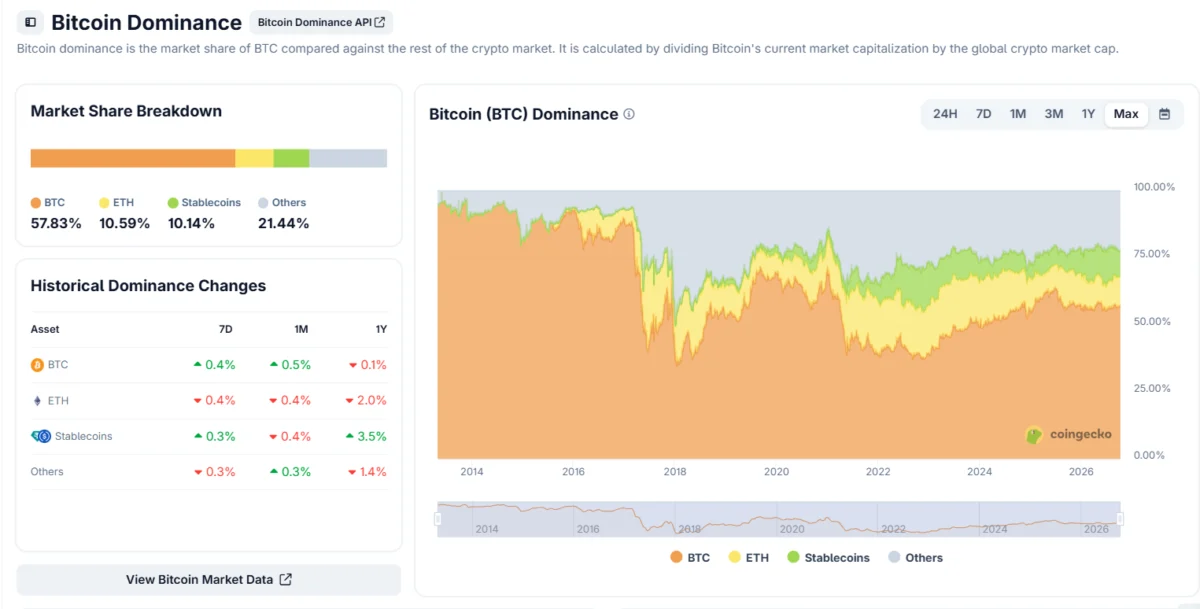
During this period of flux, Bitcoin’s dominance, a metric measuring its market capitalization relative to the total cryptocurrency market, increased to 59.5%. This rise suggests that in times of uncertainty or sell-offs, capital tends to flow into Bitcoin, often perceived as a safer haven within the volatile crypto space. Bitcoin’s market capitalization stabilized around $1.66 trillion following its rebound.
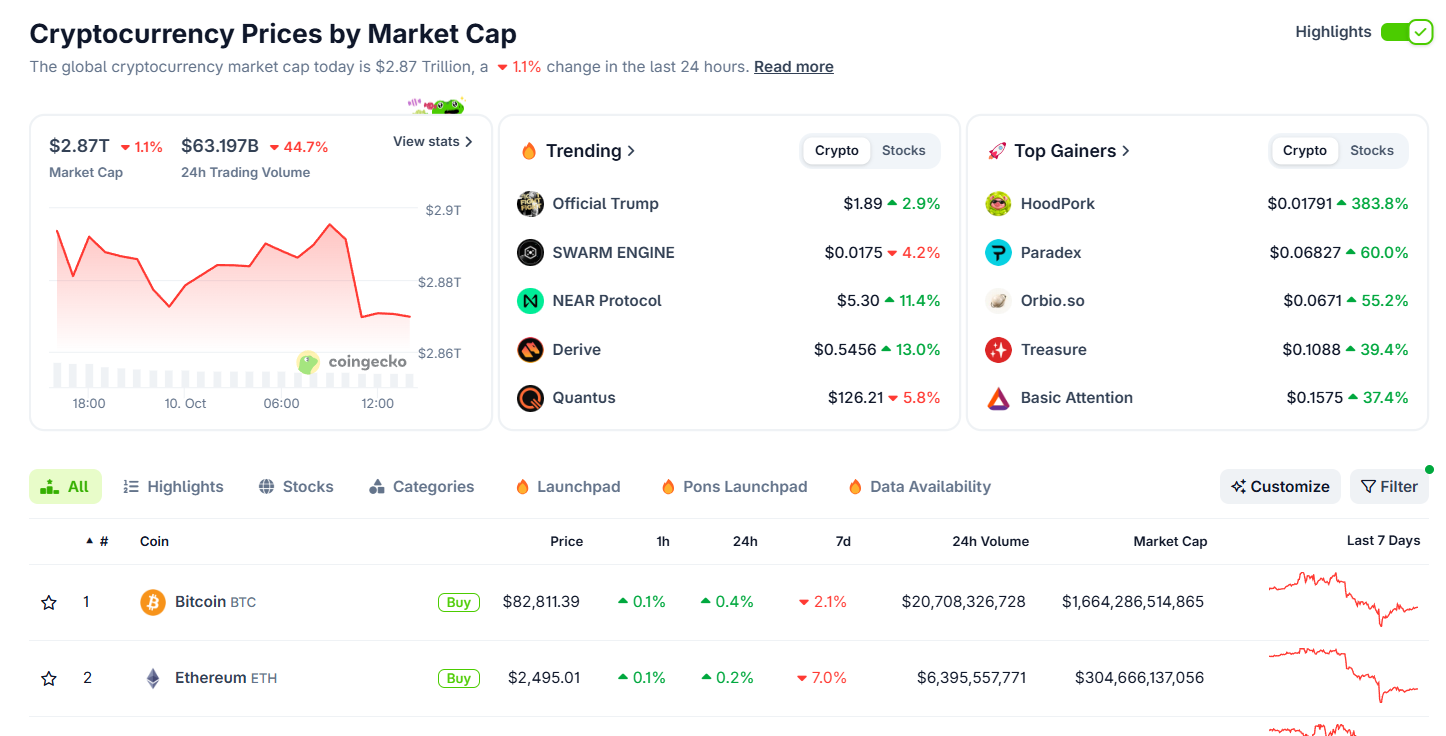
The total crypto market value, which had shed approximately $200 billion from its peak to its lowest point during the sell-off, rebounded to about $2.8 trillion by week’s end. This recovery, while significant, left several large tokens below their recent highs, indicating that the damage was not fully reversed. Ethereum (ETH) recovered towards $2,500 after briefly dipping to $2,400, while XRP moved from $1.34 to around $1.41. Stellar (XLM) posted the steepest decline among major tokens at 13.5%, further emphasizing the uneven nature of the market correction. The bounce restored some lost value, yet the underlying sentiment remained cautious, with investors closely monitoring for signs of sustained recovery or further downside risk.
Altcoin Resilience: NEAR Protocol and Monero Under the Microscope
The contrasting performance of NEAR Protocol and Monero against the backdrop of a broader market downturn warrants a closer examination. NEAR Protocol’s remarkable 91.7% surge in the preceding month, followed by its subsequent 10%+ gain on October 10th, positions it as a significant outlier. Analysts attribute NEAR’s robust performance to a confluence of factors, including its strong ecosystem development, strategic partnerships, and increasing interest in its underlying technology, particularly its sharding capabilities and developer-friendly environment. Some market observers, referencing broader industry narratives, have also pointed to NEAR’s potential in AI-driven applications, which could be attracting speculative capital seeking high-growth opportunities. The ability of NEAR to sustain its upward momentum despite a market-wide correction suggests strong conviction among its holders and a potentially growing user base, rather than purely speculative trading.
Monero’s comparatively small 1.3% weekly loss also stands out. As a leading privacy coin, Monero’s value proposition is distinct, focusing on fungibility and transaction anonymity. Its price movements are often influenced by different factors than mainstream cryptocurrencies, including global privacy concerns, regulatory discussions around anonymity-enhanced cryptocurrencies (AECs), and its fundamental use cases. The relatively minor decline could indicate a strong holding base among users who value its privacy features, or it could be a result of lower liquidity and trading volumes compared to more actively traded assets, meaning fewer transactions are needed to influence its price. However, its stability in a volatile market suggests a certain level of decoupling, reflecting specific demand that is less sensitive to broader market swings.
Broader Impact and Implications: A Market in Search of Direction
The week’s events underscore a cryptocurrency market grappling with multiple forces. The immediate implication is heightened volatility, reminding investors that even strong upward trends can be punctuated by sharp corrections. The failed attempts by Bitcoin to sustain above $87,000 highlight critical resistance levels that institutional and retail investors are closely watching, indicating a potential ceiling in the near term.
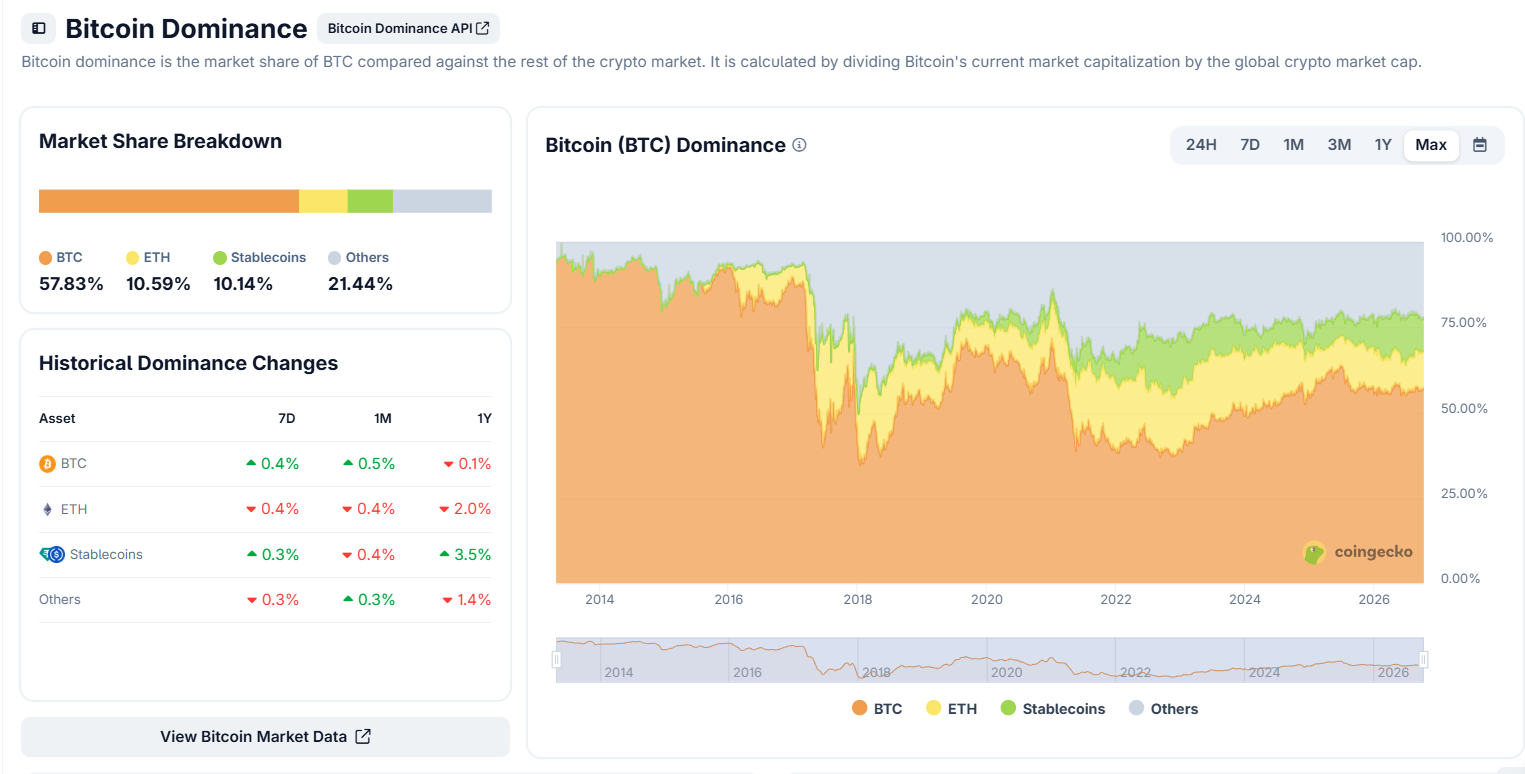
The divergence in performance between Bitcoin and many altcoins, coupled with the relative resilience of NEAR and Monero, suggests a nuanced market. Bitcoin’s increased dominance during the sell-off indicates a flight to quality, where investors consolidate their positions in the largest and most liquid asset during periods of uncertainty. However, the strong performance of specific altcoins like NEAR demonstrates that project-specific fundamentals and emerging narratives (such as AI integration) can still attract significant capital, potentially leading to periods of decoupling from Bitcoin’s price action.
The complex signals from ETF flows further complicate the outlook. While institutional capital remains a crucial driver for market growth, the observed outflows from Bitcoin ETFs suggest that institutional participation is not monolithic and is subject to strategic rebalancing and profit-taking. This implies that while institutional adoption provides legitimacy and liquidity, it also introduces traditional financial market dynamics, including sensitivity to macroeconomic indicators and risk-off sentiment.
Looking ahead, the market appears to be in a phase of consolidation and re-evaluation. Investors will likely monitor macroeconomic data, such as inflation reports, interest rate decisions, and geopolitical developments, which have a significant bearing on risk assets like cryptocurrencies. Regulatory clarity, particularly around stablecoins and digital asset classifications, will also play a crucial role in shaping market sentiment. The resilience shown by certain altcoins could signal a maturing market where fundamental value propositions and technological advancements are increasingly recognized, even amidst broader market corrections. However, until Bitcoin decisively breaks through its key resistance levels and sustained institutional inflows return, the market may continue to experience choppy price action, characterized by quick bounces followed by periods of consolidation or renewed selling pressure. The current environment calls for a cautious yet discerning approach, recognizing both the inherent volatility and the underlying innovation driving specific projects within the digital asset space.














