


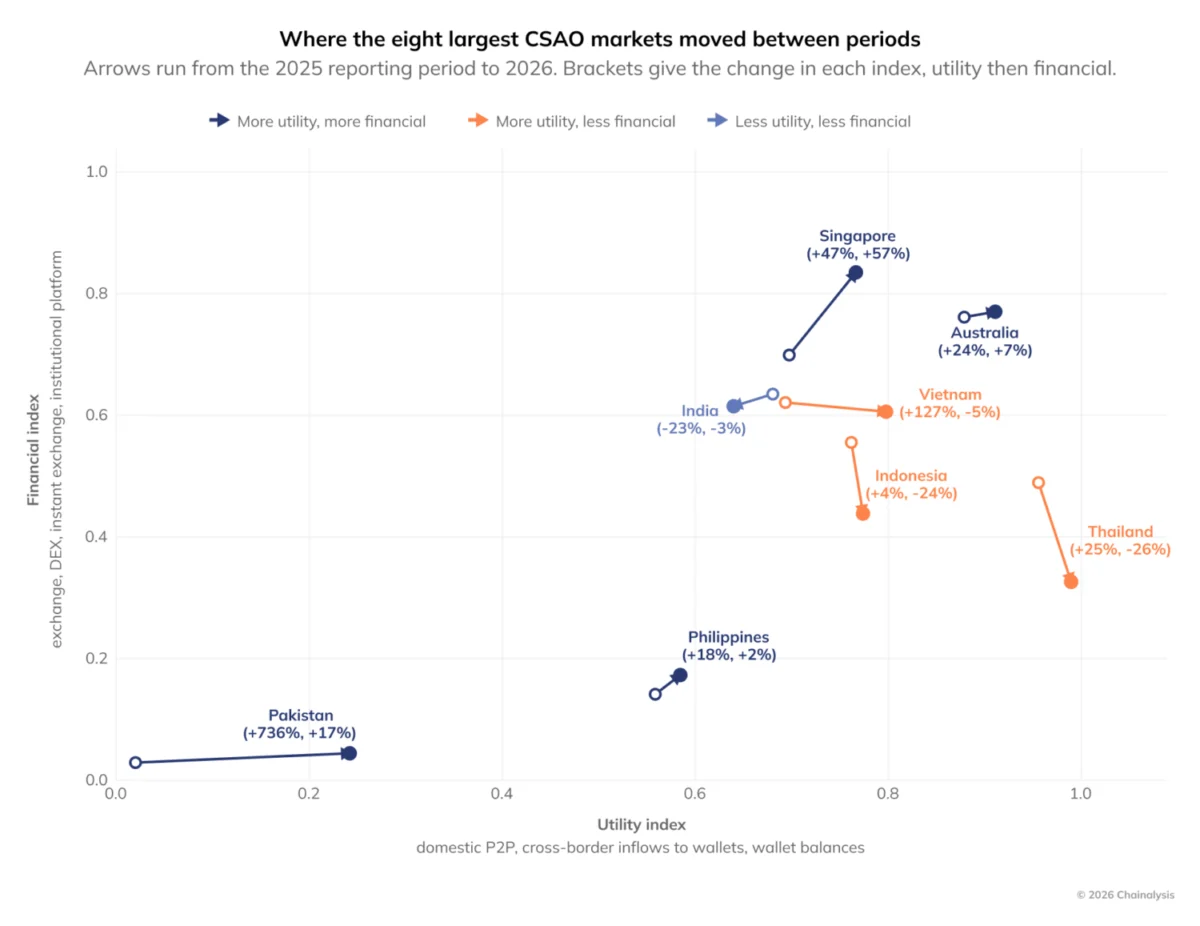
The Central & Southeast Asia and Oceania (CSAO) region, currently ranked as the sixth-largest crypto economy globally, has emerged as a primary case study in the diversification of digital asset utility. While the region’s broader crypto market experienced a 6.8% contraction between July 1, 2025, and June 30, 2026, the underlying data reveals a sophisticated evolution. Far from a uniform decline, the period was defined by localized surges in institutional participation, the maturation of regulatory frameworks, and a pivot toward "blockchain as infrastructure" rather than purely speculative trading. In markets ranging from the high-finance hubs of Singapore and Australia to the remittance-dependent economies of the Philippines and Vietnam, the use of digital assets has increasingly moved toward practical, day-to-day applications.

Regional Economic Performance and Market Leadership
During the 2025-2026 reporting period, Singapore solidified its status as the regional epicenter for digital finance. The city-state recorded a staggering $284 billion in crypto activity, representing a 55.4% increase year-over-year. This growth was not merely a result of retail interest but was driven by a 94% surge in institutional-platform activity, which reached $60 billion. Singapore’s growth profile was notably diverse, characterized by a 30% increase in inflows to centralized exchanges (CEX) and a 69% increase in decentralized exchange (DEX) activity.
Australia followed as the region’s second-largest digital asset economy, processing $173.1 billion in transactions. Although the overall market value in Australia dipped by 5.6%—primarily due to a decline in DEX flows—the institutional sector remained resilient. Activity among custodians, market makers, and over-the-counter (OTC) desks grew significantly, indicating that the Australian market is transitioning into a more structured, professionalized environment.

In contrast, India, which remains a massive market in absolute terms, saw its crypto economy contract by 14.7% during a period characterized by global bearish sentiment and local regulatory friction. Despite this, India recorded $135 billion in activity and maintained its position as the region’s leader in centralized exchange inflows. This suggests that while the pace of growth has slowed, the depth of the investor base remains significant.
A Chronology of the 2025-2026 Cycle
The timeline of the CSAO crypto economy over the past year reflects a shift from speculative volatility to strategic implementation:

- July 2025: The reporting period begins with a general slowdown in global retail activity, though institutional desks in Singapore begin scaling operations.
- November 2024 – March 2025: A pivotal shift occurs in Singapore’s custody landscape. Self-custody of assets drops from 71% to 39% as users move toward regulated institutional services.
- April 2026: Pakistan makes a landmark decision by dropping a seven-year ban that had previously prohibited domestic banks from working with cryptocurrency firms. This leads to a massive 736% rally in utility-based activity off a shallow base.
- June 2026: The reporting period concludes with institutional-platform activity across the region reaching $152.3 billion, accounting for nearly 19% of all regional crypto activity.
The Utility Index: P2P Activity and Remittances
While institutional growth dominated the headlines in developed markets, the "Utility Index"—which measures crypto adoption through practical applications like peer-to-peer (P2P) payments—showed remarkable strength in Southeast Asian emerging markets. The Philippines, Thailand, and Vietnam collectively outperformed global trends in small-value transfers.
These three nations accounted for 5.4 million small-value P2P transfers (defined as transactions under $10,000) during the 2026 period. Remarkably, while these countries represent only 2.5% of the global crypto economy by value, they accounted for 14.4% of the global total for small-value transfers. In these markets, more than 80% of domestic transfers were under $1,000, with an average transfer size of $618—nearly half the global average of $1,210.

Nicole Nguyen, co-founder of APAC DAO, noted that in countries like Vietnam, stablecoins have become an "informal dollar savings vehicle." Residents use these assets to protect their wealth against the depreciation of the local currency, the dong. Furthermore, the large digital nomad and freelance populations in the region have adopted P2P crypto transfers as a more efficient way to receive payments from international clients.
In the Philippines, the fourth-largest remittance market in the world, the shift toward stablecoins is even more pronounced. Nichel Gaba, CEO of the Philippine Digital Asset Exchange (PDAX), estimates that between 5% and 10% of inbound remittances are now settled using stablecoins. This trend is being driven by major remittance companies that are actively seeking to bypass the delays and high fees associated with the traditional SWIFT banking system.

The Stablecoin Dominance in Cross-Border Settlement
A defining feature of the 2025-2026 period was the overwhelming preference for stablecoins in cross-border value movement. Across every market analyzed in the CSAO region, cross-border stablecoin activity exceeded domestic activity. The regional average for this ratio was 3.2 to 1, but in Malaysia, the gap was much wider, with cross-border activity being 29.5 times larger than domestic usage.
David Low, CEO of the Malaysian exchange Hata, explains this disparity by pointing to the efficiency of domestic payment rails. In countries like Malaysia, local digital payment systems are already fast and inexpensive, leaving little room for stablecoins in everyday domestic commerce. However, for international settlements, stablecoins offer a "deployed reality" for corporate treasuries and regional merchants.

Srivatsan Tirumalai, a former executive at Singapore’s UOB, noted that business-to-business (B2B) payments are increasingly moving toward regulated stablecoins. By using these assets, companies can achieve instant settlement, side-stepping the inefficiencies and multi-day delays common in traditional banking corridors.
Institutional Maturation and Regulatory Frameworks
The narrative of the 2026 cycle in Australia and Singapore was one of professionalization. Nicolas Gilardi, head of risk and compliance at BTC Markets, observed that "crypto stopped being a retail story" in 2026. The focus shifted from who was buying to what the asset was being used for—specifically as collateral, for settlement, and as tokenized instruments.

This institutional confidence has been bolstered by significant regulatory milestones:
- Singapore’s Digital Payment Token (DPT) Regime: The Monetary Authority of Singapore (MAS) provided a clear stablecoin regulatory framework, giving institutional participants a stable foundation for developing long-term use cases.
- Australia’s Regulatory Roadmap: The Australian Securities and Investments Commission (ASIC) announced a licensing regime for digital asset platforms and tokenized custody, set to begin in 2027. Additionally, the expansion of AML/CFT laws in 2026 to cover crypto-to-crypto exchanges has increased institutional trust.
- Project Acacia: A joint initiative between the Reserve Bank of Australia and the Digital Finance Cooperative Research Centre, this project explored the use of digital money and tokenized assets in wholesale financial markets.
In India, the market maturation is visible in the investor profile. Ashish Singhal, co-founder of CoinSwitch, reported an influx of investors aged 35 and older with larger portfolios. However, he also highlighted a significant "capital exodus" to offshore exchanges. In 2022, India introduced a 1% tax on crypto transactions at exchanges (TDS). While domestic exchanges comply with this levy, offshore platforms often do not, creating a competitive disadvantage for local firms and driving volume away from domestic oversight.

Broader Impact and Future Implications
The data from the 2025-2026 period suggests that the CSAO region is leading the global transition from viewing crypto as a speculative asset class to viewing blockchain as a foundational infrastructure. The contraction in overall market value belies a deepening of the ecosystem. As Edul Patel, CEO of Mudrex, summarized, the region is moving toward a future where blockchain coordinates supply chains, structures markets, and enables new forms of commerce.
The success of this transition will depend on several factors:

- Regulatory Clarity: Countries that provide clear rules, like Singapore, are seeing massive institutional inflows.
- Infrastructure Quality: The development of supporting infrastructure, such as regulated custody and institutional-grade exchanges, is essential for sustaining growth.
- Integration with Traditional Finance: As seen in Indonesia and Thailand, the increasing engagement between crypto businesses and traditional financial institutions is creating "real use cases" for real-world assets (RWA) and investment tokens.
However, risks remain. Ashwin Chockalingam, CFO at Blox, cautioned that as institutional participation grows, the stakes for the industry rise. A major failure or security breach could significantly damage the hard-won trust of regulators and mainstream users.
In conclusion, the CSAO region’s crypto economy in 2026 is defined by its resilience and diversity. From the institutional powerhouses of Oceania to the P2P-driven markets of Southeast Asia, the region is effectively demonstrating that the value of digital assets lies not just in their price, but in their ability to solve real-world financial inefficiencies. As the region moves toward more regulated and infrastructure-focused models, it sets a precedent for how the global crypto economy might evolve in the coming years.














