



Bitcoin (BTC) experienced a significant price surge, briefly eclipsing the $80,000 mark on Sunday night for the first time since January, before settling back to approximately $79,200. Despite this minor pullback, the flagship cryptocurrency has maintained a modest upward trajectory, registering a gain of about 0.4% over the preceding 24 hours. This recent price action is occurring against a backdrop of escalating institutional interest, which analysts believe could propel Bitcoin towards new highs in the coming months.
Charles Edwards, founder of Capriole Investments, has indicated that Bitcoin is potentially on a trajectory to reach $96,000 by June. This optimistic forecast is underpinned by a substantial increase in institutional demand, which is currently absorbing more than five times the daily supply of newly mined Bitcoin. This imbalance between robust demand and the controlled issuance of new Bitcoin is a key driver of the current bullish sentiment.
The Halving Effect and the Surge in Institutional Accumulation
The dynamics of Bitcoin’s supply have been significantly altered by its fourth quadrennial halving event, which took place in April 2024. Historically, halving events have reduced the rate at which new Bitcoins are created, thereby decreasing the supply and, in theory, increasing the price due to scarcity. Following the April 2024 halving, the daily production of new Bitcoins by miners has stabilized at approximately 450 BTC. This controlled issuance rate is crucial in maintaining a predictable supply growth.
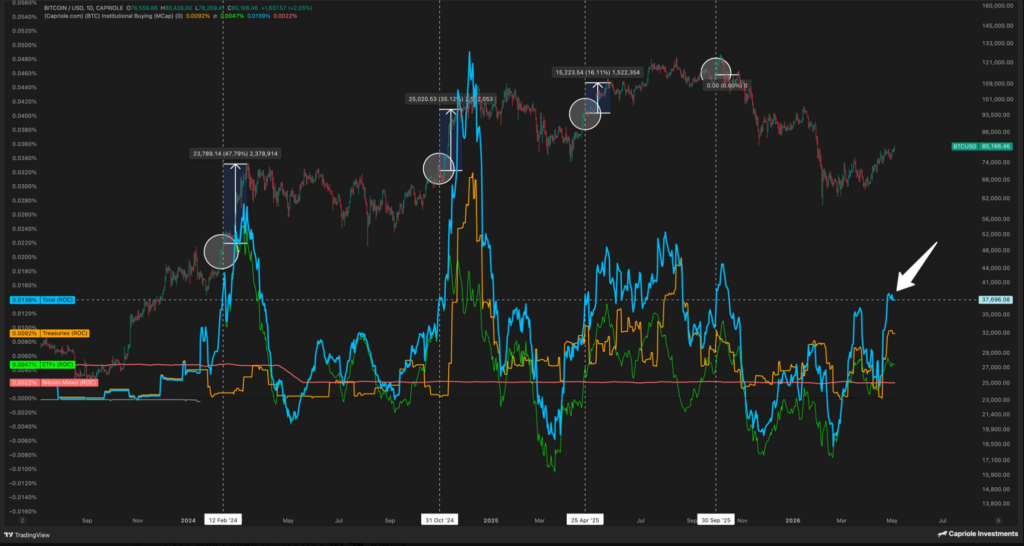
Charles Edwards, in a post on X (formerly Twitter) on May 4th, highlighted the dramatic spike in institutional demand for Bitcoin. He noted that investors are now acquiring over 500% of Bitcoin’s daily mined supply. This extraordinary absorption rate signifies a profound shift in market dynamics. Edwards illustrated this trend with a chart showcasing the rate of change (ROC) for both Bitcoin’s supply and institutional demand. As of Monday, the ROC for the network’s supply remained subdued at around 0.0022%. In stark contrast, the ROC for institutional demand was recorded at approximately 0.0139%. This disparity indicates that buying pressure from institutional investors is accelerating at a pace more than five times faster than the expansion of new Bitcoin supply.

This surge in demand can be attributed to several key factors. The introduction of U.S.-listed spot Bitcoin Exchange-Traded Funds (ETFs) in early 2024 has provided a more accessible and regulated avenue for traditional investors to gain exposure to Bitcoin. These ETFs have witnessed consistent inflows, particularly in April, when they, along with other institutional entities like Michael Saylor’s MicroStrategy, collectively acquired around 70,000 BTC. This figure significantly outpaces the roughly 13,500 BTC mined during the same period, underscoring the overwhelming demand from these sophisticated market participants.
Historical Precedents and Price Projections
Edwards’ analysis goes further, drawing parallels between the current demand-supply imbalance and historical market movements. He points out that periods where institutional demand has exceeded 500% of Bitcoin’s daily issuance have historically been followed by strong upward price performance. In previous instances, Bitcoin has averaged gains of approximately 24% within the subsequent month. If this historical trend holds true, a continuation of the current buying pressure could see Bitcoin’s price approach the $96,000 threshold by June.
"Every time it’s been this high before, price has shot up over the next week," Edwards stated. "The average return in prior cases is +24% over the next 1 month from here, that would take us to around $96K." This projection, while based on historical data, suggests a strong potential for significant upside movement in the near to medium term. The implication is that the market is currently experiencing a supply crunch exacerbated by robust institutional buying, a recipe for sustained price appreciation.
On-Chain Metrics Signal Potential Breakout
Beyond the macro-level analysis of institutional demand, several on-chain metrics are also signaling a potential for a major Bitcoin price breakout. CryptoQuant, a prominent on-chain analytics firm, shared a chart on Monday indicating that Bitcoin has successfully bounced off a key support zone. This resilience is largely attributed to sustained institutional inflows, which are often considered an early indicator of impending upward price movements.

The chart illustrates that Bitcoin has held firm around the average cost basis of investors who entered the market during the initial launch period of Bitcoin ETFs. This price level has now emerged as a critical support area, particularly amidst the current phase of market consolidation. The ability of Bitcoin to find support at this level, even after briefly touching $80,000, suggests underlying strength and a potential for further price appreciation.
The narrative of institutional accumulation driving price action is further reinforced by the behavior of Bitcoin’s holders. Data indicates that long-term holders, who typically exhibit a higher conviction in the asset, have been accumulating Bitcoin, further tightening the available supply. This behavior, coupled with the persistent inflows into ETFs, creates a powerful combination that can lead to significant price rallies.
Market Sentiment and Lingering Skepticism
Despite the overwhelmingly bullish indicators from institutional demand and on-chain metrics, a degree of market skepticism persists. Crypto analyst Matthew Hyland described Bitcoin’s recent push above $80,000 as a "disbelief rally." This term suggests that the move is occurring against a backdrop of lingering doubt among some market participants, who may have been anticipating a price correction.
Hyland’s commentary suggests that those who have been predicting lower prices, such as $60,000, might be caught off guard and could be forced to become bullish later, potentially above $90,000, as the price continues its ascent. This dynamic often characterizes the late stages of a bull run, where initial skepticism gives way to FOMO (Fear Of Missing Out) as prices climb higher.
The current price action, therefore, can be interpreted as a battle between accumulating institutional capital and a segment of the market that remains cautious or bearish. The strength of institutional demand, however, appears to be the dominant force, effectively absorbing selling pressure and providing a solid foundation for future price growth.
Broader Implications and Future Outlook
The sustained institutional interest in Bitcoin has profound implications for the broader cryptocurrency market and the traditional financial landscape. It signals an increasing acceptance of Bitcoin as a legitimate asset class, moving beyond its initial perception as a speculative venture. This institutional adoption can lead to greater market stability, increased liquidity, and wider accessibility for a diverse range of investors.
The current scenario, where institutional demand significantly outstrips new supply, is a powerful testament to Bitcoin’s narrative as a digital store of value, often compared to digital gold. The programmed scarcity, coupled with increasing adoption by major financial institutions, strengthens this narrative.
Looking ahead, the trajectory of Bitcoin’s price will likely remain closely tied to the continuation of these institutional inflows. Factors such as regulatory developments, macroeconomic conditions, and the broader adoption of blockchain technology will also play a crucial role. However, the current data strongly suggests that Bitcoin is poised for further upside potential, with the $96,000 mark by June serving as a key target for many analysts and investors. The market is at a critical juncture, where the confluence of reduced supply and amplified institutional demand is creating a fertile ground for a significant price appreciation, potentially marking a new chapter in Bitcoin’s price history. The coming weeks will be crucial in determining whether this bullish sentiment translates into sustained price momentum, solidifying Bitcoin’s position as a major asset in the global financial ecosystem.














