The digital asset market is currently navigating a pivotal transition as Bitcoin, the world’s largest cryptocurrency by market capitalization, demonstrates signs of technical exhaustion following a period of sustained dominance. Market analysts, including the prominent observer Justcryptopays, have identified a significant breach in Bitcoin’s primary trendline, a development that historically precedes a redistribution of liquidity across the broader cryptocurrency ecosystem. This technical shift comes at a time when Bitcoin is struggling to maintain its footing above the psychologically critical $90,000 threshold, leading to a palpable rotation of capital into alternative digital assets, commonly referred to as altcoins.
As the 2026 calendar year commences, the market is attempting to decouple from the bearish sentiment that defined much of 2025. While Bitcoin remains the primary bellwether for investor sentiment, its recent inability to consolidate gains above $90,000—trading most recently at approximately $90,525—has introduced an element of caution among institutional and retail participants alike. This stagnation in the flagship asset is increasingly viewed not as a market-wide retreat, but as a precursor to an "altcoin season," a phenomenon where Ethereum, Solana, and other high-utility tokens outperform Bitcoin in percentage gains.
Technical Breakdown and the Shift in Market Dynamics
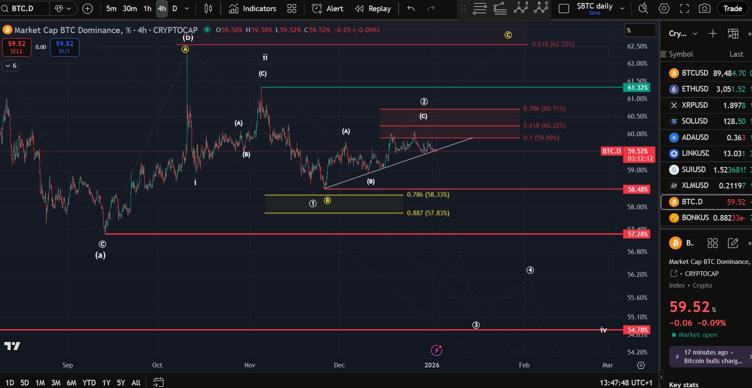
The breach of a key trendline is rarely an isolated event in the cryptocurrency markets; it often serves as a leading indicator of shifting investor priorities. For the better part of the previous year, Bitcoin served as a safe haven amid regulatory uncertainties and macroeconomic fluctuations. However, the recent technical breakdown suggests that the "Bitcoin Dominance" index (BTC.D) may have reached a local ceiling. When Bitcoin’s price stabilizes or retraces after a massive rally, the resulting "sideways" price action often provides the necessary environment for altcoins to thrive.
According to data analyzed by Justcryptopays, the breakdown below the diagonal support line indicates that the aggressive buying pressure that propelled Bitcoin toward the six-figure mark has cooled. For traders, this signal suggests a transition from a "risk-off" approach centered on Bitcoin to a "risk-on" strategy involving more volatile assets. This rotation is fundamental to the crypto-market cycle: capital flows from Bitcoin into large-cap assets like Ethereum (ETH) and Solana (SOL), eventually trickling down into mid-cap DeFi projects and speculative memecoins.
The $90,000 Psychological Barrier
In the world of high-stakes trading, round numbers often act as formidable psychological barriers. The $90,000 mark for Bitcoin has proven to be a significant zone of resistance. Despite several attempts to turn this level into a definitive support floor, the asset has faced consistent selling pressure whenever it nears this valuation.
The struggle at $90,525 highlights a tug-of-war between long-term holders taking profits and new entrants attempting to drive the price toward the elusive $100,000 milestone. When a benchmark asset fails to clear such a high-profile resistance level, capital often seeks "laggard" assets—coins that have not yet experienced their primary breakout during the current cycle. This dynamic is currently benefiting the altcoin sector, which many analysts believe is undervalued relative to Bitcoin’s year-to-date performance.

A Chronology of the Market Transition
To understand the current shift, one must look at the trajectory of the market over the preceding eighteen months.
- Late 2024 to Mid-2025: Bitcoin led the market recovery, driven by the maturation of spot ETFs and institutional adoption. During this phase, altcoins largely remained stagnant, with Bitcoin Dominance climbing to multi-year highs.
- Q4 2025: The market entered a period of "bearish momentum," characterized by regulatory crackdowns in certain jurisdictions and a cooling of the initial ETF hype. Bitcoin’s price began to oscillate in a wide range, failing to set new all-time highs.
- January 2026: As the new year opened, Bitcoin’s technical structure weakened. The breach of the key trendline identified by Justcryptopays served as the formal signal that the "Bitcoin-only" phase of the bull market might be concluding.
- Present Day: Liquidity is visibly moving into the "Total 3" index (the total market cap of all cryptocurrencies excluding Bitcoin and Ethereum). Trading volumes on decentralized exchanges (DEXs) are rising, signaling a renewed appetite for on-chain activity.
The Role of Large-Cap Altcoins: ETH, SOL, and XRP
The primary beneficiaries of this capital rotation are established assets with robust ecosystems. Ethereum (ETH), which has faced criticism over its performance relative to Bitcoin, is seeing a resurgence in interest as developers pivot back to its Layer 2 scaling solutions. As the foundational layer for decentralized finance (DeFi), any rotation into altcoins almost inevitably starts with Ethereum.
Solana (SOL) continues to position itself as a high-performance alternative, capturing a significant share of the retail market through its low transaction costs and burgeoning NFT and memecoin ecosystems. Market data suggests that Solana’s correlation with Bitcoin is beginning to weaken, allowing it to post gains even when Bitcoin remains flat.
Furthermore, legacy assets such as XRP and Cardano (ADA) are attracting "value investors" who believe these tokens are due for a catch-up rally. XRP, in particular, has benefited from increased clarity regarding its legal status, making it a viable candidate for institutional portfolios looking to diversify away from a Bitcoin-heavy concentration.
Emerging Sectors: DeFi, Web3, and Memecoins
Beyond the top ten assets, the rotation is breathing new life into the DeFi and Web3 sectors. After a quiet 2025, protocols focused on decentralized identity, cross-chain interoperability, and AI-integrated blockchain services are seeing a spike in venture capital interest and daily active users.
The memecoin sector, often dismissed as purely speculative, serves as a vital barometer for retail liquidity. The recent uptick in trading volume for leading memecoins suggests that "retail FOMO" (fear of missing out) is returning to the market. While high-risk, the volatility in this sector often provides the "spark" needed to draw mainstream attention back to the crypto space, subsequently benefiting more fundamentally sound projects.
Analyst Perspectives and Market Sentiment
Binance Research has previously suggested that an altcoin rally might be in sight when certain macro indicators align, such as a stabilization in the US Dollar Index (DXY) and a plateauing of Bitcoin’s market share. Current observations align with these theories. While some analysts remain cautious, noting that a significant drop in Bitcoin’s price could still drag the entire market down, the prevailing sentiment is one of "cautious optimism."
"The rotation we are seeing is a healthy sign of market maturation," noted one senior analyst at a leading digital asset firm. "Investors are no longer just buying ‘crypto’ as a monolithic asset class. They are differentiating between the ‘store of value’ utility of Bitcoin and the ‘platform’ utility of altcoins like Solana and Ethereum."
Broader Implications for the 2026 Outlook
The potential for an altcoin resurgence carries broader implications for the digital asset industry. A diversified market is generally more resilient than one dominated by a single asset. If altcoins can successfully shake off the bearish momentum of 2025, it would validate the long-term viability of various blockchain use cases beyond simple value transfer.
For investors, this period requires a strategic rebalancing of portfolios. The transition from a Bitcoin-led market to a more balanced ecosystem presents opportunities for significant gains, but it also increases the necessity for rigorous due diligence. Unlike Bitcoin, many altcoins carry higher project-specific risks, including smart contract vulnerabilities and fluctuating developer activity.
As capital continues to rotate, the focus will likely remain on whether Bitcoin can reclaim its trendline or if it will continue to consolidate, providing the "sideways" price action that altcoins require to mount a sustained rally. The coming weeks will be crucial in determining if the current shift is a temporary fluctuation or the beginning of a definitive "Alt-Season" that will define the crypto landscape for 2026.
Conclusion
The recent technical developments in the Bitcoin chart represent a potential watershed moment for the cryptocurrency market. With the breach of a key trendline and the struggle to maintain the $90,000 level, the stage appears set for a significant redistribution of market power. While Bitcoin remains the undisputed leader of the space, the growing prominence of altcoins suggests a market that is becoming more nuanced and multi-faceted. As 2026 unfolds, the ability of altcoins to maintain this momentum will be the primary narrative for traders and investors worldwide.