



The cryptocurrency market is currently navigating a pivotal transition as Bitcoin, the industry’s primary benchmark, demonstrates signs of technical exhaustion following a period of sustained dominance. Market analysts, including the prominent observer Justcryptopays, have identified a significant breach in Bitcoin’s primary trendline, a development that historically precedes a redistribution of liquidity across the broader digital asset ecosystem. As Bitcoin struggles to maintain its footing above the psychologically critical $90,000 threshold, evidence is mounting that capital is beginning to rotate into altcoins, potentially setting the stage for a renewed "altcoin season" as the market enters the opening stages of 2026.
This shift comes at a time when the total cryptocurrency market capitalization has faced significant volatility. While Bitcoin has traditionally captured the lion’s share of institutional and retail capital, its recent inability to hold key support levels has prompted a reassessment of risk appetite among traders. The movement of funds from the safety of Bitcoin into higher-beta assets like Ethereum, Solana, and various decentralized finance (DeFi) tokens suggests that the market may be moving toward a more decentralized distribution of value, reducing the singular reliance on Bitcoin’s price action to drive market sentiment.
Technical Analysis of the Bitcoin Trendline Breach
The primary catalyst for the current market discourse is Bitcoin’s recent descent below a multi-month ascending trendline. For much of the latter half of 2025, this trendline served as a reliable floor for price action, reinforcing the "buy the dip" mentality among institutional holders. However, the recent breakdown indicates a fundamental shift in momentum. When a flagship asset like Bitcoin breaks a primary trendline, it often signals that the preceding trend—in this case, aggressive Bitcoin dominance—has reached a point of saturation.
Currently trading around the $90,525 mark, Bitcoin’s struggle to reclaim and hold the $90,000 level is of particular concern to technical analysts. In the world of high-frequency trading and institutional algorithms, $90,000 represents more than just a number; it is a psychological "line in the sand." Failure to consolidate above this level often leads to a "sideways" market for Bitcoin, which historically provides the necessary stability for altcoins to begin their own independent rallies.
Justcryptopays notes that this specific type of price action—where Bitcoin moves horizontally or slightly downward while volatility remains high—creates a vacuum that altcoins are often quick to fill. As Bitcoin’s volatility relative to its price decreases, traders seek higher returns in assets with lower market caps, leading to the "rotation" phenomenon currently observed in exchange order books.
The Mechanics of Capital Rotation
Capital rotation in the cryptocurrency market typically follows a well-documented hierarchy. It begins with Bitcoin, moves into Ethereum (the "large-cap" leader), flows into high-performance Layer-1 protocols like Solana and Cardano, and eventually trickles down into mid-cap DeFi projects and speculative assets such as memecoins.

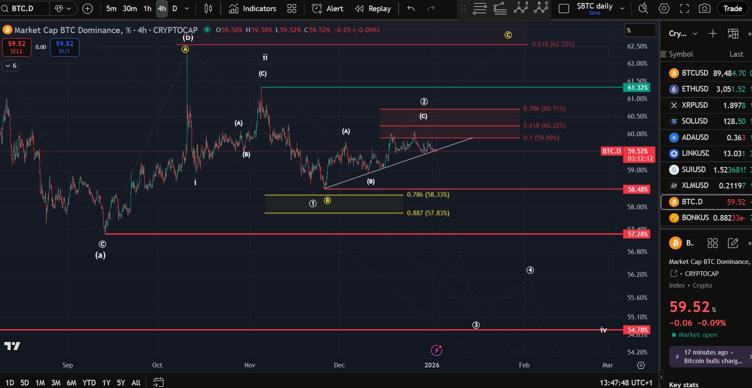
The current market data suggests we are in the early-to-mid stages of this cycle. While Bitcoin’s dominance (BTC.D) has remained high throughout 2025, the recent trendline breach has caused a slight contraction in this metric. Investors are increasingly looking at the "ETH/BTC" and "SOL/BTC" trading pairs to determine if altcoins are gaining value faster than Bitcoin. If these pairs begin to trend upward, it confirms that the market’s "smart money" is reallocating portfolios to maximize gains during the anticipated altcoin resurgence.
This rotation is also fueled by the diversification of investment products. The maturation of spot Bitcoin ETFs has provided a stable base of institutional capital, but the subsequent approval and integration of Ethereum and potentially Solana-based financial products have created regulated pathways for capital to exit Bitcoin and enter the altcoin market without leaving the digital asset ecosystem entirely.
Performance Outlook for Leading Altcoins: Ethereum, Solana, and Beyond
As 2026 begins, the focus is shifting toward how major altcoins will "shake off" the bearish momentum that characterized much of the previous year. Ethereum (ETH), despite facing criticism over its scaling roadmap and competition from faster chains, remains the foundational layer for the majority of decentralized applications. Analysts suggest that if Ether can break through its own resistance levels, it will serve as the primary signal for a broader altcoin rally.
Solana (SOL) continues to be a formidable competitor, often leading the market in terms of daily active users and transaction volume. Its ability to attract "retail" interest through its vibrant memecoin ecosystem and high-speed DeFi protocols makes it a primary beneficiary of capital rotating out of Bitcoin. Unlike Bitcoin, which is increasingly viewed as "digital gold" or a store of value, Solana and Ethereum are viewed as "digital oil," powering the infrastructure of Web3.
Other assets positioned for a potential resurgence include:
- XRP and Cardano (ADA): These "legacy" altcoins often see late-cycle surges as older participants in the market re-enter positions based on regulatory clarity and long-term development milestones.
- Chainlink (LINK): Recently noted for breaking its 21-day Moving Average (MA), LINK serves as a critical infrastructure play. Its performance is often a leading indicator for the health of the DeFi sector.
- Emerging DeFi and Web3 Tokens: As the narrative shifts from simple price appreciation to actual utility, tokens associated with decentralized identity, AI-integrated blockchain services, and cross-chain interoperability are expected to see increased trading activity.
Historical Context and Market Chronology
To understand the current shift, it is essential to look at the market’s trajectory over the past 24 months.
- Early 2024: The market saw a massive influx of capital following the approval of spot Bitcoin ETFs, driving BTC to new all-time highs and establishing the $70,000 to $80,000 range.
- Mid-to-Late 2025: Bitcoin dominance peaked as institutional investors favored the security of the flagship asset amidst global macroeconomic uncertainty. However, this led to a "stagnant" altcoin market where many tokens lost 50-70% of their value against BTC.
- Late 2025 (The Turning Point): Bitcoin reached the $90,000 to $100,000 range but failed to find the liquidity necessary to push into six-figure territory. This exhaustion coincided with the trendline breach identified by Justcryptopays.
- Early 2026: The current phase is characterized by a "rebalancing." Investors who took profits on Bitcoin are now looking for undervalued assets that underperformed in 2025, leading to the current rotation.
This chronology mirrors previous cycles, most notably the 2020-2021 bull run, where Bitcoin led the initial charge before handing the baton to Ethereum and the subsequent "DeFi Summer."
Institutional and Regulatory Implications
The transition toward an altcoin-heavy market is not happening in a vacuum. The regulatory landscape in 2026 has become significantly more defined than in previous years. In the United States and Europe, clearer guidelines regarding the classification of digital assets have reduced the "fear factor" for institutional desks looking to trade altcoins.
Inferred reactions from institutional liquidity providers suggest a growing comfort with diversified crypto portfolios. While Bitcoin remains the "anchor" asset, the inclusion of altcoins is increasingly seen as a way to achieve "alpha" (returns above the market average). If the altcoin market can maintain its current momentum, it may signal to regulators that the industry has matured beyond a single-asset class, potentially paving the way for more diverse exchange-traded products.
However, the "bearish momentum of 2025" mentioned by analysts remains a hurdle. Many altcoins are still recovering from deep drawdowns, and "overhead resistance"—where previous buyers look to break even and sell—could slow the pace of the rally. For a true altcoin season to take hold, these assets must not only rise in dollar value but also outperform Bitcoin on a percentage basis over a sustained period.
Broader Impact and Market Volatility
As capital continues to rotate, investors should prepare for increased volatility. Altcoins are inherently more volatile than Bitcoin due to their lower liquidity and smaller market capitalizations. While this presents opportunities for significant short-term gains, it also carries a higher risk of rapid "flush-outs."
The shift toward a more "balanced market," as described by market observers, is generally considered a healthy development for the long-term viability of the ecosystem. A market where only Bitcoin thrives is often fragile; a market where multiple protocols and tokens find value suggests a robust and diversifying economy.
As we move further into 2026, the key metrics to watch will be Bitcoin’s ability to reclaim the $90,000 level and the volume of capital flowing into Ethereum and Solana. If Bitcoin remains suppressed while altcoin volume rises, the "Altcoin Awakening" will move from a theoretical possibility to a market reality. Strategic investors are already positioning themselves, moving away from the safety of the "benchmark" and toward the emerging opportunities in the broader digital asset landscape.














