



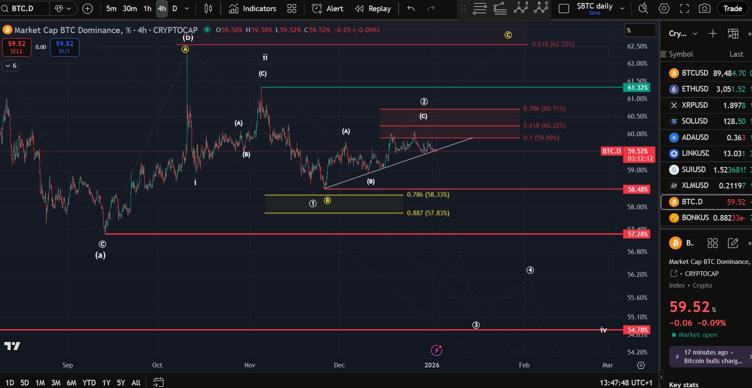
The cryptocurrency market is currently witnessing a significant technical shift as Bitcoin, the world’s largest digital asset by market capitalization, has broken below a critical long-term trendline. This development, highlighted by market analyst Justcryptopays, suggests that the period of absolute Bitcoin dominance may be yielding to a broader market expansion. As capital begins to rotate from the flagship cryptocurrency into various altcoin ecosystems, investors are closely monitoring whether this movement signals the beginning of a sustained "altcoin season." The transition comes at a pivotal moment as the industry seeks to distance itself from the bearish volatility that characterized much of 2025, positioning the first quarter of 2026 as a potential turning point for digital asset valuations.
The Technical Breakdown of Bitcoin’s Market Position
For much of the previous year, Bitcoin served as the primary safe haven for crypto-focused capital, outperforming the majority of the market. However, recent technical indicators suggest a cooling of this momentum. The break below the established trendline is more than a simple price fluctuation; it represents a breach of a support structure that has historically dictated the pace of the market’s upward trajectory. When Bitcoin loses such a key technical level, it often leads to a period of consolidation or a slight retracement, which in turn provides the necessary liquidity for investors to seek higher returns in alternative assets.
At the center of this shift is Bitcoin’s struggle to maintain its position above the $90,000 psychological threshold. While the asset has hovered around the $90,525 mark, its inability to decisively claim and hold higher ground has introduced a sense of caution among institutional and retail traders alike. In technical analysis, psychological levels such as $90,000 act as significant barriers. A failure to consolidate above this price point often results in capital "bleeding" into altcoins, as traders look for assets that have not yet reached their local peaks.
Analyzing the Mechanics of Capital Rotation
Capital rotation is a well-documented phenomenon in the cryptocurrency markets. It typically follows a specific hierarchy: capital flows first into Bitcoin, then into large-cap assets like Ethereum and Solana, before trickling down into mid-cap projects, Decentralized Finance (DeFi) protocols, and eventually high-risk memecoins. The current market data suggests we are entering the second phase of this cycle.
As Bitcoin’s dominance (BTC.D) begins to waver, the beneficiary is often the "altcoin market cap," which excludes Bitcoin’s valuation. This rotation is driven by the search for "alpha"—returns that exceed the market average. With Bitcoin having already seen substantial gains over the last cycle, the mathematical probability of a 2x or 3x return is often perceived as higher in established altcoins with lower market caps. This shift is currently being reflected in the rising trading volumes of assets like Ethereum (ETH), Solana (SOL), and Ripple (XRP), which are beginning to decouple from Bitcoin’s immediate price action.
Historical Context: From the Bearish 2025 to a New 2026 Outlook
To understand the significance of the current market shift, one must examine the backdrop of 2025. The previous year was marked by a series of macroeconomic headwinds, including fluctuating interest rates and regulatory uncertainties in major jurisdictions. These factors contributed to a bearish sentiment that kept altcoins suppressed, even while Bitcoin managed to hit new milestones. Many altcoins saw their valuations drop by significant percentages against their Bitcoin pairs, leading to a state of extreme undervaluation.

The start of 2026 represents a psychological "reset" for the market. Analysts observe that the bearish momentum of the previous year is finally exhausting itself. This exhaustion is a prerequisite for a trend reversal. As the "weak hands" have been shaken out during the 2025 downturn, the remaining holders are often long-term believers or institutional entities. This creates a supply-side liquidity crunch; when demand returns to the altcoin sector, the lack of available sell-side liquidity can lead to rapid, parabolic price increases.
The Resurgence of Major Altcoins: ETH, SOL, and XRP
As capital rotates, several key assets are positioned at the forefront of the anticipated resurgence.
Ethereum (ETH) and the DeFi Ecosystem
Ethereum remains the primary barometer for the altcoin market. Despite facing stiff competition from newer Layer 1 blockchains, Ethereum’s transition to a more scalable roadmap and its continued dominance in the DeFi and NFT sectors make it the first stop for rotating capital. If Ethereum can maintain its strength against its BTC pair (ETH/BTC), it historically serves as the "green light" for the rest of the altcoin market to rally.
Solana (SOL) and High-Performance Networking
Solana has emerged as a formidable challenger, often leading market recoveries due to its high throughput and growing developer ecosystem. Its ability to attract retail interest through low-cost transactions and a vibrant memecoin culture has made it a primary destination for speculative capital. Analysts note that Solana’s price action often front-runs broader altcoin rallies, making it a critical asset to watch in the coming months.
XRP, Cardano (ADA), and Regulatory Clarity
Other "legacy" altcoins like XRP and Cardano are also seeing renewed interest. For XRP, the resolution of long-standing legal challenges has provided a clearer path for institutional adoption. Cardano, meanwhile, continues to focus on rigorous academic development and governance, appealing to a different demographic of long-term investors. The inclusion of these assets in the rotation suggests that the current move is broad-based rather than limited to a single niche or sector.
The Role of Emerging Sectors: Web3, DeFi, and Memecoins
Beyond the top-ten assets, the rotation is reaching into specialized sectors. Web3 infrastructure tokens, which provide the backbone for decentralized internet services, are seeing a spike in utility-driven demand. Similarly, the DeFi sector, which saw a contraction during the 2025 bear market, is showing signs of life as yields become more attractive compared to traditional financial instruments.
Perhaps most surprisingly, the memecoin sector remains a significant factor in market dynamics. While often dismissed as purely speculative, memecoins serve as a gateway for retail liquidity. The "wealth effect" generated by successful memecoin trades often flows back into more fundamental projects, creating a feedback loop that benefits the entire ecosystem. However, this segment also brings increased volatility, which could pose a risk to inexperienced traders during the transition phase.
Institutional Influence and the Impact of ETFs
A major difference between the current market cycle and those of the past is the presence of institutional infrastructure. The approval and integration of Bitcoin and Ethereum Spot ETFs (Exchange-Traded Funds) in various global markets have changed how capital moves. Institutional investors are no longer limited to Bitcoin; they now have regulated pathways to gain exposure to Ethereum and, potentially, other large-cap assets in the near future.
This institutional presence acts as both a stabilizer and a catalyst. While it may reduce the extreme volatility seen in previous "alt-seasons," it also provides a much higher floor for valuations. As institutional portfolios rebalance for the new year, a shift of even a small percentage of Bitcoin holdings into altcoin-based products can result in billions of dollars of buy pressure, further fueling the rotation observed by analysts.
Broader Implications and Market Outlook
The potential shift toward a more balanced market has several implications for the digital asset landscape. First, it suggests a maturing market where Bitcoin is no longer the sole driver of sentiment. A diversified market is generally considered healthier, as it indicates that investors are valuing projects based on their individual merits, technology, and use cases rather than simply following the price of Bitcoin.
Second, the increased volatility associated with altcoin rallies will require heightened vigilance. While the opportunities for gains are substantial, the risks of rapid corrections remain. Investors are advised to look for projects with strong fundamentals, active developer communities, and clear utility to navigate the transition successfully.
As the market progresses through the first quarter of 2026, the focus will remain on whether Bitcoin can reclaim its trendline or if the $90,000 level will continue to act as a ceiling. If Bitcoin enters a period of "sideways" consolidation, it would provide the ideal environment for altcoins to flourish. This "Goldilocks" scenario—where Bitcoin is stable and altcoins are appreciating—is what many market participants define as a true altcoin season.
In conclusion, the break in Bitcoin’s trendline and the struggle at the $90,000 mark appear to be the opening chapters of a new market narrative. With capital rotating into established and emerging digital assets, the stage is set for a dynamic and potentially lucrative year. Vigilant monitoring of technical levels, macroeconomic factors, and ecosystem developments will be essential for those looking to capitalize on the evolving landscape of the cryptocurrency market.














