Large Bitcoin holders, often referred to as "whales," have significantly increased their holdings by accumulating over $4.3 billion worth of Bitcoin in the past 60 days, while smaller investors have divested more than $5 billion. This notable shift in accumulation patterns, as reported by the cryptocurrency analytics firm CryptoQuant, signals a potential divergence in market sentiment and strategy between different tiers of Bitcoin investors. The data, which categorizes investors based on their Bitcoin holdings, reveals a pronounced trend of large-scale acquisition by major players and a simultaneous sell-off by smaller participants.
The analysis from CryptoQuant, shared via their official X (formerly Twitter) account, highlights a distinct behavior among different investor segments. "Fish," defined as wallets holding between 100 and 1,000 BTC, have been actively selling their Bitcoin throughout June and July. This contrasts sharply with the aggressive buying behavior observed among larger entities. The implication of this trend suggests that smaller investors may be looking to realize profits or de-risk their portfolios at current price levels, potentially anticipating a prolonged period of market consolidation or a downturn. This could be a reaction to a buying spree during the first and second quarters of the year, where these smaller players likely acquired Bitcoin in anticipation of a rapid return to bull market conditions, which have not yet materialized.
The cryptocurrency market has experienced a period of relative stagnation for Bitcoin, with the asset trading below the significant $70,000 mark. This lack of substantial upward momentum might be prompting these smaller investors to exit their positions, as profit margins may not be as attractive as initially hoped. The prevailing sentiment appears to be one of cautious optimism among the largest holders, while smaller investors are exhibiting a more risk-averse stance.
Beyond the "whales" and "fish," another significant demographic, the "dolphins" (wallets holding between 1,000 and 10,000 BTC), have also demonstrated aggressive Bitcoin accumulation. In fact, their buying activity has reportedly been even more substantial than that of the whales themselves over the recent months. This parallel behavior between dolphins and whales, and their divergent strategy from the fish, could be interpreted as a strong signal that the long-term market bottom may have been established. This collective confidence from substantial holders suggests a belief in the future appreciation of Bitcoin, potentially fueled by underlying market fundamentals or upcoming catalysts.
The Shifting Landscape of Bitcoin Investment
The current accumulation trend by large Bitcoin holders is occurring against a backdrop of renewed institutional interest in the cryptocurrency, primarily driven by the performance of U.S. spot Bitcoin Exchange-Traded Funds (ETFs). In July, several of the leading spot Bitcoin ETFs, including BlackRock’s iShares Bitcoin Trust (IBIT), have experienced multi-day inflow streaks. On July 20th alone, these exchange-traded funds collectively saw inflows of approximately $227 million. Over a five-day period, these inflows surpassed $700 million, indicating a growing appetite from institutional investors for direct Bitcoin exposure through regulated financial products.

This institutional influx provides a critical counterpoint to the selling pressure from smaller retail investors. The increasing accessibility and perceived legitimacy of Bitcoin through ETFs could be a significant factor bolstering the confidence of larger investors. For whales and dolphins, the stability and regulatory clarity offered by these products might reinforce their conviction in Bitcoin as a long-term asset.
However, a crucial segment of the market remains notably absent from this bullish narrative: the retail investor. While institutional interest fluctuates, the sustained participation of individual retail buyers is essential for driving the cryptocurrency market to new highs. The current stall in Bitcoin’s price action, despite strong institutional inflows and large holder accumulation, suggests that a broader base of demand is still needed to propel the market forward. If retail participation does not pick up significantly, Bitcoin may continue to trade within a range-bound environment in the near future.
Bitcoin’s Recent Price Performance and Market Dynamics
Bitcoin’s price has recently shown signs of stabilization, managing to hold above the critical $60,000 support level. After testing lower support zones between $58,000 and $60,000 earlier in the summer, the cryptocurrency has been trading within the $63,000 to $66,000 range. This consolidation follows a period of underperformance across the last three quarters, during which Bitcoin has struggled to regain its previous all-time highs.
This lackluster performance has reportedly led some short-term speculators to seek opportunities in other, more dynamic markets, such as the booming stock and equities markets. The comparative volatility and perceived higher returns in traditional markets may have diverted capital away from Bitcoin, contributing to its sideways trading. However, the consistent buying by whales and dolphins, coupled with institutional inflows, suggests that a segment of the market remains committed to Bitcoin’s long-term value proposition, irrespective of short-term market fluctuations.
Analyzing the Divergent Investor Strategies
The distinct behaviors of "fish," "dolphins," and "whales" offer valuable insights into the current market sentiment and future expectations. The selling by "fish" could be attributed to several factors. Firstly, these investors may have entered the market during the previous bull run or at elevated price points and are now looking to cut their losses or secure modest profits as the market consolidates. Secondly, a lack of clear upward momentum might lead them to believe that the opportune moment for significant gains has passed, prompting them to reallocate capital to assets with more immediate growth potential. Their definition as holding between 100-1000 BTC places them in a category that is significant enough to influence market dynamics but also potentially more susceptible to herd mentality or short-term market signals compared to the largest holders.
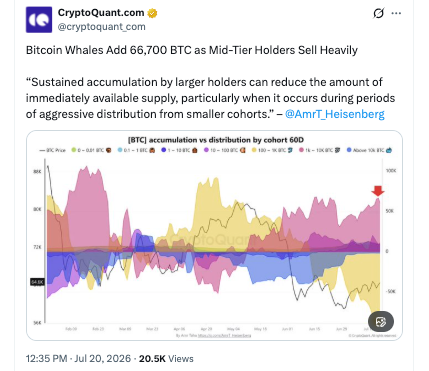
Conversely, the aggressive accumulation by "dolphins" and "whales" points to a strong conviction in Bitcoin’s long-term future. These larger players often possess greater financial resources, more sophisticated analytical tools, and a longer investment horizon. Their continued buying suggests they perceive current price levels as attractive entry points, possibly anticipating a significant price appreciation driven by factors such as increasing institutional adoption, the halving event’s long-term effects, or broader macroeconomic shifts. The fact that dolphins are buying even more aggressively than whales could indicate a strategic allocation within the larger holder community, with mid-tier large holders actively positioning themselves for future growth. This sustained accumulation by substantial investors can act as a stabilizing force in the market, providing a floor for prices and potentially signaling a bottoming-out phase.
The Role of Institutional Capital and Future Outlook
The resurgence of institutional interest through U.S. spot Bitcoin ETFs cannot be overstated. These financial products have democratized access to Bitcoin for a wider array of investors, including pension funds, asset managers, and other institutional entities that previously faced regulatory or operational hurdles. The consistent inflows into these ETFs suggest a growing acceptance of Bitcoin as a legitimate asset class, akin to gold or other commodities. This institutional validation is crucial for attracting further capital and enhancing the overall stability and maturity of the Bitcoin market.
The data from July, showing significant inflows into ETFs like IBIT, underscores this trend. For instance, a five-day streak of inflows totaling over $700 million demonstrates a strong and sustained demand from institutional investors. This influx of capital not only provides direct buying pressure but also signals confidence in Bitcoin’s long-term viability, potentially influencing the investment decisions of other market participants, including larger individual investors.
However, the continued absence of widespread retail participation remains a key concern for sustained market growth. While institutional and large holder buying is significant, a robust retail base is typically essential for pushing cryptocurrencies to new all-time highs. The current market conditions, characterized by Bitcoin trading well below its peak and competing with strong performances in traditional markets, may be deterring many smaller retail investors. For Bitcoin to truly enter another parabolic bull run, a renewed surge in retail interest would likely be necessary to complement the existing institutional and whale accumulation. Without this broader participation, Bitcoin may continue to experience periods of consolidation and sideways movement, despite the positive signals from larger market players. The next few months will be crucial in observing whether retail investors return to the market or if the current trend of large holder accumulation continues without broader market participation. The interplay between these different investor demographics will ultimately shape Bitcoin’s trajectory in the coming year.