



On-chain indicators are signaling a potential turning point in Bitcoin’s prolonged bear market, with a key metric indicating that the current downturn, which has lasted approximately nine months, may be entering its final stages. This optimistic outlook is primarily driven by the observed downward crossover of the Short-Term Holder (STH) and Long-Term Holder (LTH) cost bases, a development highlighted by popular crypto analyst Darkfost. The confirmation of this trend over a 72-hour period, a standard benchmark for validating significant on-chain movements, suggests that the market dynamics are shifting, potentially paving the way for a recovery.
The significance of this STH/LTH cost basis crossover lies in its historical correlation with market bottoms. When the cost basis of short-term holders—those who have held Bitcoin for less than 155 days—falls below that of long-term holders, it suggests that recent buyers are realizing losses, effectively capitulating and driving down the average purchase price for this cohort. This capitulation can be a precursor to a market bottom, as it indicates that selling pressure from newer investors is abating, and remaining holders are more conviction-driven.
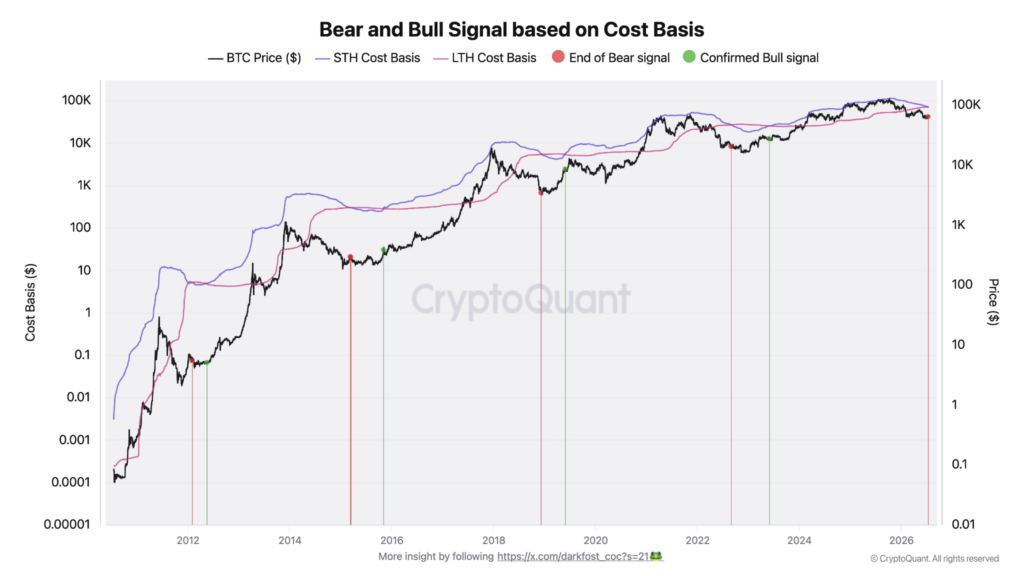
Darkfost, in a detailed analysis shared on social media platforms, emphasized the reliability of this signal. He noted, "The end-of-bear-market signal has just flashed. This signal is defined by the downward crossover of the STH/LTH cost basis (with a 3-day confirmation window to validate the signal)." This technical observation, supported by a visual representation of the cost bases over time, paints a picture of an evolving market landscape. The accompanying graph, illustrating the fluctuating cost bases, shows a dramatic decline in the STH cost basis, from a peak of approximately $112,500 to a current level of around $69,000. This sharp drop signifies that a substantial number of short-term holders acquired Bitcoin at higher prices and have since experienced significant unrealized losses, leading to a capitulation event.
The convergence and subsequent potential dip of the STH cost basis below the LTH cost basis is a critical development. Long-term holders, by definition, have demonstrated a higher degree of conviction, often buying and holding through market cycles. Their cost basis represents a more entrenched support level. When short-term holders’ average entry price falls below this, it suggests that the market is becoming more accessible to new buyers at lower average prices, potentially creating a fertile ground for a Dollar Cost Averaging (DCA) strategy to become particularly effective. DCA involves investing a fixed amount of money at regular intervals, regardless of the asset’s price, which can help reduce the average purchase price over time, especially during volatile or declining markets.
Historical Context of Bitcoin Bear Markets
To understand the current situation, it is crucial to contextualize Bitcoin’s historical market cycles. Bitcoin has historically experienced periods of significant price appreciation, often referred to as bull markets, followed by prolonged downturns, or bear markets. These cycles are often attributed to a combination of factors, including halving events (which reduce the rate of new Bitcoin creation), macroeconomic conditions, technological developments, and investor sentiment.
The current bear market began in earnest in late 2021, following Bitcoin’s all-time highs. Several factors contributed to this prolonged downturn, including rising inflation and interest rate hikes by central banks, the collapse of major cryptocurrency entities like Terra/Luna and FTX, and general global economic uncertainty. This nine-month period of decline has seen Bitcoin’s price drop substantially from its peak, leading to widespread investor concern and a re-evaluation of market trajectories.
Previous Bitcoin bear markets have typically lasted between 12 to 18 months, often characterized by periods of sharp declines followed by protracted sideways movements and eventual recovery. The STH/LTH cost basis crossover has historically been a reliable indicator of the later stages of these bear markets, signaling that the pain of declining prices has reached a point where new buying interest can begin to absorb selling pressure.

Analyzing the Short-Term and Long-Term Holder Dynamics
The distinction between Short-Term Holders (STH) and Long-Term Holders (LTH) is a fundamental concept in on-chain analysis.
- Short-Term Holders (STH): These are investors who have acquired Bitcoin within the last 155 days. Their behavior is often more reactive to market sentiment and price fluctuations. When prices decline sharply, STHs are more likely to sell at a loss to cut their losses, contributing to downward price momentum. A declining STH cost basis indicates that these newer entrants are buying at progressively lower prices, and a significant portion are selling at a loss.
- Long-Term Holders (LTH): These are investors who have held Bitcoin for more than 155 days. They are generally considered more "diamond-handed," possessing stronger conviction in Bitcoin’s long-term value proposition. Their selling activity is typically more strategic and less driven by short-term market volatility. The LTH cost basis represents a more stable and often lower entry point for experienced investors.
The crossover event signifies a critical shift. When the STH cost basis falls below the LTH cost basis, it implies that the average purchase price of recent buyers is now lower than that of the more seasoned holders. This can be interpreted as a sign that the market is being "cleansed" of speculative froth, and that the remaining supply is being accumulated by investors with a longer-term perspective, or that new investors are entering at more attractive price points.
The data suggests that the STH cost basis has indeed fallen from a high of approximately $112,500 to around $69,000. This represents a significant decrease in the average acquisition cost for those who have bought Bitcoin more recently. The overlap, and potential for the STH cost basis to dip further below the LTH cost basis, indicates that the market is entering a terminal phase of the bear market. However, it is crucial to note that this is not an immediate signal of a bull market’s commencement but rather an indication that conditions are becoming more favorable for a potential bottoming process.
The Future Outlook and Potential Implications
The implications of this on-chain signal are significant for investors and the broader cryptocurrency market. While the signal suggests the bear market is nearing its end, it does not guarantee an immediate or sharp recovery. The market could still experience further consolidation or even a final push lower before a definitive bottom is established. Some analysts believe that a dip below the current lows, which have hovered around $58,500, might still be necessary for a clear market bottom to form. Conversely, others are optimistic that the current price levels may represent a viable bottom.
The divergence and subsequent re-convergence of STH and LTH cost bases are key to monitoring the transition to a bull market. A subsequent upward crossover, where the STH cost basis rises back above the LTH cost basis, would serve as a stronger confirmation of the onset of a bull market. However, this process can be lengthy, potentially taking months or even over a year to materialize. Patience and careful observation of these on-chain metrics will be crucial for investors looking to navigate this phase.
Despite the cyclical nature of Bitcoin markets, some critics have argued that the traditional four-year cycle, often linked to halving events, may be weakening or becoming obsolete due to increased institutional adoption, evolving regulatory landscapes, and broader macroeconomic influences. However, the current on-chain data, particularly the enduring relevance of the STH/LTH cost basis dynamic, suggests that fundamental investor behavior and cyclical patterns may still hold significant sway in the Bitcoin market. This resilience in cyclical investor behavior indicates that, at least for Bitcoin, the established rhythms of market cycles may continue to play out, albeit potentially with modified characteristics.
The current situation underscores Bitcoin’s ongoing maturation as an asset class. As it evolves, it faces new challenges and opportunities, influenced by a complex interplay of technological advancements, regulatory scrutiny, and global economic forces. The observed on-chain signals provide valuable insights into the underlying health of the network and the behavior of its participants, offering a data-driven perspective on the potential trajectory of Bitcoin’s price movements.
Broader Market Impact and Investor Sentiment
The potential end of the nine-month bear market carries significant implications for investor sentiment. A sustained period of declining prices can lead to disillusionment and a withdrawal of capital from the crypto market. However, signs of a bottoming process can rekindle optimism and attract new investment.
The current macroeconomic environment, characterized by concerns about inflation and interest rates, continues to play a crucial role in shaping the broader financial markets, including cryptocurrencies. Any shifts in central bank policies or significant economic developments could either accelerate or decelerate Bitcoin’s recovery.
Furthermore, regulatory clarity and developments surrounding the approval of Bitcoin-related financial products, such as spot Bitcoin Exchange-Traded Funds (ETFs), could also significantly influence market dynamics. Positive regulatory news or approvals could act as catalysts for increased institutional and retail adoption, further bolstering a potential bull market.
The analysis of STH and LTH cost bases provides a granular view of market health, complementing broader market sentiment indicators. As the cost basis for short-term holders continues to decline, it suggests a gradual shift from speculative, short-term trading to more fundamental accumulation. This could lead to a more sustainable and robust recovery when it eventually occurs.
In conclusion, while the path forward for Bitcoin remains subject to various influencing factors, the on-chain data, particularly the STH/LTH cost basis crossover, offers a compelling argument for optimism. The signal suggests that the prolonged bear market may be entering its final, most challenging phase, where capitulation by newer investors paves the way for a potential market bottom. Investors are advised to monitor these key on-chain metrics closely, alongside broader market and macroeconomic trends, as Bitcoin navigates this critical juncture. The long-term conviction of LTHs, coupled with the potential for new entrants to acquire Bitcoin at lower average prices, could lay the groundwork for a future recovery and the commencement of a new bull cycle.














