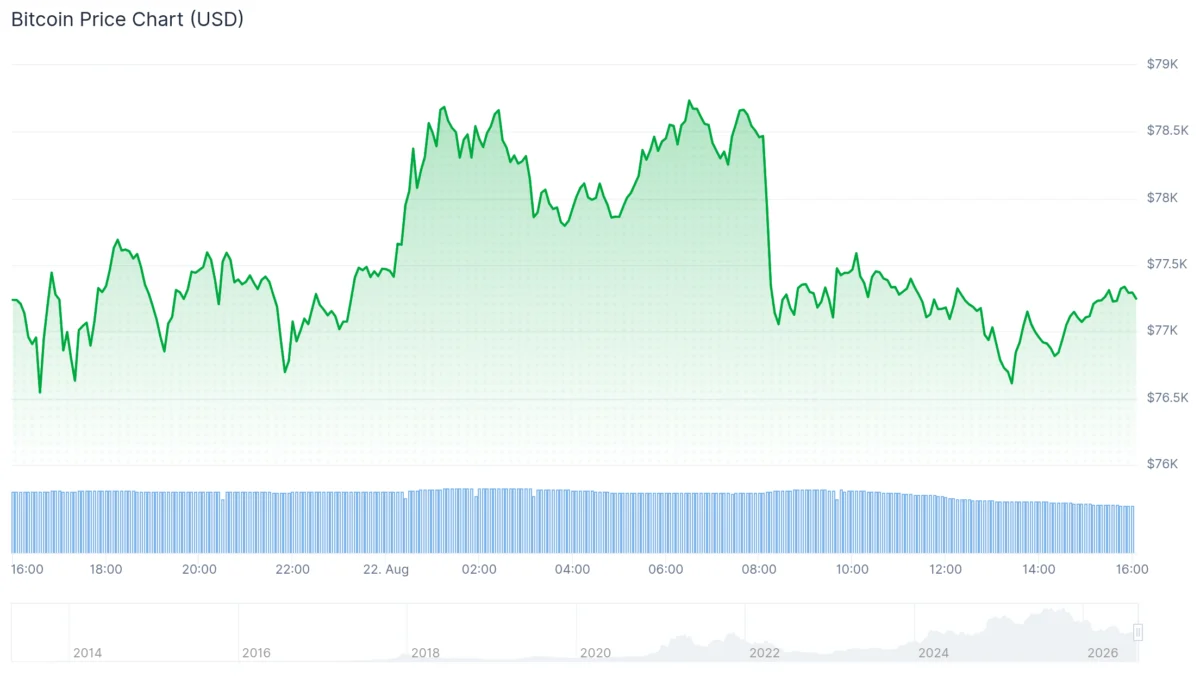
Bitcoin, the world’s leading cryptocurrency, has recently displayed clear signs of exhaustion following a vigorous surge that propelled its price tantalizingly close to the $80,000 mark. This remarkable rally saw the digital asset gain more than $15,000 within a mere 48 hours, a testament to intense buying pressure. However, the momentum faltered as sellers emerged, effectively rejecting a sustained breakout above this critical psychological and technical resistance level. Currently, Bitcoin is trading near $77,325, navigating an intraday range between $76,400 and $78,763. This recent pullback has ignited discussions and raised concerns among market participants about a potential price correction, especially given that the preceding advance represented one of Bitcoin’s strongest weekly performances since the beginning of 2024.
The underlying strength of this rally has been attributed to several key factors, primarily sustained inflows into spot exchange-traded funds (ETFs) in the United States and evolving expectations regarding US liquidity conditions. These elements have provided a robust foundation for Bitcoin’s upward trajectory. Despite these supportive macroeconomic and structural drivers, the emergence of heavy whale selling, coupled with stretched momentum indicators and a rapidly escalating "market greed" sentiment, suggests that many traders are now actively protecting their accumulated gains. These converging signals place the pivotal $80,000 resistance level, and subsequent support zones, under heightened scrutiny as the market grapples with potential volatility.
The Rapid Ascent and Subsequent Rejection
The recent price action saw Bitcoin stage a sharp and decisive advance from the mid-$60,000 area. This impressive move culminated on Friday, when Bitcoin touched $79,463, marking its highest price point since May. However, this peak proved unsustainable, and the cryptocurrency subsequently relinquished the $78,000 level. Data from TradingView indicates a substantial 24.27% weekly gain, a figure that, while impressive, leaves late buyers vulnerable should the market’s bullish momentum dissipate. The speed of this ascent is a double-edged sword: it attracts significant attention and capital, but also creates conditions ripe for profit-taking and technical pullbacks.

This rapid appreciation has been fueled by a confluence of factors. Foremost among them are the unprecedented inflows into US-based spot Bitcoin ETFs. These investment vehicles, which launched earlier in the year, have democratized access to Bitcoin for institutional investors and traditional finance players. On Thursday alone, US Bitcoin ETFs attracted a staggering $606.3 million in net inflows, contributing to an impressive weekly total of approximately $1.61 billion. These consistent inflows underscore a growing institutional appetite for Bitcoin, signalling a maturing market and increased mainstream adoption. Institutions, ranging from hedge funds to wealth managers, are increasingly allocating capital to digital assets, viewing Bitcoin as a legitimate part of a diversified portfolio.
Beyond direct spot demand, a significant catalyst for the rally was widespread short covering. Over a three-day period from Wednesday through Friday, more than $4.3 billion in crypto shorts were liquidated across various exchanges. This phenomenon occurs when the price of an asset rises sharply, forcing traders who bet against it (short sellers) to buy back the asset to cover their positions and prevent further losses. This "mechanical buying" can create a powerful feedback loop, accelerating price increases far beyond what spot demand alone might achieve. However, this type of buying is inherently transient, fading once leveraged bearish positions are closed, which often leaves the market susceptible to corrections once the artificial demand subsides.
Mounting Pressure from Whale Selling and Technical Overextension
As Bitcoin approached the formidable $80,000 resistance, an observable increase in selling activity from large holders, often referred to as "whales," began to exert downward pressure. On-chain analytics firm Lookonchain tracked a notable instance of such selling, reporting that one unidentified address offloaded an additional 2,700 BTC, valued at approximately $211.8 million, on Saturday. This same wallet had previously sold 7,700 BTC, worth an estimated $576.6 million, over the preceding three days. Such concentrated selling by major entities can significantly impact market dynamics, especially when order books are relatively thin after a rapid ascent, as these large transactions can quickly absorb available buy-side liquidity.
Further evidence of whale activity includes a separate wallet, identified by its ending address "bc1qqt," which sold 550 BTC for $39.43 million, locking in an estimated $4.5 million in profit. While these individual sales do not definitively confirm the initiation of a sustained Bitcoin price correction, they collectively indicate a clear trend of profit-taking near a major resistance zone following a period of rapid price repricing. This behavior is typical for large holders who strategically manage their positions, often reducing exposure after significant gains to mitigate risk. The influx of supply from these large sales directly counters the demand generated by ETF inflows and other market participants, creating a critical tug-of-war at key price levels.
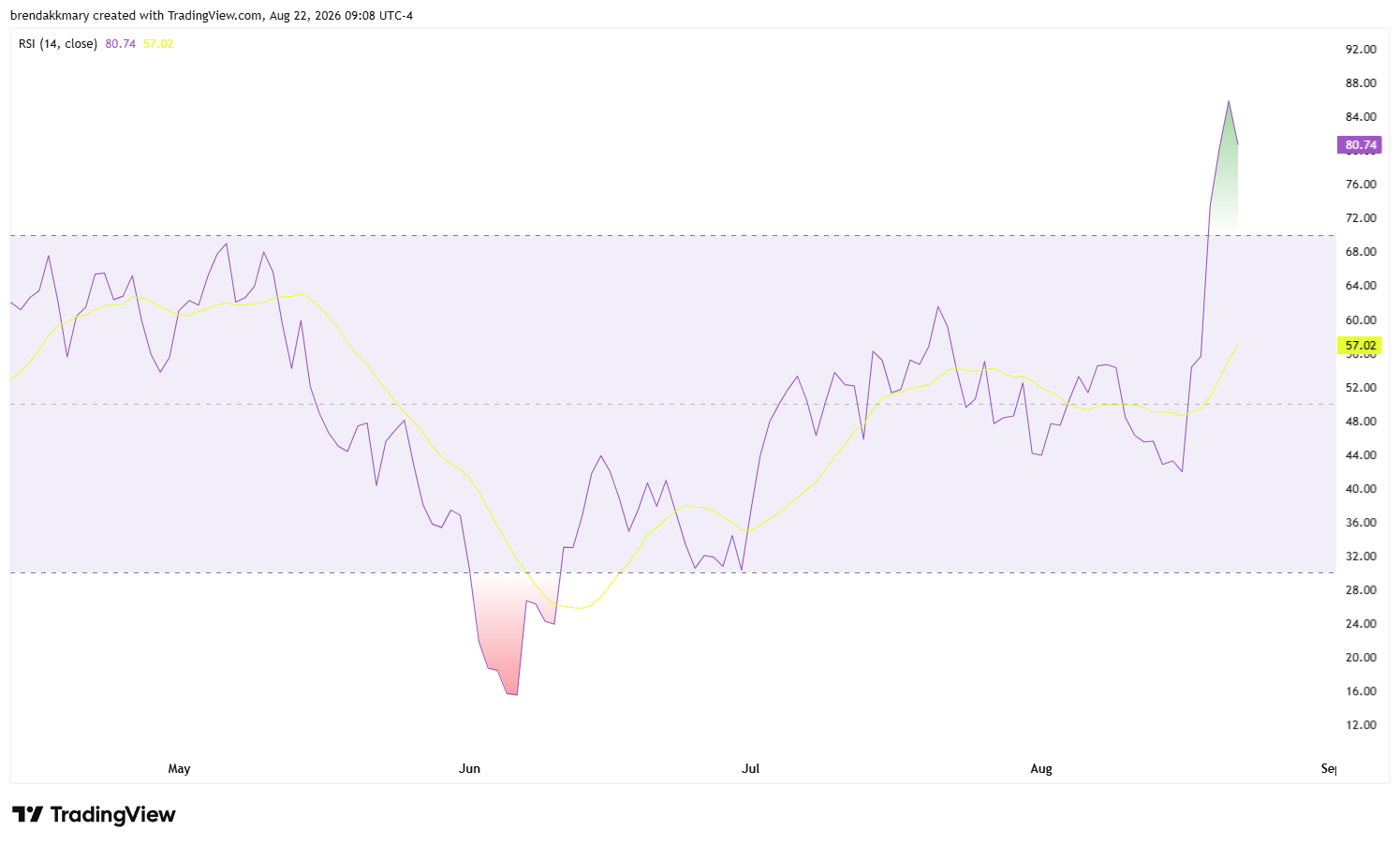
Compounding the pressure from whale selling are the signals emanating from various momentum gauges, which collectively point to an overextended market. Bitcoin’s four-hour Relative Strength Index (RSI) surged to an unprecedented level of 87 during Friday’s push towards $79,700. Similarly, the Money Flow Index (MFI) reached its maximum reading of 100. Both indicators were deep within "overbought" territory, suggesting that the asset’s price had risen too quickly and might be due for a pause or reversal. The RSI measures the speed and change of price movements, with readings above 70 typically interpreted as overbought conditions, while MFI incorporates volume into its calculation, providing a similar but often more robust indication of buying and selling pressure.
While it is true that during exceptionally strong trends, overbought RSI signals can persist for extended periods as prices continue to climb, their presence in conjunction with significant whale selling and a major resistance level amplifies the potential for a correction. The market sentiment has also shifted dramatically in a short span. The Crypto Fear and Greed Index, a composite metric reflecting various market behaviors, recorded a reading of 71, categorized as "greed." This stands in stark contrast to just one week prior, when the index registered a mere 34, indicating "fear." This dramatic 37-point swing within a week illustrates how rapidly caution transformed into widespread enthusiasm, often a precursor to increased market fragility and vulnerability to negative news or profit-taking waves.
Critical Support and Resistance Levels
The current market juncture places particular emphasis on key price levels that will dictate Bitcoin’s immediate trajectory. The $80,000 mark remains the most formidable resistance. A decisive breach of this level, sustained by continued robust spot demand, would significantly weaken the case for an imminent Bitcoin price correction and could open the door for further upward movement toward new all-time highs. Such a breakthrough would require sufficient buying pressure to absorb the ongoing profit-taking from both whales and short-term traders.
Conversely, the market’s ability to hold critical support levels is paramount. The immediate breakout zone, ranging from $75,000 to $76,000, is now a crucial battleground. Should Bitcoin fail to maintain this level, it would signal a loss of short-term control by buyers, potentially paving the way for sellers to gain dominance. A deeper retreat would likely see the broader $70,000 to $72,000 area become the next significant support zone. This range is psychologically important and has historically served as a strong foundation during previous market uptrends. A sustained move below these levels would confirm a more significant correction, potentially unwinding a substantial portion of the recent gains.
Broader Market Implications and External Factors
The interplay between institutional demand and profit-taking is a defining characteristic of the current Bitcoin market. The consistent inflows into US Bitcoin ETFs provide a powerful counterweight to the selling pressure from individual whales. However, the equilibrium between these forces is delicate. Should ETF inflows decelerate or reverse, the market’s ability to absorb whale supply would diminish, thereby increasing the risk of a Bitcoin price correction, particularly if the $76,000 support level is breached.
External macroeconomic factors also continue to play a crucial role. The US Treasury’s plans to double long-dated bond buybacks to at least $4 billion per operation are significant. This policy is generally expected to exert downward pressure on bond yields and potentially weaken the US dollar. Lower yields and a softer dollar typically enhance the attractiveness of scarce assets like Bitcoin, as investors seek higher returns and inflation hedges. Changes in global liquidity conditions, influenced by central bank policies, directly impact risk appetite and capital flows into digital assets. Therefore, shifts in these macroeconomic expectations can either bolster or undermine Bitcoin’s current valuation.
Finally, while market analysis often focuses on technicals and on-chain data, social sentiment also weaves its way into market discourse. The recent comment by financial personality Jim Cramer, recommending Bitcoin over Bitmine stock, added a peculiar social-media talking point. Cramer’s market calls have gained a meme-like status, with many traders jokingly advocating for an "inverse Cramer" strategy. While this "inverse Cramer" meme is not a measurable market indicator and provides no factual evidence about price direction, support, volume, or liquidity, its widespread discussion highlights the prevailing sentiment and the often-humorous ways in which market participants process information and react to public figures.
In conclusion, Bitcoin stands at a critical juncture. The rapid ascent to near $80,000 demonstrated immense underlying demand, largely driven by institutional ETF inflows and favorable liquidity expectations. However, this powerful rally has been met with significant profit-taking from large holders and a clear indication of technical overextension. The coming days will be pivotal, with market participants closely watching the $80,000 resistance and key support levels around $75,000-$76,000 and $70,000-$72,000. The balance between sustained institutional buying and short-term profit-taking, set against a backdrop of evolving macroeconomic conditions, will ultimately determine Bitcoin’s immediate direction and whether it can overcome its current exhaustion to target new highs or if a more substantial correction is on the horizon.