


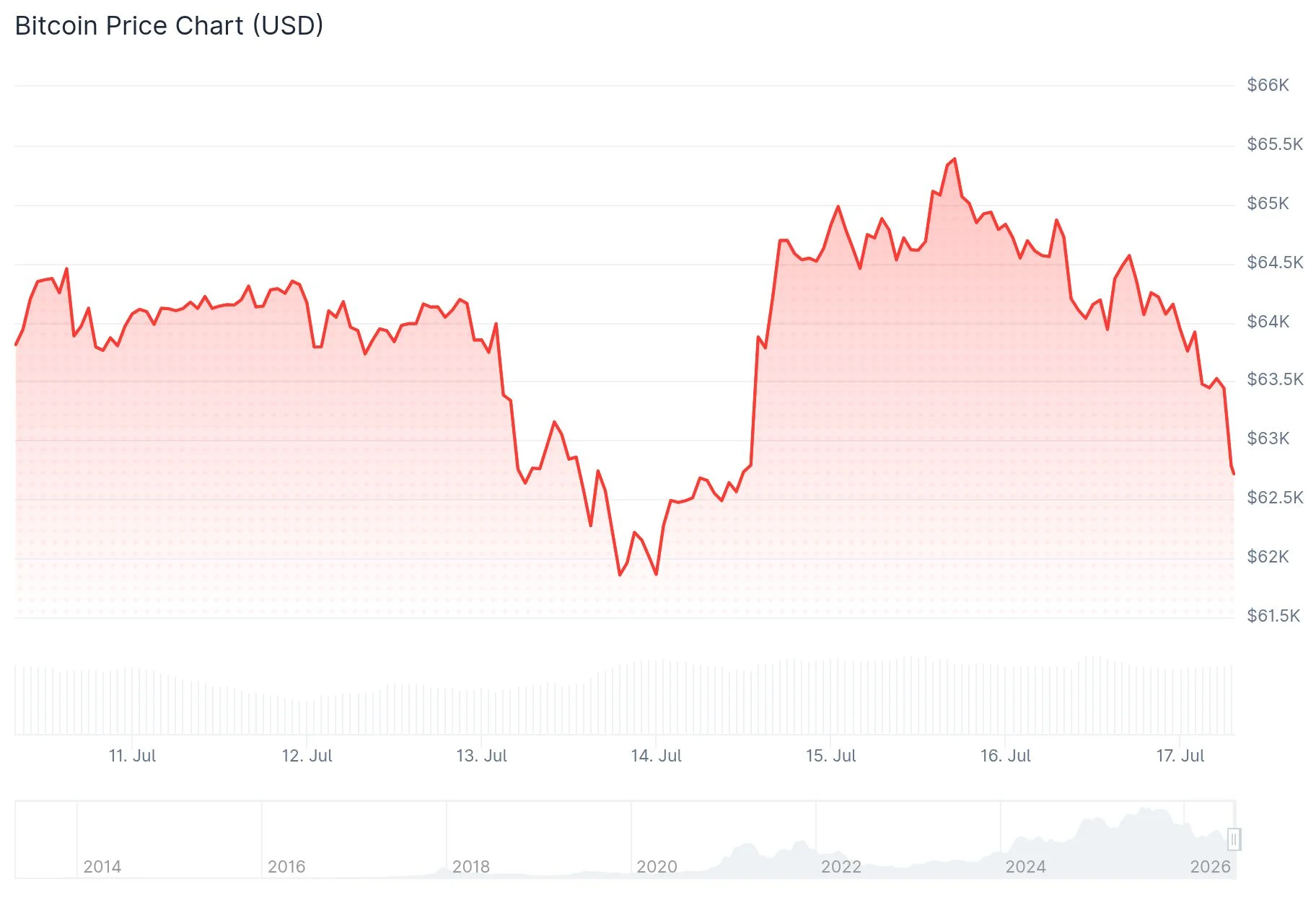
Bitcoin (BTC) experienced a notable downturn to approximately $63,000 on Friday, marking a significant reversal from a brief two-day rally, as a confluence of intensifying geopolitical concerns and heightened domestic political instability created substantial headwinds for risk-sensitive assets across the cryptocurrency sector. This latest price action underscores Bitcoin’s increasing susceptibility to global macro-events, challenging narratives of its complete decoupling from traditional financial markets and risk factors. The decline represents a critical moment for investors assessing the digital asset’s resilience in an increasingly volatile global landscape.
The cryptocurrency market, often characterized by its inherent volatility, has once again demonstrated its sensitivity to external pressures. The recent dip in Bitcoin’s value to the $63,000 range follows a period of cautious optimism, which was primarily fueled by economic data suggesting a potential easing of inflationary pressures in the United States. However, this positive momentum proved ephemeral, quickly overshadowed by a complex interplay of international military operations and contentious political discourse within the US. The immediate aftermath saw a broader sell-off in risk assets, including technology equities, indicating a widespread flight to safety among investors.
The Ephemeral Boost from Inflation Reports
Earlier in the week, market sentiment had received a temporary uplift from better-than-anticipated US inflation reports. Specifically, June’s Consumer Price Index (CPI) and Producer Price Index (PPI) both registered figures below market forecasts. The Consumer Price Index, a key gauge of inflation, measures the average change over time in the prices paid by urban consumers for a market basket of consumer goods and services. A lower-than-expected CPI often signals a potential slowdown in inflation, which can lead to speculation about the Federal Reserve adopting a less aggressive monetary policy, potentially including interest rate cuts. Such prospects generally bode well for risk assets like Bitcoin, as lower interest rates can make traditional investments less attractive and encourage capital flow into higher-growth, higher-risk alternatives.
Similarly, the Producer Price Index, which tracks the average change in selling prices received by domestic producers for their output, also came in below expectations. A subdued PPI can indicate easing cost pressures for businesses, potentially leading to stable consumer prices in the future. The combined effect of these reports initially sparked a modest rally across financial markets, with Bitcoin briefly climbing to three-week peaks near $65,900. Investors interpreted these data points as signs that the economy might be heading towards a "soft landing," where inflation cools without triggering a severe recession. This optimism, however, proved fragile and short-lived, highlighting the delicate balance of factors influencing market movements.
Tech Sector Contagion and Retail Investor Exodus
The positive momentum quickly dissipated as the broader technology equities market experienced significant selling pressure. This sector, often seen as a bellwether for risk appetite, saw prominent companies face substantial declines. Micron Technologies, a leading semiconductor manufacturer, notably plunged over 30% from its June 22nd peak. This sharp drop in a bellwether tech stock often signals a broader re-evaluation of growth-oriented assets.
Adding to the market’s woes, retail investors engaged in considerable profit-taking. Data indicated that approximately $200 million in Tesla and Apple shares were offloaded during the preceding two-week period. This outflow from highly popular retail stocks suggests a shift in investor sentiment, moving away from speculative growth plays towards more defensive positions. Market analytics firm The Kobeissi Letter underscored the magnitude of this retail activity, highlighting that retail trading volume in individual equities reached an unprecedented $370 billion, surging from $220 billion recorded at the beginning of 2026. This dramatic increase in trading volume, largely attributed to market participants securing gains from the earlier technology sector rally, illustrates the significant impact retail investors can have on market dynamics, particularly during periods of heightened volatility and uncertainty. The interconnectedness between traditional tech stocks and risk assets like Bitcoin means that a downturn in one often precipitates a similar movement in the other, as investors de-risk across their portfolios.
Bitcoin’s Technical Crossroads: Resistance and Reversals
From a technical analysis perspective, Bitcoin’s brief ascent to near $65,900 encountered immediate resistance. Market analyst Rekt Capital observed that Bitcoin was displaying initial resistance signals at its 50-month exponential moving average (EMA) positioned precisely at that threshold. The 50-month EMA is a long-term indicator used by traders to identify significant support and resistance levels over extended periods. A rejection at such a critical long-term moving average suggests that sustained upward momentum requires considerable buying pressure to overcome this established technical barrier.
Further complicating the technical outlook, analyst Exitpump highlighted the anchored Volume Weighted Average Price (VWAP) from Bitcoin’s $82,000 peak in early May as another critical resistance zone. The anchored VWAP is a technical analysis tool that calculates the average price of an asset weighted by volume, starting from a specific point in time. It provides insight into the average price at which an asset has traded since a significant event or price high. In his analysis shared with X followers, Exitpump suggested that retesting this level "should cap the upside and give stronger rejection." This implies that even if Bitcoin were to push higher, the price region around the anchored VWAP from its previous peak would likely act as a formidable ceiling, making a sustained breakout challenging without a fundamental shift in market sentiment. The confluence of these technical resistance levels painted a picture of an uphill battle for Bitcoin bulls, making the asset vulnerable to external shocks.
Military Operations Intensify Market Pressure
The primary catalyst for the widespread risk-off sentiment and Bitcoin’s subsequent decline was a significant escalation in geopolitical tensions, particularly in the Middle East. The US Central Command verified ongoing military operations against Iran for the sixth consecutive evening on July 17. These strike packages were reportedly targeting critical Iranian infrastructure, including coastal surveillance installations, air defense networks, military supply chains, and maritime facilities. Intelligence reports pinpointed specific locations such as the Bandar Khamir overpass infrastructure, the Gariveh Bridge, and a significant railway terminal near Bandar Abbas, all strategic points for Iran’s military and logistical capabilities.

In response to these perceived aggressions, Iranian forces reportedly initiated countermeasures directed at Qatar, with preliminary accounts indicating actions in proximity to the American Al Udeid Air Base. This tit-for-tat escalation in military activity between the US and Iran immediately sent ripples through global financial markets. Geopolitical instability traditionally leads to a flight to safety, where investors move capital out of riskier assets and into perceived safe havens. The US Dollar Index (DXY), which measures the dollar’s strength against a basket of major currencies, climbed higher to 100.79, reflecting its status as a safe-haven asset. Simultaneously, crude oil prices surged to $80 per barrel, driven by concerns over potential disruptions to oil supply from the strategically vital Strait of Hormuz, a key chokepoint for global oil shipments. Both a stronger DXY and higher crude oil prices typically contribute to downward pressure on risk assets, including cryptocurrencies like Bitcoin, as they signal heightened global uncertainty and potential inflationary pressures.
The historical context of US-Iran relations, marked by periods of intense confrontation and proxy conflicts, further exacerbated market anxiety. Past incidents, such as attacks on oil tankers or drone strikes, have consistently demonstrated the region’s capacity to trigger significant global market reactions. The current situation, involving direct military engagements, represents a more severe escalation, justifying the heightened risk aversion observed in financial markets.
Presidential Address Fuels Domestic Market Anxiety
Compounding the geopolitical concerns was a significant source of domestic political instability in the United States. President Donald Trump delivered a prime-time national address centered on electoral integrity, an issue that has historically stirred considerable debate and controversy in American politics. During his address, President Trump alleged that Chinese actors had obtained 220 million American voter records in what he characterized as "the largest compromise of election data in history." These claims, while echoing previous contentions regarding election security, immediately sparked fresh anxieties about the stability of the upcoming midterm elections and the broader political landscape.
The President advocated for advancing the SAVE America Act, proposed legislation that would require voter identification and citizenship verification. While proponents argue such measures are necessary to safeguard electoral processes, opposition lawmakers swiftly dismissed the allegations as unfounded conspiracy narratives, intensifying the partisan divide. The specter of a contested election, or even widespread doubts about electoral outcomes, can significantly undermine investor confidence. Political uncertainty often translates into economic uncertainty, as businesses and investors become hesitant to make long-term commitments amidst an unpredictable policy environment.
The timing of the President’s address, amidst escalating international tensions, created a perfect storm for risk assets. Investors typically prefer stability and predictability, and the combination of geopolitical conflict abroad and political contention at home serves to erode confidence. Such domestic political events, especially those questioning foundational democratic processes, can trigger a flight of capital, as both domestic and international investors seek safer havens away from perceived instability. The tweet from Bloomberg highlighted the severity of the President’s claims, noting his focus on securing a victory in the midterms in November, suggesting the political rhetoric might intensify as the election cycle progresses.
Analyst Forecasts and Institutional Sentiment
Amidst the turbulence, market analysts offered divergent forecasts for Bitcoin’s future trajectory. Analyst Ted Pillows published his forecast on X, suggesting a scenario where $BTC appreciates to the $70,000–$72,000 range by August, only to subsequently retrace to fresh cycle lows near $50,000. This highly volatile prediction underscores the prevailing uncertainty and the potential for significant price swings in the coming months, indicating that any short-term gains might be unsustainable in the face of underlying macro pressures.
In contrast to some of the more cautious or bearish short-term outlooks, institutional confidence appears to remain resilient in the long run. BlackRock CEO Larry Fink, a prominent figure in traditional finance whose firm recently launched a highly successful spot Bitcoin ETF, stated that Bitcoin maintains stability at its present price levels. He further expressed an optimistic stance on the cryptocurrency sector throughout the next 12-month period. Fink’s comments carry significant weight due to BlackRock’s immense influence in global finance and its pivotal role in bridging traditional investment vehicles with digital assets. His optimism reflects a growing institutional belief in Bitcoin’s long-term value proposition, despite short-term market fluctuations driven by external factors. This dichotomy between short-term technical and macro-driven volatility and long-term institutional confidence highlights the ongoing maturation of the cryptocurrency market, where both speculative trading and fundamental adoption play significant roles.
Broader Implications and Future Outlook
The events of the past week underscore the complex and multifaceted nature of Bitcoin’s price discovery. No longer a niche asset driven solely by crypto-specific narratives, Bitcoin is now deeply integrated into the global financial ecosystem, reacting to macroeconomic data, geopolitical shifts, and domestic political developments with increasing sensitivity. The immediate implications include a reinforced perception of Bitcoin as a high-beta risk asset, prone to significant pullbacks during periods of global uncertainty.
Looking ahead, the market will closely monitor several key indicators. The trajectory of US-Iran relations and the broader stability of the Middle East will remain a critical geopolitical factor. Any de-escalation could provide relief, while further intensification would likely exacerbate risk aversion. Domestically, the progression of the US midterm elections and the rhetoric surrounding electoral integrity will continue to influence investor sentiment. Political stability is a cornerstone of economic confidence, and ongoing contention could prolong market anxieties. Economically, future inflation reports and the Federal Reserve’s monetary policy decisions will dictate the broader liquidity environment, directly impacting capital flows into risk assets.
The retail trading volume surge, while demonstrating continued engagement, also points to a market where individual investors are actively managing risk and taking profits. The institutional perspective, as articulated by Larry Fink, suggests that despite these short-term headwinds, the long-term bullish thesis for Bitcoin remains intact. However, the path to further adoption and price appreciation will likely remain volatile, characterized by periods of rapid growth interspersed with sharp corrections influenced by the ever-present forces of global macroeconomics and geopolitics. For investors, navigating this landscape will require a nuanced understanding of both technical indicators and the broader geopolitical and economic currents shaping the world stage.














