Bitcoin (BTC) has demonstrated remarkable resilience, trading with modest gains as elevated market liquidity continues to underpin its price action. Over the past seven days, the world’s leading cryptocurrency has surged by nearly 6%, extending a broader recovery trend that has defied selling pressure observed across other major digital assets. This sustained upward movement, despite a seemingly balanced market indicated by sideways price action, is increasingly being attributed to a significant uptick in whale activity, subtly shifting market sentiment towards a quiet bullish bias.
Whale Accumulation Signals Strategic Positioning
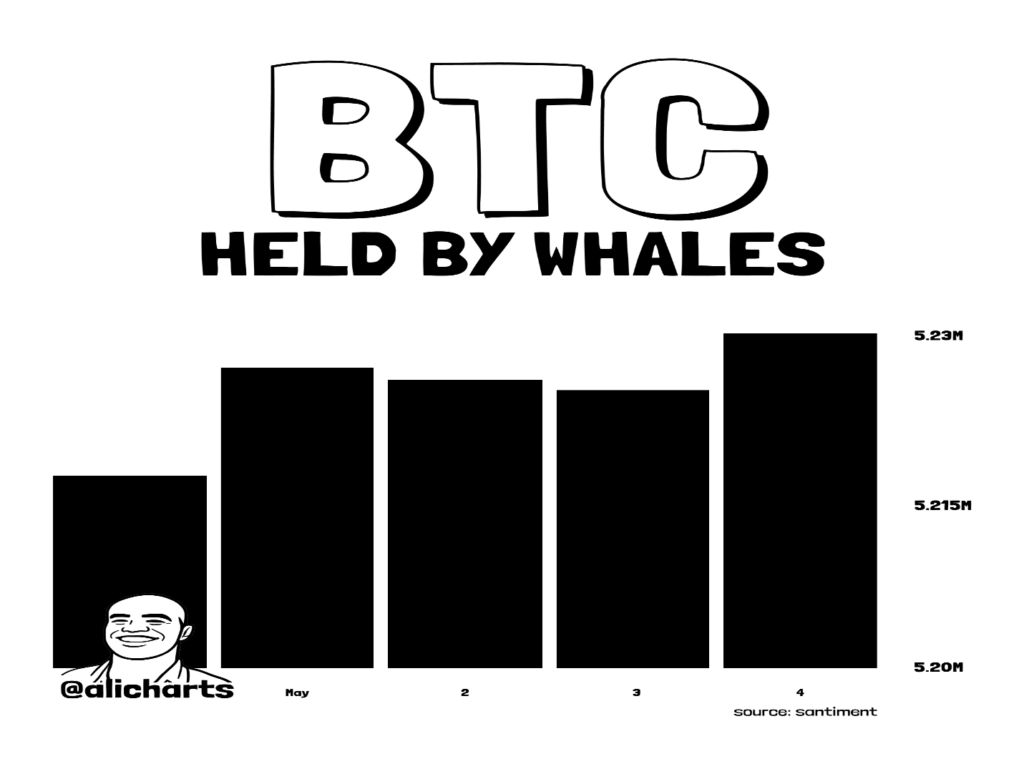
Recent analysis from prominent on-chain observer Ali Martinez indicates a substantial influx of Bitcoin into the wallets of large-scale holders, commonly referred to as "whales." Martinez reported that approximately 4,527 BTC were accumulated by these significant investors within a single 24-hour period. This accumulation, valued at an estimated $362 million, suggests that major players are strategically positioning themselves during periods of relative price stability. Such concentrated buying from whales can exert an immediate influence on liquidity dynamics, potentially signaling a lack of selling pressure and a growing conviction in the cryptocurrency’s short-to-medium term prospects.
Historically, periods of whale accumulation have often preceded significant price movements. These large holders, possessing substantial capital, can influence market trends through their buying and selling decisions. Their recent acquisition of nearly 4,500 BTC, during a time when the broader market might be exhibiting caution, suggests a contrarian approach, betting on future price appreciation. This behavior is particularly noteworthy as it occurs while Bitcoin hovers above the critical $80,000 mark, a level not sustained for several months.

Divergent On-Chain Activity Sparks Market Debate
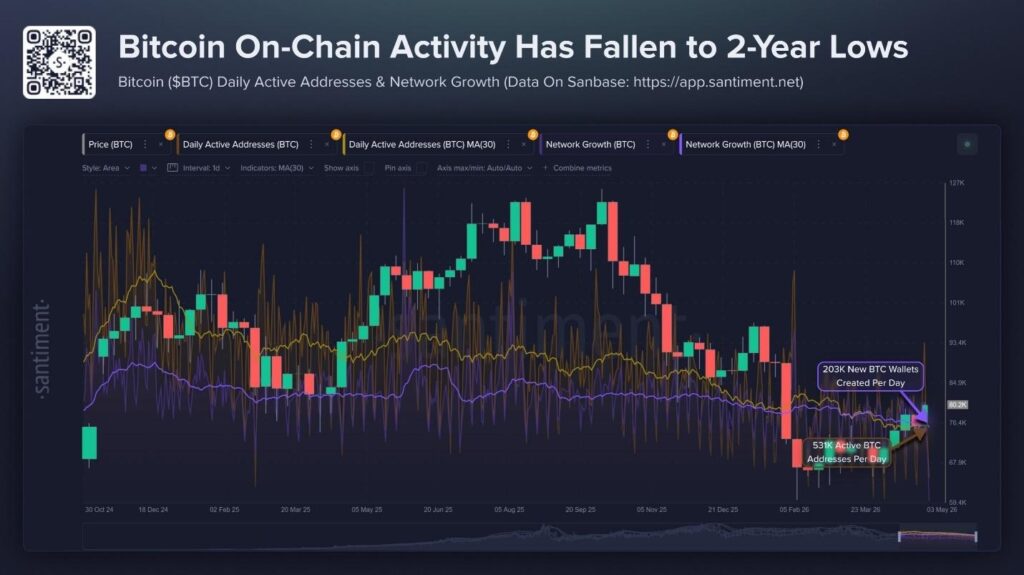
Contrasting this bullish accumulation narrative, data from the analytics firm Santiment Intelligence presents a more nuanced picture. Santiment reported that Bitcoin’s on-chain activity has receded to its lowest levels in approximately two years. This decline is evidenced by metrics such as the number of active wallets and the daily creation of new wallet addresses, which are reportedly around 531,000 and 203,000, respectively.
This divergence between rising prices and declining network participation has ignited debate among market analysts regarding the sustainability of the current rally. Typically, an increase in a cryptocurrency’s price is accompanied by heightened on-chain activity. This surge in network engagement usually reflects increased retail interest, speculative trading, and broader adoption. The current scenario, where Bitcoin’s upward momentum is not mirrored by a commensurate rise in network activity, suggests that the driving force behind the price appreciation may be a smaller, concentrated group of participants rather than widespread public adoption.
The Fragility of Concentrated Market Movements
Santiment’s analysis further highlights the potential fragility of market movements driven by a limited number of large holders. In such structures, price increases might lack the fundamental support needed for long-term sustainability. If these large-scale holders decide to divest, particularly in the absence of sufficient retail buyers to absorb the selling pressure, a significant price correction could ensue. This scenario underscores the importance of broad-based participation for a truly robust and enduring market rally.
However, historical precedent offers a counterpoint. Periods of low on-chain activity have often served as precursors to periods of strong growth. This pattern suggests that market disinterest can sometimes act as a period of consolidation, allowing for a build-up of latent interest that can lead to rapid re-engagement once momentum returns. Bitcoin’s current strength above $80,000, despite minimal network activity, could therefore be interpreted as an early sign of accumulation rather than a sign of impending decline. This "quiet accumulation" phase could be laying the groundwork for a more significant price surge once broader market interest is reignited.
Technical Indicators Point to Potential Upside
Beyond on-chain metrics, technical analysis also offers insights into Bitcoin’s potential trajectory. Analyst Ted, observing the market, noted that Bitcoin is currently making a concerted effort to reclaim a key technical zone that corresponds with the November 2025 lows. According to his analysis, a successful breakout above this critical resistance level could act as a significant catalyst, accelerating upward momentum.
Ted’s projections suggest that such a breakout could propel Bitcoin towards the $84,000 to $85,000 range within a relatively short timeframe. This particular price band is being closely monitored by traders and investors as a potential short-term trigger zone for further continuation. The confluence of whale accumulation, a resilient price above $80,000, and promising technical indicators paints a picture of a market potentially poised for further gains, albeit driven by a more concentrated investor base for the moment.
Contextualizing Bitcoin’s Price Action
To fully appreciate the current market dynamics, it is essential to consider the recent history of Bitcoin’s price movements and the broader cryptocurrency landscape. The period leading up to this current phase of resilience was marked by significant volatility. Following a period of substantial gains in late 2023 and early 2024, driven by the approval of spot Bitcoin ETFs in the United States, the cryptocurrency experienced a correction. This correction saw Bitcoin briefly dip below $60,000, leading to concerns about the sustainability of the bull market.
The approval of spot Bitcoin ETFs by the U.S. Securities and Exchange Commission (SEC) in January 2024 was a landmark event for the cryptocurrency industry. It provided institutional investors with a regulated and accessible avenue to invest in Bitcoin, significantly increasing its legitimacy and attracting substantial capital inflows. This influx of institutional money was a primary driver of the early 2024 bull run. However, as is often the case after such significant price appreciation, a period of consolidation and profit-taking followed, leading to the aforementioned correction.

The current price action, with Bitcoin trading above $80,000, represents a significant recovery from the lows experienced earlier in the year. The fact that this recovery is occurring despite a dip in retail participation and on-chain activity is a key point of discussion. Some analysts interpret this as a sign of maturity in the market, where large holders are absorbing selling pressure and accumulating strategically, anticipating future demand. Others remain cautious, emphasizing the risks associated with a market heavily influenced by a few large players.
The Role of Market Liquidity
The mention of "elevated market liquidity" as a factor containing price action is also crucial. Liquidity refers to the ease with which an asset can be bought or sold without significantly impacting its price. In the context of cryptocurrencies, liquidity can be influenced by various factors, including the number of exchanges, trading volumes, and the availability of stablecoins. High liquidity generally leads to more stable price movements, reducing the likelihood of extreme volatility.
In Bitcoin’s case, the ongoing presence of significant liquidity, potentially fueled by institutional inflows and robust over-the-counter (OTC) trading desks, is acting as a buffer against sharp price declines. This sustained liquidity allows for the absorption of selling pressure, even as retail engagement might be subdued. It creates an environment where whales can accumulate without drastically driving up the price, allowing for a more gradual and controlled build-up of their positions.
Broader Implications and Future Outlook
The current market scenario presents a complex interplay of bullish accumulation, subdued on-chain activity, and promising technical indicators. The implications of this dynamic are multifaceted:
- Institutional Dominance: The data suggests a continued and potentially growing influence of institutional investors and large holders in shaping Bitcoin’s price. This could lead to more controlled price movements, with fewer extreme spikes and dips driven by retail sentiment.
- Potential for Explosive Growth: Conversely, the quiet accumulation phase, coupled with the potential for a technical breakout, could indicate that a significant price surge is on the horizon. Once broader market sentiment shifts and retail investors re-enter, the accumulated supply could be rapidly absorbed, leading to a sharp upward movement.
- Risk of Manipulation: The concentration of holdings among whales also carries inherent risks. A coordinated sell-off by a few large holders could trigger panic selling among smaller investors, leading to a swift and substantial price decline.
- Evolution of Bitcoin Adoption: The divergence between price and on-chain activity might also signal an evolving pattern of Bitcoin adoption. As the asset becomes more integrated into traditional finance through vehicles like ETFs, its price discovery may become less reliant on individual retail transactions and more influenced by broader market forces and institutional strategies.
At the time of reporting, BTC was trading at approximately $80,730, reflecting a notable 3.15% gain in the preceding 24 hours. This price point, combined with the ongoing whale accumulation and technical signals, suggests that despite the current lull in on-chain activity, the market sentiment remains cautiously optimistic. Investors and analysts will be closely watching for further developments, particularly any signs of increased network activity that could signal a broader re-engagement with the Bitcoin market. The interplay between large-scale holders and the broader market will be a critical determinant of Bitcoin’s trajectory in the coming weeks and months.