


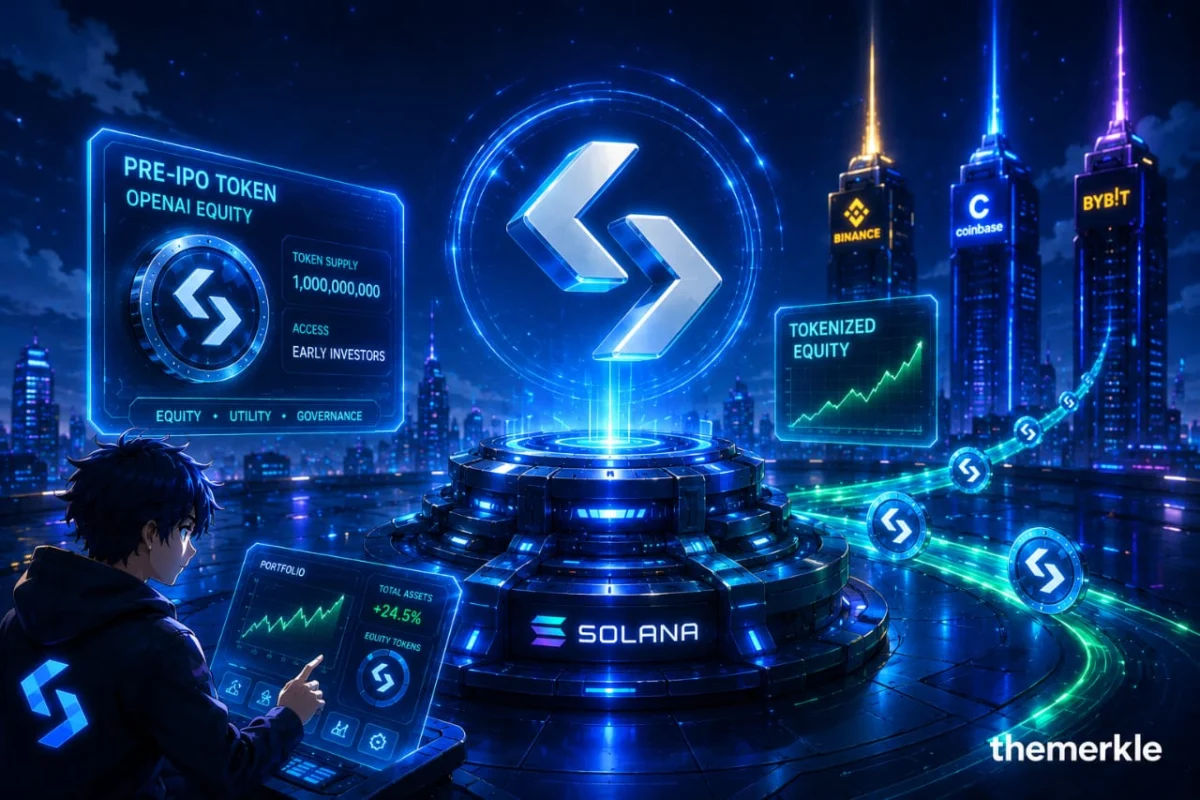
Bitget, a prominent cryptocurrency exchange, has officially unveiled pre-IPO access to OpenAI through its innovative IPO Prime platform, marking a significant step in deepening its engagement across the interconnected layers of tokenized finance, artificial intelligence, and retail crypto-asset investing. This strategic move allows select clientele to gain exposure to OpenAI’s anticipated performance during its eventual public listing, long before the company formally debuts on a traditional stock exchange. The product, dubbed "preOPAI," is issued on Republic and designed to mirror the performance of OpenAI’s future public listing at a 1:1 ratio once the company goes public and its shares begin trading on exchanges, all facilitated through the Solana blockchain. Users interested in participating could engage with a minimum investment of $100 during the initial subscription window, which was open from May 12 to 15, according to Bitget.
The announcement immediately resonated across both the cryptocurrency and artificial intelligence spheres, a testament to OpenAI’s status as one of the most closely observed private technology companies globally. Over the past two years, the rapid acceleration in the development of generative AI technology, spearheaded by OpenAI’s groundbreaking innovations, has fueled an unprecedented rush of institutional investment and public interest in the sector. This burgeoning enthusiasm has, in turn, sharply increased the demand for accessible exposure to leading artificial intelligence firms. Bitget’s initiative therefore represents a broader, evolving trend within digital asset markets, where cryptocurrency exchanges are increasingly innovating by offering tokenized versions of private equity, real-world assets (RWAs), and now, exclusive pre-IPO access. Unlike traditional models where investors passively await companies to list on public bourses, these crypto platforms are actively packaging sophisticated, measured exposure products that can be accessed globally by virtually any retail investor, democratizing access to previously exclusive financial opportunities.
The Genesis of OpenAI and the AI Investment Boom
OpenAI’s journey from a research laboratory to a global technology powerhouse has been nothing short of meteoric. Founded in 2015 by a group including Elon Musk, Sam Altman, Greg Brockman, Ilya Sutskever, and others, with a mission to ensure that artificial general intelligence (AGI) benefits all of humanity, the organization initially operated as a non-profit. However, in 2019, it restructured to include a "capped-profit" entity to attract the substantial capital required for large-scale AI research and development. This restructuring paved the way for significant investment from Microsoft, which initially injected $1 billion and later committed billions more, notably $10 billion in early 2023, valuing OpenAI at approximately $29 billion at the time.
The true inflection point for OpenAI, and indeed for the entire AI industry, came in November 2022 with the public release of ChatGPT. This conversational AI model quickly became a global phenomenon, captivating millions with its ability to generate human-like text, answer complex questions, and even write code. Its launch ignited a fierce competition among tech giants and startups alike, sparking an "AI arms race" and drawing unparalleled investor interest. By early 2024, through a tender offer, OpenAI was reportedly valued at around $80 billion to $90 billion, solidifying its position as one of the world’s most valuable private technology companies. Despite this staggering valuation and widespread interest, direct equity access to OpenAI has largely remained the exclusive domain of institutional investors, venture capital firms, and accredited investors involved in private funding rounds. This exclusivity has created a significant demand gap among retail investors eager to participate in the AI revolution, a void that platforms like Bitget are now seeking to fill.
Bitget’s IPO Prime: Bridging Traditional and Tokenized Finance
The launch of Bitget’s IPO Prime initiative, with preOPAI as its flagship offering, underscores a fundamental transformation within the crypto exchange landscape. These platforms are rapidly evolving beyond their foundational role as basic spot trading venues. In recent years, they have progressively rolled out a diverse array of products and services, including sophisticated derivatives markets, innovative tokenized assets, launchpads for new projects, AI infrastructure solutions, and synthetic investment vehicles. This diversification is a strategic imperative, driven by intense competition in spot trading and the need to explore new revenue streams.
Bitget’s specific objective with preOPAI is to capitalize on the artificial intelligence narrative, which currently stands as one of the most potent forces driving global financial markets. The product’s design is meticulously crafted to address the aforementioned void in retail access to private AI giants. PreOPAI functions as a blockchain-collateralized investment product, structured to deliver exposure to the future performance of OpenAI once it lists publicly. The mechanism is designed for a 1:1 mimicry of OpenAI’s stock price after its public debut, offering a preemptive measure of how the company’s future listing will perform. By issuing this product on Republic, a regulated crowdfunding platform, and leveraging the high throughput and low fees of the Solana blockchain, Bitget aims to ensure both accessibility and efficiency for its users. The minimum investment threshold of $100 is particularly notable, as it significantly lowers the barrier to entry for retail investors worldwide, who would otherwise be excluded from such private market opportunities. This innovative structure exemplifies how crypto exchanges are leveraging blockchain technology to democratize financial access, enabling fractional ownership and global transferability of assets that were historically illiquid and exclusive.
Chronology of Convergence: AI, Crypto, and Capital Markets
The timeline leading to Bitget’s preOPAI launch is rooted in several converging trends:
- 2015: OpenAI is founded, setting the stage for future AI breakthroughs.
- 2019: OpenAI restructures to a "capped-profit" model, attracting significant institutional investment, notably from Microsoft, highlighting the massive capital requirements for advanced AI research.
- November 2022: ChatGPT is released, sparking the global generative AI boom and unprecedented public interest in OpenAI. This event creates immense demand for AI exposure.
- Late 2022 – Early 2024: Institutional investors pour billions into AI companies, driving valuations of private firms like OpenAI to tens of billions. Retail investors largely remain on the sidelines due to lack of direct access.
- Throughout 2023: The "tokenization of real-world assets" (RWAs) emerges as a dominant narrative in the crypto space. Crypto exchanges increasingly experiment with tokenized securities, private equity, and structured products.
- May 2024: Bitget formally launches IPO Prime and the preOPAI product, capitalizing on the confluence of the AI narrative, the demand for private equity access, and the technological capabilities of tokenized finance. The subscription window for preOPAI runs from May 12-15, making it one of the first widely accessible tokenized pre-IPO products for a major private tech firm.
This chronology illustrates how the increasing maturity of blockchain infrastructure, coupled with the explosive growth of specific technological sectors like AI, has created fertile ground for new financial products that blur the lines between traditional and decentralized finance.
Intensifying Competition in Tokenized Pre-IPO Markets
Bitget’s strategic maneuver also appears to be a direct response to, and catalyst for, intensifying competition within the digital asset market. Shortly after Bitget’s announcement, rumors began circulating within the crypto community suggesting that Binance, the world’s largest cryptocurrency exchange, had stealthily commenced testing infrastructure related to a "Pre-IPO Vault." While Binance has not made any formal announcements regarding such a product, the widespread speculation indicates a clear industry trend: major exchanges are recognizing the immense potential of tokenized pre-IPO offerings and are actively preparing to enter this burgeoning market.
This competition is rooted in a sound strategic rationale. Historically, access to early-stage IPO allocations, venture capital deals, and private market investments has been the exclusive privilege of traditional financial institutions, institutional investors, and ultra-high-net-worth individuals. Crypto exchanges, leveraging blockchain technology, see an opportunity to disrupt this exclusivity by offering globally accessible, blockchain-based alternatives. By democratizing access to private company exposure, these platforms aim to capture a significant share of capital that would otherwise remain sidelined or flow through traditional, often cumbersome, financial channels.
Furthermore, exchanges are under considerable pressure to diversify their revenue streams. The intense fee competition in spot trading markets has led to declining margins, prompting platforms to seek new growth avenues. Derivatives trading, tokenized assets, launchpads for new projects, staking infrastructure, and synthetic financial products have become crucial components of their expansion strategies. Pre-IPO tokenization is emerging as a particularly significant battlefront in this diversification effort. While initial offerings may focus on high-profile AI firms like OpenAI, a successful model could quickly expand to include other high-growth sectors such as fintech, biotech, robotics, gaming, and autonomous systems. This broader application would further solidify crypto exchanges’ positions as comprehensive financial service providers, challenging the long-standing dominance of traditional investment banks and brokerage firms in capital markets.
Broader Implications and the Future of Capital Markets
The long-term implications of tokenized pre-IPO products for retail investing and global capital markets could be transformative. Analysts suggest that such innovations could fundamentally alter the landscape of capital formation and investment access. By leveraging blockchain infrastructure, users from diverse geographical locations are gaining the ability to acquire smaller, fractional ownership stakes in private companies well before the traditional IPO stage. This democratizes investment, potentially redirecting significant capital flows and challenging the existing power structures of financial institutions.
The launch of preOPAI also powerfully illustrates the ongoing convergence between crypto markets and existing financial systems. Decentralized alternatives to legacy finance are evolving into hybrid ecosystems that seamlessly combine robust blockchain infrastructure with traditional investment products. Bitget’s offering, linking a blockchain-based product with one of the world’s most valuable private tech companies, exemplifies this trend. It highlights how tokenization is progressively enhancing financial access by making assets not only more programmable but also globally transferable and continuously tradable, free from the constraints of traditional financial rails.
However, the path to mass adoption for tokenized pre-IPO products is not without hurdles. Analysts widely agree that while these products represent a significant growth category in crypto finance, widespread mainstream acceptance will likely hinge on the evolution of the regulatory environment. Clearer, more consistent regulatory frameworks around blockchain-based securities and synthetic financial instruments are essential to provide investor protection, ensure market integrity, and build trust among a broader investor base. Until such clarity emerges, these innovative products may remain largely within the crypto-native ecosystem.
Nevertheless, Bitget’s latest offering indicates that the barriers separating crypto, AI, and traditional finance are progressively dissolving. This ongoing breakdown, driven by fierce competition among blockchain platforms to construct the next wave of digital capital markets, points towards a future where investment opportunities are more accessible, global, and technologically integrated than ever before. The "primordial species" of a new financial ecosystem is indeed taking shape, promising profound changes for investors and capital markets globally.
Disclosure: This is not trading or investment advice. Always do your research before buying any cryptocurrency or investing in any services.














