



BitMine Holding Inc. (OTC: BTHGF) has significantly expanded its Ethereum (ETH) treasury, adding an additional 111,942 ETH over the past week, bringing its total holdings to a staggering 5,390,404 ETH. This substantial accumulation, disclosed in a recent company treasury update on May 26, solidifies BitMine’s position as one of the largest known institutional holders of Ethereum globally. Based on Ethereum’s price of approximately $2,134 at the time of the announcement, BitMine’s ETH holdings alone are valued at over $11.49 billion. This aggressive expansion, largely executed during a market pullback, underscores the company’s profound bullish conviction in Ethereum’s long-term trajectory and its strategic ambition to bridge traditional financial markets with the burgeoning digital asset ecosystem.
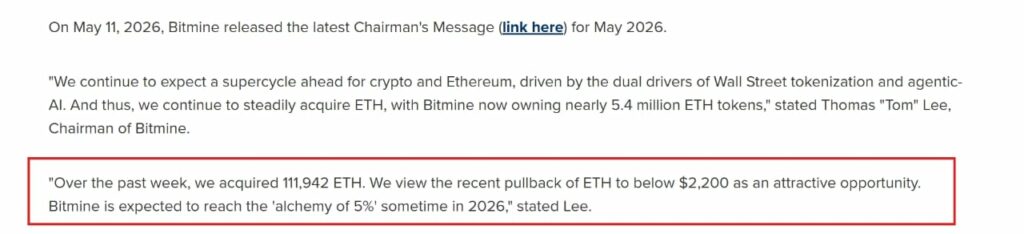
The recent acquisition of 111,942 ETH represents a daily increase in BitMine’s treasury, occurring almost every day over the last week. This consistent accumulation strategy has propelled the company’s total Ethereum reserves to new heights, reinforcing its status as a rapidly growing leader among publicly traded firms with a significant Ethereum-centric focus. The timing of these substantial purchases is particularly noteworthy, as they coincided with a period of broader market weakness, where Ethereum’s price traded below the $2,200 threshold.
According to BitMine Chairman Tom Lee, this price weakness presented an "attractive entry point" for institutional long-term accumulation. Lee’s statement highlights a calculated approach, leveraging market dips to bolster the company’s strategic asset base. Such heavy acquisitions, made against a backdrop of general market turbulence, unequivocally demonstrate BitMine’s staunch bullish view on the future of Ethereum. This proactive investment strategy during a market downturn suggests a belief in Ethereum’s underlying fundamentals and its potential for significant appreciation, rather than a reactive response to price movements.
Beyond its dominant Ethereum position, BitMine’s balance sheet reflects a diversified portfolio of crypto assets, cash, and what the company terms "moonshot" investments, totaling approximately $12.3 billion. While Ethereum constitutes the overwhelming majority of its digital asset exposure, BitMine also holds 202 Bitcoin (BTC), representing a more modest, yet notable, stake in the pioneering cryptocurrency. The company’s financial liquidity is robust, with nearly $444 million in cash and equivalents as of June 30. Furthermore, BitMine has strategic equity interests, including a $200 million stake in MrBeast-affiliated Beast Industries and a $95 million equity interest in Eightco Holdings, indicating a broader investment thesis that extends into high-growth, innovative ventures alongside its core crypto strategy.

BitMine has articulated an ambitious long-term target, dubbed the "alchemy of 5%," aiming to capture approximately 5% of Ethereum’s circulating supply by 2026. With its current holdings of 5,390,404 ETH, BitMine already accounts for roughly 4.47% of Ethereum’s total circulating supply, which stands at approximately 120 million ETH. This places BitMine among the most sizeable concentrated holders of ETH on the market, a position that carries significant implications for market dynamics and price stability. Such a scale of accumulation is beginning to reshape the narrative around Ethereum treasury concentration, institutional exposure, and the innovative blending of public equity markets with crypto-native asset strategies. Should BitMine achieve its 5% target, it would not only solidify its financial strength but also exert a considerable influence on the Ethereum ecosystem, potentially impacting governance, liquidity, and overall market sentiment.
A crucial aspect of BitMine’s Ethereum strategy is its extensive engagement in staking operations. Unlike passive holding, staking allows the company to actively participate in the Ethereum network’s proof-of-stake consensus mechanism, thereby generating recurring revenue. As per the latest update, an impressive 4,712,917 ETH from BitMine’s treasury is currently staked across various blocks, equating to approximately $10.05 billion at current market prices. This substantial commitment makes BitMine one of the largest institutional players within Ethereum’s proof-of-stake ecosystem, underscoring its dual role as both an asset holder and a critical infrastructure provider.
The firm has reported annualized staking revenues reaching approximately $276 million, demonstrating the potent revenue-generating capacity of its treasury-based Ethereum accumulation model. This model functions not only as a speculative balance sheet strategy focused on asset appreciation but also as an economic infrastructure generating a consistent, yield-based income stream. BitMine also announced a 7-day annualized staking yield of 2.75 percent, further illustrating the profitability of these operations. This phenomenon distinctively sets apart Ethereum treasury strategies from those employing the Bitcoin treasury model. While Bitcoin treasury firms primarily depend on price increases for returns, infrastructure companies in the Ethereum ecosystem can generate ongoing yield through staking, offering a more diversified and potentially stable revenue profile. The growing narrative of potential treasury upside combined with ongoing staking revenue is increasingly attracting and shaping institutional approaches to accumulating Ethereum.
BitMine’s expanding scale is poised to transcend the crypto market, as the company has now qualified for inclusion in the Russell 1000 index, a preeminent benchmark for large-cap U.S. public companies. The final adjusted Russell 1000 inclusion list is anticipated to be released by BitMine on June 18, with the new index composition taking effect on June 26. This potential inclusion represents a pivotal moment for BitMine and the broader crypto market. For many institutional asset managers and passive investment funds, strict mandates often limit their investments to equities listed within major index benchmarks like the Russell 1000. By becoming part of such an esteemed index, BitMine could unlock a vast pool of traditional capital.
Historically, once included in major indexes, passive index funds and exchange-traded funds (ETFs) frequently accumulate between 20% to 25% of a public company’s market capitalization. Consequently, BitMine’s potential inclusion could spur significant new institutional demand for its shares, indirectly augmenting conventional equity market exposure to Ethereum through the treasury access gained by the company. This development further highlights the growing convergence of crypto-native balance sheet strategies with traditional financial market and institutional investment infrastructure. For investors seeking exposure to digital assets without directly purchasing cryptocurrencies, BitMine’s stock would offer a regulated and familiar pathway, potentially drawing in a new wave of capital into the crypto-adjacent sector. The eligibility for the Russell 1000 signals a maturing phase for companies operating at the intersection of blockchain and traditional finance, validating their business models within established financial frameworks.
The expansion of BitMine represents a larger, accelerating trend of public companies developing significant crypto treasury strategies centered around Ethereum. Traditionally, Bitcoin played the leading role in corporate treasury adoption, primarily valued as "digital gold" and a macro hedge asset. However, Ethereum’s unique characteristics—its proof-of-stake consensus mechanism, the inherent staking rewards it offers, and its extensive utility ecosystem that underpins decentralized finance (DeFi), NFTs, and Web3 applications—are increasingly attracting a new category of institutional treasury participants. These Ethereum treasury firms are evolving beyond mere speculative crypto holders into infrastructure-aligned financial entities, capable of generating native blockchain yield potential alongside long-term asset appreciation.
On a broader scale, this institutional accumulation strengthens the fusion process of traditional capital markets with blockchain ecosystems. Publicly traded treasury firms are effectively assembling businesses that serve as equity-based exposure pieces, enabling traditional investors to participate indirectly in digital asset upside via regulated stock exchanges. This allows for a more accessible and compliant entry point for institutional capital that might otherwise be restricted from direct cryptocurrency investments due to regulatory or internal policy constraints.
In conclusion, BitMine’s latest expansion is far more than a routine treasury update; it signals, in part, the accelerating institutionalization of Ethereum itself. With over 5.39 million ETH in assets under management (AUM), billions in crypto-linked assets held on its balance sheet, and the imminent prospect of Russell 1000 inclusion, BitMine has strategically positioned itself at the epicenter of a growing crossover between public markets, institutional finance, and blockchain-native capital allocation strategies. The company’s actions underscore a profound belief in Ethereum’s future as a foundational layer of the next generation of financial infrastructure and digital economy. As such, BitMine’s trajectory will likely serve as a bellwether for how traditional finance continues to integrate with and be transformed by the rapidly evolving world of digital assets.
Disclosure: This is not trading or investment advice. Always do your research before buying any cryptocurrency or investing in any services.














