


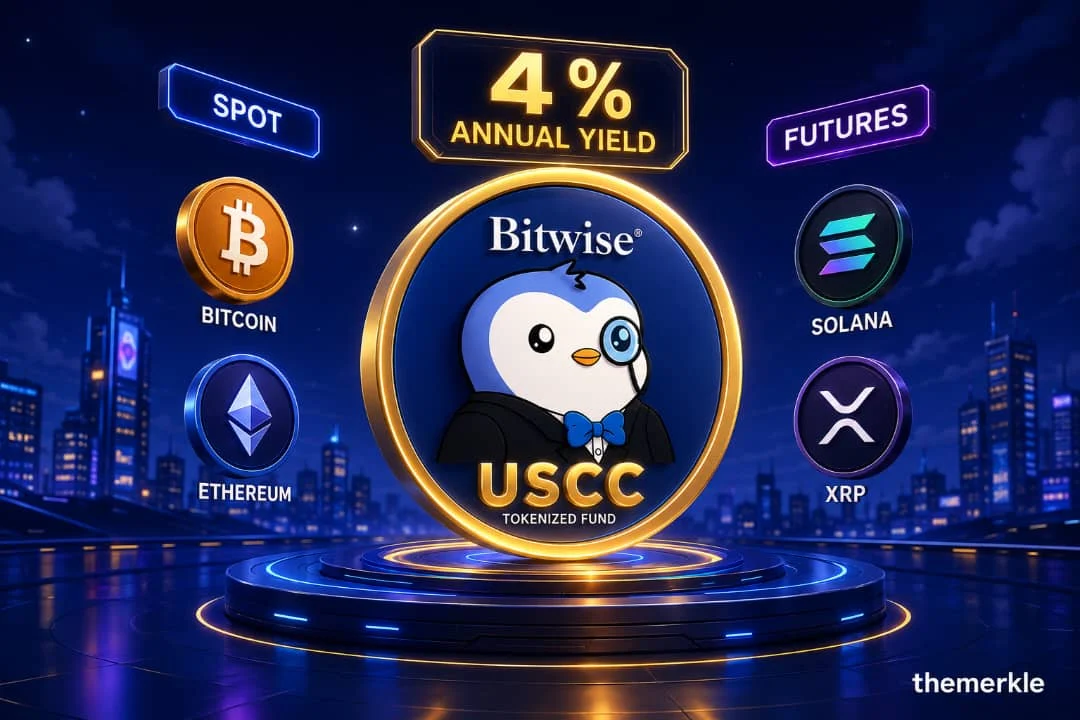
Bitwise Asset Management, a prominent name in the digital asset investment landscape, has officially marked its entry into the burgeoning field of tokenized funds by assuming investment management responsibilities for the Bitwise Crypto Carry Fund (USCC). This strategic move brings a substantial $259 million in assets under management (AUM) under Bitwise’s purview, signifying a significant milestone in the convergence of traditional asset management and on-chain finance. The announcement, detailed via Bitwise’s official channels, confirms that the product, ticker USCC, is now available to qualified purchasers, broadening access to a sophisticated market-neutral strategy within the crypto ecosystem.
A New Frontier: Bitwise’s Strategic Expansion into Tokenized Assets
This venture represents Bitwise’s inaugural foray into tokenized fund structures, a deliberate expansion that underscores the firm’s conviction in the long-term viability and transformative potential of on-chain financial products. For years, Bitwise has cultivated a reputation as a trailblazer in crypto asset management, pioneering index funds and exchange-traded funds (ETFs) that have democratized access to digital assets for a growing base of institutional and retail investors. Their successful launch of the Bitwise Bitcoin ETF (BITB) earlier this year cemented their position as a leading innovator in the space. The transition into tokenized funds is not merely an opportunistic move but a logical extension of this established trajectory, leveraging blockchain technology to enhance efficiency, transparency, and composability for investment vehicles.
The broader financial landscape is increasingly recognizing the profound implications of asset tokenization. Reports from leading financial institutions and consulting firms, such as Boston Consulting Group and SBI Holdings, project the market for tokenized real-world assets (RWAs) to reach trillions of dollars by the end of the decade. This growth is driven by the potential for fractionalization, instant settlement, reduced intermediaries, and enhanced liquidity that blockchain technology offers. By stepping into this arena with the USCC fund, Bitwise is positioning itself at the forefront of this financial evolution, signaling to the market that tokenized products are becoming an integral component of institutional-grade crypto investment portfolios.
The Bitwise Crypto Carry Fund (USCC): A Deep Dive into its Market-Neutral Strategy
At the core of the USCC fund’s appeal is its meticulously crafted crypto basis trade strategy, designed to deliver consistent yield irrespective of market direction. The fund operates on a market-neutral principle, which means its performance is not tied to the appreciation or depreciation of underlying crypto assets. Instead, it capitalizes on the persistent "basis" or spread between the spot price of major cryptocurrencies and the price of their corresponding futures contracts.
Specifically, the USCC fund simultaneously acquires spot positions in leading crypto assets such as Bitcoin (BTC), Ethereum (ETH), Solana (SOL), and XRP, while concurrently selling futures contracts tied to these same assets. The yield generated by the fund stems directly from the premium at which futures contracts typically trade above their spot counterparts in the crypto market. This premium, often referred to as contango, is a structural feature of crypto markets, largely driven by the sustained demand for leveraged long exposure among traders and the cost of funding such positions. By systematically executing this strategy, the fund captures this spread, effectively converting it into an annualized yield for investors.
The result is a highly appealing proposition: a market-neutral position that aims to insulate investors from the extreme directional volatility that characterizes much of the cryptocurrency market. While a 4% annual yield, as currently delivered by the USCC fund, might not appear "explosive" compared to the parabolic gains sometimes seen in bull markets, its consistency and detachment from price swings offer a distinct advantage. For institutional investors and qualified purchasers, who often prioritize risk-adjusted returns and capital preservation, this stability is a significant draw. The basis trade, while not novel in traditional finance (where it’s applied to commodities, equities, and fixed income), gains renewed relevance and efficiency when applied systematically across multiple crypto assets within a transparent, tokenized fund structure. It provides a sophisticated mechanism for qualified investors to access a crypto-native yield without undertaking the complexities of managing spot and futures positions themselves or exposing their capital to speculative price movements.
Superstate’s Role and the Power of On-Chain Infrastructure
The USCC fund was originally conceived and launched by Superstate in 2024, an innovative firm specializing in on-chain fund infrastructure. The current arrangement sees Superstate continuing to play a pivotal role, maintaining responsibility for the fund’s underlying on-chain infrastructure through its proprietary FundOS platform. This partnership model is a testament to a growing trend in digital asset management: a strategic division of labor that optimizes for the unique strengths of each participant.
Superstate’s FundOS platform is specifically engineered to manage the complex operational requirements of tokenized funds, including issuance, redemption, and the seamless integration with various blockchain protocols. Their expertise ensures the technical backbone of the USCC fund remains robust and efficient. Bitwise, in turn, brings its extensive experience in investment management, regulatory compliance, distribution capabilities, and institutional credibility to the partnership. This synergistic collaboration allows Bitwise to leverage Superstate’s cutting-edge technology without having to build the entire on-chain infrastructure from scratch, while Superstate benefits from Bitwise’s established market presence and ability to scale. This clear delineation of responsibilities — Superstate handling the "how" of on-chain operations and Bitwise managing the "what" and "why" of investment strategy — is often critical for the successful deployment and growth of complex financial products in a rapidly evolving ecosystem.
Enhanced Capital Efficiency: USCC’s DeFi Integration
What truly sets the USCC fund apart from many other tokenized offerings is its deep integration with the decentralized finance (DeFi) ecosystem, significantly enhancing its capital efficiency. Beyond simply existing as a tokenized representation of fund positions, USCC tokens are accepted as collateral across several major DeFi lending markets, including Aave, Kamino, and Morpho. This feature unlocks a layer of utility that is virtually impossible in traditional fund structures.
For investors, this means holding USCC tokens not only earns them the intrinsic 4% annual basis yield but also provides them with the ability to use these tokens as collateral to borrow stablecoins or other assets from these leading DeFi protocols. This "composability" allows the same capital to perform multiple functions simultaneously: generating yield from the fund’s strategy while also acting as a liquid asset that can be leveraged for additional capital without requiring a sale of the underlying investment. For example, an investor could earn yield on their USCC holdings and then borrow stablecoins against those holdings to fund other investments, cover operational expenses, or enhance liquidity, all without disrupting their yield-generating position.
The fact that Aave, Kamino, and Morpho — three of DeFi’s most significant and reputable lending markets — have integrated USCC tokens as accepted collateral at launch is a powerful endorsement. Such integrations are not automatic; they signify a high degree of confidence from the DeFi community in the fund’s underlying quality, its operational robustness, and the credibility of its managers. This proactive embrace by the DeFi community highlights the potential for tokenized funds to bridge the gap between traditional asset management and the innovative, permissionless capabilities of decentralized finance, fostering a new paradigm of capital efficiency and interoperability.
The Evolution of Crypto Asset Management: A Timeline
The journey of crypto asset management has been one of rapid innovation and increasing sophistication. In the early days, investing in cryptocurrencies primarily involved direct ownership on exchanges or self-custody. As the market matured, the need for more structured investment vehicles became apparent.
- 2013-2016: Early crypto hedge funds began to emerge, offering accredited investors exposure to digital assets, often through complex trading strategies.
- 2017-2018: The first attempts at regulated crypto funds and trusts appeared, providing more traditional investment wrappers for Bitcoin and Ethereum. Grayscale’s Bitcoin Trust (GBTC) became a prominent example.
- 2018-Present: Bitwise emerged as a key player, focusing on institutional-grade products. They were instrumental in developing the first crypto index funds, offering diversified exposure to the broader digital asset market. Their persistent efforts in advocating for a spot Bitcoin ETF were a multi-year endeavor, culminating in the landmark approvals by the U.S. Securities and Exchange Commission (SEC) in January 2024.
- 2020-Present: The explosion of decentralized finance (DeFi) brought new financial primitives to the blockchain, including lending protocols, decentralized exchanges, and yield farming strategies. This period also saw the conceptualization and initial development of tokenized funds and real-world assets. Superstate, founded in 2024, is a product of this era, specializing in the infrastructure to bring traditional fund structures onto the blockchain.
- 2024: Bitwise’s acquisition of investment management for USCC marks a significant step in this evolution, demonstrating a clear strategic pivot towards integrating the efficiencies of on-chain finance with established asset management practices. This move represents a logical progression from offering direct asset exposure (ETFs) to offering sophisticated, composable investment strategies within a tokenized framework.
Industry Reactions and Broader Market Implications
The announcement has been met with considerable interest across both traditional finance and crypto circles. While Bitwise has not released direct quotes from executives regarding this specific acquisition, the move aligns perfectly with their publicly articulated vision for the future of finance. Industry observers interpret this as a strong signal that Bitwise views tokenized funds not as a niche experiment, but as a fundamental pillar of future asset management. This strategic alignment suggests a belief that the operational benefits and capital efficiencies of on-chain products will ultimately drive significant institutional adoption.
For Superstate, the partnership validates their innovative approach to on-chain infrastructure. It demonstrates that their FundOS platform is capable of supporting high-value, institutionally managed products. This collaboration could set a precedent for other infrastructure providers in the tokenized asset space, fostering more partnerships between traditional asset managers and specialized blockchain technology firms.
Analysts predict that Bitwise’s entry will likely spur other major asset managers to accelerate their own explorations into tokenized funds. The validation from a firm of Bitwise’s stature provides a layer of credibility that could encourage more cautious institutional players to consider similar products. This could lead to a rapid expansion of tokenized offerings across various asset classes, from fixed income and real estate to private equity and alternative strategies, all leveraging the power of blockchain. Moreover, it highlights the potential for a new wave of capital inflows into the DeFi ecosystem, as institutional capital seeks to leverage the enhanced capital efficiency offered by collateralized tokenized assets. Regulatory bodies, which are continuously grappling with the rapidly evolving digital asset landscape, will also be closely observing such developments, likely influencing future guidelines and frameworks for tokenized securities.
Addressing Market Volatility: Why Market-Neutral Products Matter Now
The timing of Bitwise’s embrace of the USCC fund is particularly pertinent given the current macroeconomic and crypto market climate. Crypto markets, while offering substantial upside potential, remain characterized by extreme volatility. The periods of significant gains in 2024 and early 2025 have often been followed by notable corrections, making sustained, directional exposure a challenging proposition for many institutional investors with strict risk mandates.
In this context, a market-neutral yield product like USCC fills a critical gap. Traditional institutions and qualified purchasers often seek exposure to the innovation and growth of the crypto ecosystem without being subjected to its inherent price swings. Prior to such products, options were limited: either accept high volatility, or forgo significant participation. The USCC fund offers a third path, providing exposure to crypto-native yield generation that is largely decoupled from the directional movements of Bitcoin, Ethereum, and other major assets. This stability is highly attractive to those who value consistent returns and risk mitigation over speculative gains.
While other yield-generating strategies exist in crypto, such as staking and lending, they often come with their own set of risks, including smart contract vulnerabilities, counterparty risk, or dependency on specific protocol mechanics. The basis trade, when executed by an experienced manager and supported by robust on-chain infrastructure, presents a relatively defined and historically proven method for extracting yield with a clear risk profile. The combination of a substantial fund size ($259 million AUM), the credibility of Bitwise as an investment manager, the proven infrastructure of Superstate, and the groundbreaking DeFi collateral integration positions USCC as one of the most comprehensive and compelling market-neutral offerings available to qualified purchasers today.
Future Outlook for Tokenized Finance and Bitwise’s Position
The move into tokenized funds with USCC is likely just the beginning for Bitwise. As the tokenized asset market continues its projected exponential growth, it is reasonable to anticipate further innovations and product launches from the firm. This could include tokenized versions of their existing index funds, new yield-generating strategies, or even tokenized real-world assets. Bitwise’s strategic alignment positions them to be a dominant force in shaping the future of on-chain finance, acting as a crucial bridge between the traditional financial system and the decentralized economy.
For qualified purchasers, the USCC fund offers an accessible, institutionally managed pathway to a unique crypto yield strategy. As the ecosystem matures and regulatory clarity improves, the accessibility of such products may expand beyond qualified purchasers, potentially opening doors for broader retail participation in sophisticated tokenized investment vehicles. The 4% annual yield is indeed the headline figure, but it is the underlying structure — the market neutrality, the composability within DeFi, and the institutional-grade management — that truly marks USCC as a significant indicator of where tokenized finance is heading.
Bitwise directs interested qualified purchasers to bitwiseinvestments.com/crypto-funds/uscc for more information or through their official channels. This development serves as a compelling data point in the ongoing evolution of financial markets, highlighting the relentless drive towards efficiency, transparency, and innovation enabled by blockchain technology.
Disclosure: This is not trading or investment advice. Always do your research before buying any cryptocurrency or investing in any services.














