The prevailing narrative in the cryptocurrency market often points to specific governance tokens when discussing the largest buyback initiatives. Ask most industry participants to name the biggest buyback story in crypto right now, and the immediate responses typically include Hyperliquid, followed by guesses like Aerodrome or Pump. However, a closer examination of on-chain data, specifically DefiLlama’s comprehensive Holders Revenue rankings, reveals a significantly more nuanced landscape, highlighting that two of the top three positions are not occupied by governance tokens executing discretionary buybacks but by entire blockchains structurally burning their own transaction fees. This paradigm shift underscores a fundamental divergence between popular perception and verifiable on-chain reality, compelling a re-evaluation of what constitutes effective value accrual for digital asset holders.
Redefining Value Accrual: DefiLlama’s Methodological Insight
DefiLlama, a leading data aggregator in the decentralized finance (DeFi) space, offers a unique lens through which to analyze value distribution within crypto ecosystems. Its Holders Revenue Rankings meticulously track actual dollar amounts flowing to token or network holders. Crucially, this metric is derived from verifiable on-chain activity, capturing value returned through various mechanisms such as buyback-and-burn programs, direct fee-burning protocols, and direct staker distributions, rather than relying on self-reported figures. This comprehensive definition is pivotal, as it extends beyond the traditional understanding of DeFi protocols actively purchasing their governance tokens from the open market. It explicitly includes entire blockchain networks that automatically burn a portion of their transaction fees. From an economic standpoint, this structural fee burning achieves the same outcome as a conventional buyback: it reduces the circulating supply of the native asset, thereby theoretically increasing the scarcity and value for existing holders, albeit without a treasury or team actively executing market purchases. This broader interpretation is precisely what has reshaped the current leaderboard, bringing to light the quiet efficiency of network-level value accrual mechanisms.
The Evolution of Value Accrual Mechanisms in Crypto
The concept of returning value to shareholders or token holders is not new, tracing its roots to traditional finance with stock buybacks and dividend distributions. In the nascent days of cryptocurrency, value accrual was often more implicit, tied to the utility of a token within an ecosystem or speculative interest in its future adoption. However, as the industry matured, protocols began to experiment with more explicit tokenomics designed to incentivize long-term holding and participation.
The initial wave of "buybacks" in crypto largely mirrored their traditional finance counterparts: a protocol’s treasury would use accumulated fees or revenue to purchase its native governance token from the open market, subsequently burning it or redistributing it. This approach gained significant traction, as it provided a tangible mechanism for protocols to demonstrate commitment to their token’s value and align incentives with holders. Tokens like UNI (Uniswap), AERO (Aerodrome), and PUMP (Pump) represent this model, where a team or a decentralized autonomous organization (DAO) makes a decision to execute buybacks based on protocol performance.
A significant evolution occurred with the advent of Layer-1 blockchains implementing native fee-burning mechanisms. Ethereum’s EIP-1559, introduced in August 2021, stands as a seminal example. While not a direct "buyback" in the sense of a protocol purchasing its own token, EIP-1559 fundamentally altered Ethereum’s monetary policy by burning a portion of every transaction fee, rather than sending it all to miners. This mechanism effectively transformed ETH into a deflationary asset under certain network conditions, directly benefiting all ETH holders by reducing supply. This structural, automatic burning of transaction fees set a powerful precedent, demonstrating that value accrual could be hard-coded into the very architecture of a blockchain, operating continuously and transparently without discretionary intervention. It is this lineage of innovation that Canton and Tron now extend, showcasing the effectiveness of network-level value capture on a grand scale.
The Current Leaderboard: A Deep Dive into the Top Earners
DefiLlama’s latest 30-day Holders Revenue rankings paint a compelling picture, challenging conventional wisdom and highlighting diverse approaches to value accrual.
1. Hyperliquid: The Dominant DeFi Contender
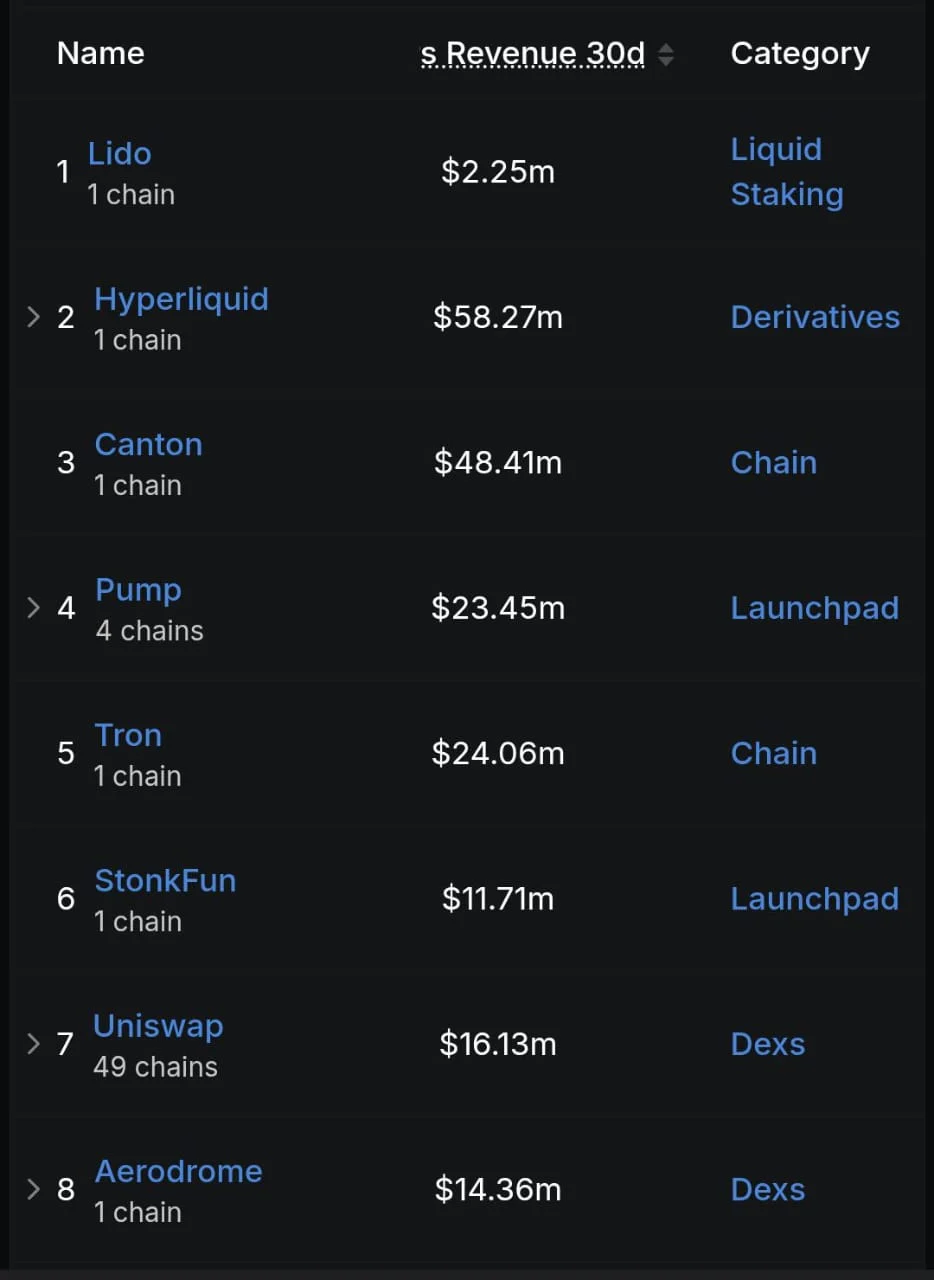
Hyperliquid firmly holds the top position, demonstrating a commanding lead with an impressive $58.27 million in holder revenue over the past 30 days. This figure significantly outstrips its nearest competitors, generating more revenue in a single month than the combined total of the next two entries on the list. Hyperliquid is a decentralized perpetual exchange that has rapidly gained prominence for its high performance and innovative trading features. Its tokenomics are designed with an aggressive value accrual mechanism: a substantial 99% of perpetual trading fees and up to 99% of spot trading fees are routed directly into the protocol’s Assistance Fund. This fund is then programmatically utilized to purchase HYPE, Hyperliquid’s native token, on the open market. This direct and substantial reinvestment of protocol revenue into its native token forms a robust and consistent buyback pressure, making Hyperliquid a standout example of a DeFi protocol effectively translating its operational success into tangible value for its token holders. The sheer volume of trading on Hyperliquid, driven by its sophisticated infrastructure and growing user base, fuels this aggressive buyback mechanism, cementing its position as a leader in the traditional buyback narrative.

2. Canton: The Quiet Giant of Institutional Blockchain
Surpassing numerous well-known DeFi protocols, Canton, a privacy-focused institutional blockchain, secures the second spot with a remarkable $48.41 million in 30-day holder revenue. Canton’s presence on this list is particularly noteworthy because its mechanism for value accrual diverges sharply from the discretionary buyback model. Unlike DeFi protocols where a team or DAO actively decides to execute market purchases, Canton’s value return is entirely structural and automatic. As a permissioned blockchain designed for enterprise applications, Canton charges various fees for network usage, including traffic purchases, preapproval burns, preapproval renewal burns, setup burns, dust expiry, holding fees, and sender-change fees. Every single one of these fees is burned outright as an intrinsic part of how the chain operates and charges for its services. There is no daily decision-making process for buybacks; the burn occurs instantaneously and automatically with every network activity.
This structural burning of fees makes Canton’s approach both highly efficient and transparent. While the term "buyback" might not apply in the traditional sense of a treasury purchasing tokens, DefiLlama’s definition of value returned to holders unequivocally includes such fee burns. Canton’s strong performance underscores the significant demand for privacy-preserving and compliant blockchain solutions within institutional finance, where its native token acts as the gas and value transfer mechanism. The consistent and increasing institutional adoption driving network activity directly translates into a continuous reduction of its token supply, demonstrating that robust underlying utility can be a powerful engine for value accrual.
3. Tron: A Veteran Chain’s Enduring Strength
Nudging out Pump by a narrow margin, Tron secures the third position with $24.06 million in 30-day holder revenue. Tron, a well-established Layer-1 blockchain known for its high throughput and extensive stablecoin ecosystem, employs a value accrual mechanism akin to Canton’s structural model. A predetermined share of every transaction fee generated on the Tron network is automatically burned as part of its standard operating procedure. This is not a discretionary decision made by the Tron DAO or any specific team; it is an immutable aspect of the chain’s protocol.
Tron’s enduring relevance is amplified by its robust ecosystem, which hosts a significant portion of the global stablecoin supply and a wide array of decentralized applications. The sheer volume of transactions, particularly those involving stablecoin transfers and DeFi activities, generates a continuous stream of network fees. A portion of these fees is permanently removed from circulation, creating a consistent deflationary pressure on the TRX token supply. This mechanism, similar to Ethereum’s EIP-1559, represents a powerful, silent engine of value accrual that often goes unnoticed in the more sensationalized discussions around token buybacks. The fact that two of the top three spots are occupied by base-layer fee burns, rather than governance token buybacks, highlights a crucial oversight in the popular "biggest buybacks in crypto" discourse, which tends to favor stories of active team management over algorithmic, protocol-level mechanics.
The Familiar Names: Where Traditional Buybacks Stand
While Hyperliquid, Canton, and Tron lead the pack, several other prominent DeFi protocols continue to implement significant buyback programs, demonstrating varied approaches to token value support.
Pump: Just behind Tron, Pump records $23.45 million in 30-day holder revenue. Pump is a platform known for its innovative bonding curve trading, PumpSwap, and its trading terminal. The figure for Pump aggregates PUMP token buybacks sourced from on-chain burns across these various platform activities. Its model represents a more traditional, albeit automated, form of token burning tied directly to user engagement and trading volume on its ecosystem.
Uniswap: Following Pump, Uniswap, the leading decentralized exchange, secured $16.13 million. This revenue figure is particularly significant as it follows the long-anticipated activation of its "fee switch." For years, the potential to redirect a portion of Uniswap’s trading fees to UNI token holders or for buybacks was a hotly debated topic. Its activation represents a major milestone, signaling a more direct value accrual mechanism for UNI holders and potentially setting a precedent for other established DeFi protocols.
Pons and Aerodrome: Pons comes in close behind Uniswap at $15.83 million, while Aerodrome registers $14.36 million. Aerodrome, despite its reputation as one of the most frequently cited buyback tokens in DeFi, especially within the Base ecosystem, currently ranks sixth on this broader list. Its ve(3,3) tokenomics model, designed to incentivize liquidity provision and reward long-term holders, contributes to its consistent, though not leading, position in holder revenue.
Other Significant Contributors: Further down the list, StonkFun contributes $11.1 million, consistent with its stated 60%-of-revenue buyback policy. Protocols like Sky, Aster, and Raydium each sit in the $4-5 million range for the same 30-day window, demonstrating that a wide array of projects are implementing various forms of value return to their communities.
Analyst Perspectives and Market Implications

The DefiLlama data serves as a critical corrective to market perceptions, suggesting a maturation in how value is perceived and accrued within the crypto economy. Blockchain analysts widely acknowledge that the "noise" in the market often gravitates towards discretionary buyback announcements from project teams, as these events tend to be more newsworthy and can generate short-term speculative interest. However, market observers note that the emergence of structural, chain-level fee burns at the top of these rankings points to a more fundamental and sustainable model of value accrual.
"The distinction is crucial for long-term investors," states a blockchain economist who preferred to remain anonymous due to institutional affiliations. "A discretionary buyback relies on team decisions, treasury management, and market timing. While effective, it can be inconsistent. A protocol-level fee burn, however, is a transparent, predictable, and continuous mechanism baked into the very economics of the network. It’s akin to a fundamental property of the asset, not a temporary corporate action."
This perspective highlights several key implications:
Investment Thesis Shift: Investors evaluating digital assets purely on a "buyback thesis" may need to broaden their scope. Prioritizing assets with robust, intrinsic fee-burning mechanisms, especially at the Layer-1 level, could offer a more stable and predictable long-term value proposition compared to protocols reliant on active management of buyback programs. The inherent transparency and algorithmic nature of chain-level burns reduce counterparty risk and offer greater clarity on future supply dynamics.
Sustainability and Transparency: Structural burns contribute to the long-term sustainability of a network’s tokenomics. They are less prone to market manipulation or changes in team strategy. Every transaction contributes directly to the scarcity of the asset, creating a virtuous cycle where increased network adoption directly benefits existing holders. This level of transparency in value accrual can foster greater trust and confidence among investors.
Competitive Landscape Redefined: The success of Canton and Tron in these rankings suggests a new competitive edge for Layer-1 blockchains. Beyond technical specifications like throughput and security, the effectiveness of a chain’s native value accrual mechanism could become a significant differentiator. Projects building on these chains also benefit from the underlying deflationary pressure, creating a more attractive environment for developers and users.
Market Education Imperative: The disparity between popular narrative and on-chain reality underscores a need for greater market education. Understanding the nuances between discretionary token purchases and structural network-level burns is vital for making informed investment decisions. As the crypto market matures, the ability to discern truly sustainable value accrual models from more ephemeral or discretionary ones will become increasingly important.
The Future of Tokenomics: Looking ahead, the trend highlighted by DefiLlama’s data suggests a potential shift towards hybrid tokenomics models. Protocols might increasingly seek to combine the agility of discretionary buybacks with the robust, foundational benefits of structural fee burns. This could involve Layer-2 solutions or dApps integrating a portion of their fees into the base layer’s burn mechanism, or designing their own automated, protocol-level burns that mimic the efficiency of Layer-1 chains. The ultimate goal remains consistent: to create tokenomics that effectively align the incentives of all stakeholders—users, developers, and holders—and drive sustainable growth and value in the decentralized economy.
In conclusion, while Hyperliquid’s aggressive buyback strategy rightly earns it the top spot, the true revelation from DefiLlama’s Holders Revenue rankings is the quiet, yet profound, impact of chain-level fee burns. Canton and Tron, with their automatic, structural mechanisms for reducing token supply, are demonstrating that value accrual in crypto is far more diverse and deeply embedded than often assumed. This data challenges the conventional understanding of "buybacks," urging the market to look beyond the headlines and delve into the fundamental architecture of blockchain networks to truly understand where value is being created and returned to holders. The distinction between a discretionary token purchase and a structural network-level burn is not merely semantic; it represents a fundamental difference in predictability, transparency, and long-term sustainability that every serious participant in the crypto ecosystem must acknowledge.