The 2026 FIFA World Cup has concluded not only as a historic sporting milestone but as a transformative moment for the integration of blockchain technology into global mainstream events. While traditional metrics underscored the tournament’s massive scale—drawing 6.8 million in total attendance, attracting $10.5 billion in advertising spend, and capturing a U.S. television audience of 66 million for the final match—newly released data from Chainalysis reveals an unprecedented surge in on-chain financial activity. According to the research, the tournament catalyzed $20 billion in prediction market volume from January 2026 through the tournament’s conclusion, alongside a burgeoning $24 million digital collectible economy.
This surge in decentralized finance (DeFi) and non-fungible token (NFT) activity marks a shift in how fans interact with global spectacles. For the first time, the "on-chain" economy of the World Cup moved beyond a niche interest into a multi-billion-dollar parallel infrastructure, providing a microcosm of how the world’s financial rails are evolving.
The Rise of Decentralized Prediction Markets
The most significant driver of on-chain volume was the explosion of decentralized prediction markets. Unlike traditional sportsbooks, these platforms allow users to trade shares in the outcome of events using smart contracts, often offering better odds and higher transparency than centralized counterparts. Chainalysis reports that approximately 400,000 unique digital wallets interacted with these markets, generating $5.7 billion in volume during the five-week tournament alone.

The scope of these bets ranged from standard match outcomes to highly specific "novelty" markets. For instance, a market predicting whether Portuguese legend Cristiano Ronaldo would cry at the end of his final World Cup campaign generated $49 million in volume. When the star eventually showed emotion following his team’s exit, the market settled in the affirmative.
The data suggests that these markets were not merely driven by speculative "gamblers" but by a sophisticated class of participants. Analysis shows that 55% of all bettors finished the tournament in profit. Within that successful group, nearly 80% were identified as experienced "prognosticators" with long histories of on-chain activity. This indicates that prediction markets are increasingly serving as a legitimate asset class for data-driven analysts rather than just casual sports fans.
A Chronology of On-Chain Activity: From Qualifiers to the Final
The financial momentum of the 2026 World Cup did not begin with the opening whistle in June; it was a year-long escalation that mirrored the intensity of the qualification rounds.
Phase I: The Build-Up (January – May 2026)
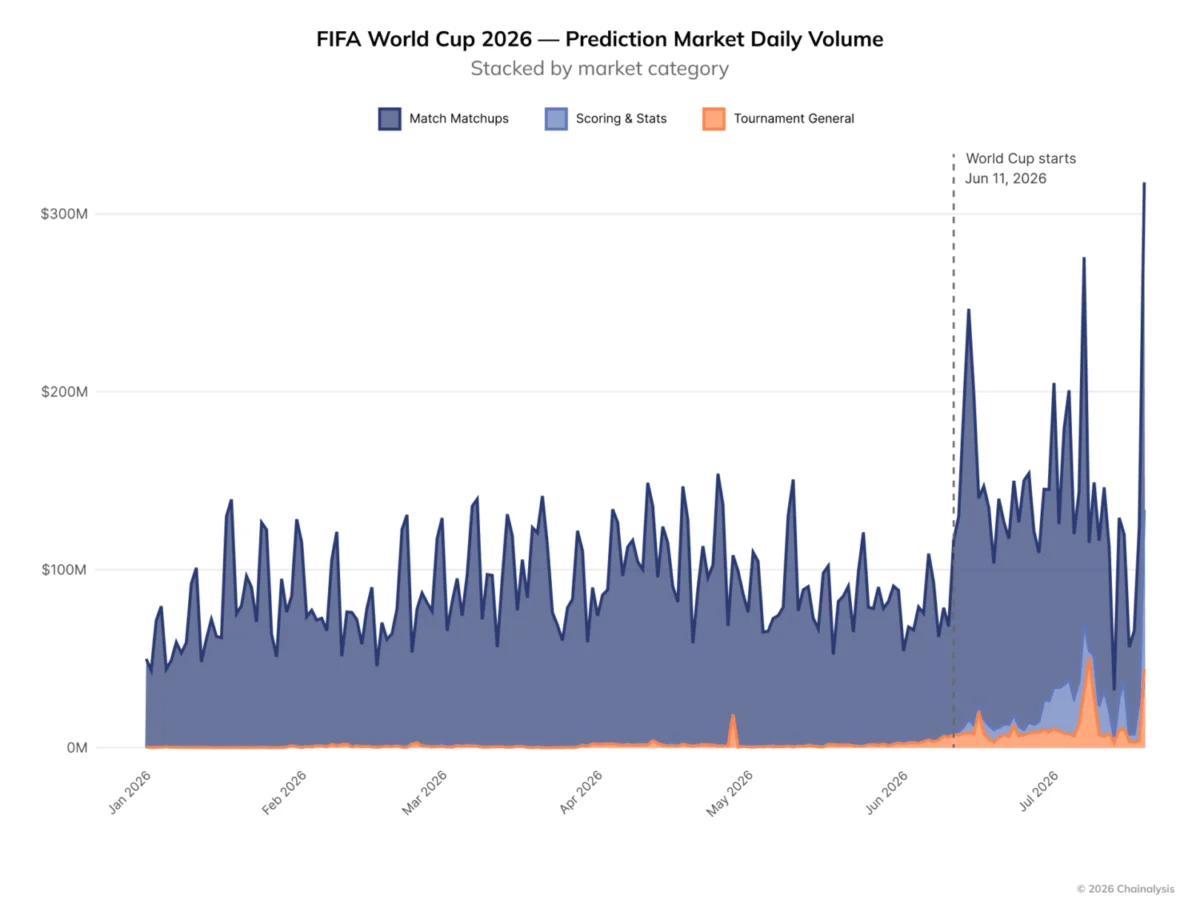
As national teams battled through the final stages of qualification in early 2026, on-chain prediction markets were already seeing daily volumes of nearly $50 million. Participants primarily focused on group placements and which teams would secure the final spots in the expanded 48-team roster. During peak qualification windows in March, daily activity frequently surpassed $100 million.

Phase II: The Tournament Kick-Off (June 11 – June 30, 2026)
When the tournament officially opened on June 11, the volume shifted into a higher gear. Daily transactions jumped to the $250 million range almost immediately. This period was characterized by high-frequency betting on group stage matches, where the sheer volume of games provided constant opportunities for market participants.
Phase III: The Knockout Stages and the Grand Finale (July 2026)
While the number of matches decreased as the tournament progressed into the knockout rounds, the "value per match" skyrocketed. The spacing of games led to slight dips in daily volume, but the intensity peaked during the championship match between Spain and Argentina. On the day Spain bested Argentina to claim the trophy, bettors powered over $300 million in volume on the final alone. Throughout the entire tournament window, World Cup-related bets accounted for a staggering 63% of all global prediction market activity.
FIFA Collect and the Evolution of Digital Ticketing
Parallel to the betting markets, FIFA’s official digital collectible initiative, "FIFA Collect," demonstrated the practical utility of NFTs in large-scale event management. Hosted on the Avalanche blockchain, the platform allowed fans to purchase "digital moments"—video highlights and commemorative assets—that functioned as more than just souvenirs.
A critical feature of FIFA Collect was its integration with real-world logistics. The platform provided an alternative access path to the tournament, allowing collectors to redeem specific NFTs for match tickets. This "right to buy" mechanism helped over 100,000 fans bypass the traditional, highly competitive ticket lotteries.

Chainalysis’s review of the smart contracts associated with FIFA Collect found that the platform generated $24 million in payments from May 2025 through the end of the tournament. The system operated on a stablecoin-powered economy, where FIFA captured a 5% commission on every secondary market transaction. This secondary market activity alone is estimated to have funneled at least $6 million in revenue directly to the organization.
The user demographic for FIFA Collect was split between "crypto-natives" and newcomers. While the majority of the $24 million came from experienced wallets, the platform successfully onboarded a significant number of new users who were drawn by the tangible benefit of ticket access rather than the speculative value of the NFTs.
Geographic Distribution: A Global Phenomenon
The on-chain data confirms that the 2026 World Cup was a truly global event, with participation spanning every continent. However, certain regions emerged as dominant hubs for blockchain-based betting.
The United States and China led the world in total prediction market volume. The high participation in the U.S. can be attributed to the country’s role as a primary host of the tournament and its maturing crypto-regulatory landscape. China’s high volume, despite restrictive domestic policies on cryptocurrency trading, underscores the persistent demand for decentralized financial tools in the region. Other top contributors included Canada, Thailand, and the United Kingdom.

Interestingly, the flow of funds into FIFA Collect was more concentrated among fans from the 48 qualifying nations. These users contributed $17.6 million of the $24 million total, suggesting that the "utility" of the NFTs (ticketing and team-specific memorabilia) was the primary driver of value for those with a direct stake in the tournament.
Compliance and the Challenge of Illicit Flows
As with any financial system of this scale, the 2026 World Cup on-chain economy was not immune to illicit activity, though the levels varied significantly between platforms.
In the open prediction market ecosystem, Chainalysis identified approximately 3,700 wallets—less than 1% of the total—with histories tied to illicit actors. The largest source of "tainted" volume came from the exchange Huobi (now HTX), which had been sanctioned by UK and EU authorities in early 2026 for allegedly facilitating Russian financial flows. Approximately $5.4 million in betting volume was traced back to Huobi-linked wallets. Other minor flows were connected to known scams and high-risk jurisdictions.
In contrast, the FIFA Collect platform remained remarkably "clean." The research attributed this to FIFA’s stringent Know Your Customer (KYC) protocols. To access the "right to buy" tickets or move significant funds, users underwent manual verification and source-of-wealth declarations. This robust compliance framework served as a deterrent for bad actors, resulting in negligible exposure to illicit funds.

Broader Impact and Future Implications
The success of on-chain initiatives during the 2026 World Cup provides a blueprint for the future of global sports and entertainment. The tournament proved that blockchain technology can handle massive transaction volumes under the pressure of a global spotlight, offering transparency and utility that traditional systems struggle to match.
The contrast between the "open" prediction markets and the "permissioned" FIFA Collect platform highlights an ongoing tension in the crypto industry. While open platforms drive massive volume and innovation, they require sophisticated monitoring tools to manage illicit risks. Conversely, permissioned platforms like FIFA Collect show that with proper compliance, blockchain can be safely integrated into the operations of the world’s most conservative organizations.
Industry analysts suggest that by the next World Cup cycle, the "on-chain" component of these events will no longer be considered a separate category of activity. Instead, digital ticketing, decentralized betting, and stablecoin-based commerce are likely to become the standard infrastructure for the global sports economy. As financial "rails" continue to move on-chain, the ability for regulators and organizations to track these flows in real-time will be paramount to maintaining the integrity of the world’s most-watched events.