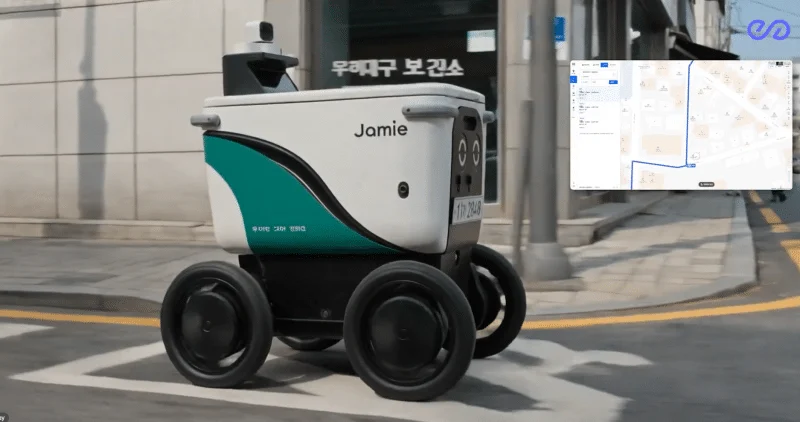
Peaq, a prominent layer 1 network focused on Decentralized Physical Infrastructure Networks (DePIN), has successfully demonstrated a simulated robotic delivery system that integrates onchain payment processing. This groundbreaking advancement, showcased through its marketplace, robotic.sh, operating on the peaqOS operating system, signals a significant step towards autonomous, blockchain-enabled real-world operations for machines. The demonstration vividly illustrated a Serve Robotics delivery robot navigating the bustling streets of Seoul, utilizing NAVER Maps for navigation, and seamlessly settling payments in Tether (USDT) on the Solana blockchain via Tether’s Wallet Development Kit (WDK).
The core innovation lies in the system’s ability to empower robots to access real-world digital services, make independent decisions, and execute financial transactions without any human intervention. This "no human in the loop" paradigm is central to peaq’s vision of a decentralized machine economy where machines can autonomously interact, transact, and provide services. The verifiable nature of blockchain transactions ensures transparency and trust, as all transaction records, wallet activities, and settlement data are permanently recorded and auditable onchain.
Genesis of the Autonomous Machine Economy
The concept of machines operating autonomously and participating in economic activities has long been a subject of science fiction and technological aspiration. However, the advent of blockchain technology, particularly with the rise of DePIN, has provided a tangible framework for realizing this vision. DePIN networks leverage blockchain to incentivize the creation and maintenance of physical infrastructure, from charging stations for electric vehicles to decentralized storage networks. Peaq is at the forefront of this movement, building a robust ecosystem that supports over 60 applications across more than 20 industries and connecting millions of machines and devices.
The recent demonstration by peaq is not an isolated event but rather a culmination of years of development in both robotic autonomy and blockchain integration. The partnership with Serve Robotics, a company renowned for its autonomous delivery robots, provides a practical use case for the technology. Serve Robotics has been a pioneer in deploying sidewalk robots for last-mile delivery, making their integration into a blockchain-enabled payment system a logical and impactful progression.
NAVER Maps, a dominant mapping service in South Korea, further grounds the simulation in real-world utility. The integration allows robots to access sophisticated navigation capabilities, a critical component for any mobile autonomous system. By making this integration available through robotic.sh, peaq is democratizing access to these essential services for any machine operating within its ecosystem.
The Technical Underpinnings and Workflow
The simulated workflow demonstrated by peaq highlights a sophisticated interplay of various technologies:
- Robotic Autonomy: Serve Robotics’ platform provides the physical robot and its autonomous navigation capabilities, enabling it to perceive its environment, plan routes, and execute movements.
- Mapping and Navigation: The integration with NAVER Maps allows the robot to access detailed, up-to-date map data, crucial for efficient and safe navigation in complex urban environments like Seoul. This could involve real-time traffic updates, road closures, and pedestrian traffic analysis.
- Decentralized Marketplace (robotic.sh): This marketplace, built on peaqOS, acts as a hub for machines to discover and access various services. It facilitates the discovery of navigation services, payment gateways, and other machine-accessible APIs.
- Blockchain Integration (Solana and Tether): Payments are settled on the Solana blockchain, known for its high transaction throughput and low fees, making it suitable for microtransactions. Tether (USDT), a stablecoin pegged to the US dollar, ensures price stability for the transactions.
- Tether Wallet Development Kit (WDK): The WDK from Tether enables seamless integration of USDT payments into the robot’s operational logic, allowing it to initiate and receive payments directly.
- peaqOS: The underlying operating system that enables machines to interact with the peaq network, access decentralized services, and manage their digital identity and assets.
The process, as described by peaq, would involve the robot receiving a delivery request. Its onboard AI would then query robotic.sh for available navigation services, opting for NAVER Maps. Upon route completion or a specific service milestone, the robot would automatically initiate a payment to the service provider (e.g., NAVER Maps for the navigation service) via USDT on Solana, facilitated by the WDK. This entire process can occur without human oversight, from service discovery to payment settlement.
The Significance of Onchain Payments for Machines
The ability for machines to make and receive payments autonomously has profound implications:
- Automation of Services: This eliminates the need for human intermediaries in many service transactions, reducing costs and increasing efficiency. For instance, a delivery robot could autonomously pay for charging at a compatible charging station or pay for access to a secure loading bay.
- New Business Models: It opens up possibilities for novel "as-a-service" models where machines can rent out their capabilities or pay for usage of shared infrastructure in real-time. Think of a drone paying a fee to use airspace managed by a DePIN network.
- Enhanced Trust and Transparency: Blockchain’s immutable ledger ensures that all payment transactions are transparent and auditable, building trust between different machine entities and service providers.
- Decentralized Service Economy: It fosters a truly decentralized economy where machines are not just users but active participants, capable of generating revenue and managing their own operational budgets.
- Reduced Friction in Machine-to-Machine Interaction: By standardizing payment protocols and leveraging blockchain, the friction in machine-to-machine interactions is significantly reduced, paving the way for more complex collaborations.
Expanding the DePIN Ecosystem
The launch of robotic.sh with a suite of machine-accessible services marks a significant expansion of the peaq ecosystem. Beyond navigation, the marketplace currently supports a diverse range of services, including:
- AI Inference Tools: Enabling robots to access powerful AI models for tasks like image recognition, natural language processing, or predictive analytics.
- Search and Data Platforms: Allowing machines to query vast datasets or specialized information sources.
- Cloud-Based Analytics: Providing computational power for data processing and analysis.
- CAPTCHA Solving: Facilitating the automated verification of human vs. bot interactions, crucial for preventing bot abuse on decentralized platforms.
- Decentralized Storage: Enabling robots to securely store and retrieve data on decentralized networks.
This comprehensive offering underscores peaq’s commitment to building a versatile platform for the machine economy. The key differentiator is that any mobile robot, autonomous vehicle, drone, or humanoid operating on peaqOS can access these services, irrespective of the underlying blockchain network the machine itself utilizes. This interoperability is crucial for fostering a widespread adoption of DePIN technologies.
Data and Market Context
The global market for robotics is experiencing exponential growth. According to Statista, the revenue in the robotics market is projected to reach $190.30 billion in 2024. The autonomous last-mile delivery segment, in particular, is poised for significant expansion, driven by e-commerce growth and the demand for faster delivery. This growth presents a fertile ground for peaq’s DePIN solutions.
The integration of blockchain into these autonomous systems addresses critical challenges such as secure payment processing, service attribution, and the creation of a decentralized marketplace for machine-to-machine services. The use of Solana for onchain payments is strategic, given its ability to handle a high volume of transactions at low cost, essential for the frequent, small-value transactions that might occur in a machine economy.
Tether’s involvement, through its WDK, further validates the practical application of stablecoins in facilitating real-world transactions for autonomous systems. The stability offered by USDT mitigates the volatility risks associated with other cryptocurrencies, making it a more reliable medium of exchange for business operations.
Future Implications and Analyst Perspectives (Inferred)
While peaq’s announcement is based on a simulation, the implications are far-reaching. Analysts in the DePIN and blockchain space are likely to view this as a significant proof of concept that bridges the gap between the digital and physical worlds for autonomous agents.
"This demonstration by peaq is a crucial step in realizing the vision of a truly autonomous machine economy," might comment a fictional blockchain analyst. "By enabling robots to not only perform tasks but also to autonomously manage their own payments and access services, peaq is laying the groundwork for a future where machines are active economic participants, not just tools."
The scalability of this model will be a key factor in its long-term success. As more robots and autonomous systems are deployed, the demand for decentralized services and secure, efficient payment mechanisms will only increase. Peaq’s focus on interoperability, allowing machines on different blockchains to interact with its ecosystem, is a smart strategy for broad adoption.
Challenges remain, including regulatory frameworks surrounding autonomous vehicle payments, cybersecurity of decentralized machine identities, and the robustness of the underlying blockchain infrastructure under massive load. However, peaq’s proactive approach in developing and demonstrating such integrated solutions suggests a clear pathway towards addressing these challenges.
The successful implementation of such systems could lead to:
- Reduced operational costs for logistics companies: By automating payment processes and service access.
- Increased efficiency in urban logistics: Faster, more seamless delivery operations.
- Development of new urban infrastructure services: such as automated charging networks or dynamic parking payment systems for autonomous vehicles.
- Enhanced data security and integrity: through the use of blockchain for all transactions and service interactions.
Conclusion
Peaq’s simulated robotic delivery system represents a significant leap forward in the integration of blockchain technology with autonomous physical systems. By enabling onchain payments and seamless access to digital services for machines, peaq is not just building infrastructure; it is fostering a new era of machine-driven economic activity. The successful demonstration, featuring Serve Robotics and NAVER Maps, highlights the tangible potential of DePIN to revolutionize industries and create a more automated, efficient, and transparent future. As the DePIN landscape continues to mature, peaq’s contributions are likely to be pivotal in shaping the autonomous machine economy.