



The digital asset market has witnessed a significant reshuffling of its top-tier rankings as BNB, the native utility token of the Binance ecosystem, reclaimed its position as the fourth-largest cryptocurrency by market capitalization, successfully overtaking XRP. This recent price action has reignited a fierce debate among market analysts and institutional investors regarding the long-term ceiling for the asset. While optimistic projections suggesting a climb toward the $2,000 mark are grounded in current fundamental growth, more aggressive forecasts of $10,000 to $20,000 per token face a rigorous mathematical reality that would require the entire cryptocurrency sector to expand far beyond its current institutional footprint.
The trajectory of BNB has been defined by its transition from a simple exchange-based discount token to the foundational layer of a sprawling decentralized finance (DeFi) ecosystem. However, as the asset matures, its valuation is increasingly scrutinized through the lens of traditional market cap mechanics and global liquidity trends. According to a comprehensive breakdown by the prominent market analyst known as Crypto Patel, the feasibility of "moon-shot" price targets is inextricably linked to the token’s deflationary supply model and the broader expansion of global crypto dominance.
The Mathematical Framework of a $10,000 BNB
To understand the gravity of a $10,000 or $20,000 price target, one must analyze the relationship between circulating supply and market capitalization. BNB currently maintains a market capitalization of approximately $80.6 billion. For the asset to reach a price of $10,000 per token, assuming it reaches its ultimate supply goal of 100 million tokens through its aggressive burn mechanism, the resulting market capitalization would be $1 trillion.
A $1 trillion valuation would place BNB in a rarefied atmosphere currently occupied only by Bitcoin and a handful of the world’s most valuable technology corporations, such as Microsoft, Apple, and Nvidia. At a $20,000 price point, the market cap would soar to $2 trillion. To put this in perspective, a $2 trillion valuation for a single asset would exceed the total combined value of the entire cryptocurrency market during several periods of its history. As Crypto Patel noted in his analysis, any suggestion that such targets are "near-term" is likely based more on speculative marketing than on sound financial modeling. For BNB to achieve these heights, the total crypto market cap would likely need to exceed $10 trillion to $15 trillion, representing a massive influx of sovereign wealth and institutional capital.

Historical Context and the Burn Mechanism
The evolution of BNB’s value is inseparable from its supply-side economics. Launched in 2017 via an Initial Coin Offering (ICO), BNB originally operated as an ERC-20 token on the Ethereum blockchain before migrating to its own proprietary network. A core pillar of its value proposition is the commitment by Binance to reduce the total supply from 200 million tokens to 100 million.
This reduction is achieved through two primary mechanisms:
- The Quarterly Auto-Burn: A programmatic system that uses a formula based on the price of BNB and the number of blocks generated on the BNB Chain during the quarter to determine the amount of tokens to be removed from circulation.
- The BEP-95 Real-Time Burn: Introduced in late 2021, this mechanism burns a portion of the gas fees spent on the BNB Chain in real-time, mirroring the deflationary pressure seen in Ethereum’s EIP-1559.
The historical peak mentioned in recent analyses—an all-time high of approximately $1,370—demonstrated the market’s willingness to price the asset at a valuation near $185 billion. Reclaiming this level is viewed by many as the first "realistic" milestone in a renewed bull cycle.
The Battle for the Second Spot: Can BNB Overtake Ethereum?
Having successfully distanced itself from XRP, the next structural milestone for BNB is the "flippening" of Ethereum. This is a significantly more difficult hurdle. Currently, BNB would need to trade at approximately $1,500—surpassing its previous record high—just to match Ethereum’s current market capitalization of roughly $203 billion.
However, market dynamics are rarely static. A market environment that pushes BNB to $1,500 would almost certainly see Ethereum’s valuation rise as well, as both assets benefit from the same "rising tide" of capital inflow. For BNB to legitimately overtake Ethereum, it would need to demonstrate superior growth in on-chain metrics, such as Total Value Locked (TVL), daily active users, and developer retention.

While Ethereum remains the dominant force in institutional smart contract adoption, the BNB Chain has carved out a massive niche in the retail sector due to its lower transaction costs and high throughput. The recent growth in Real World Asset (RWA) tokenization on the BNB Chain, which recently hit a value of $3 billion, suggests that the network is diversifying its utility beyond simple retail trading and meme coins.
Structural Risks and the Binance Concentration Factor
One of the most significant obstacles to BNB’s exponential growth is what analysts describe as "concentration risk." Unlike Bitcoin, which is decentralized and lacks a single point of failure, or Ethereum, which has a diverse ecosystem of developers and stakeholders, BNB’s value is heavily tethered to the health and reputation of the Binance exchange.
The utility of BNB—ranging from trading fee discounts and Launchpad participation to its role as the gas token for the BNB Chain—is largely driven by the Binance user base. Consequently, regulatory headwinds facing the exchange have a direct and often outsized impact on the token’s price. The 2023 settlement between Binance and the U.S. Department of Justice (DOJ), which resulted in a $4.3 billion fine and the resignation of founder Changpeng Zhao (CZ), served as a stress test for the asset.
While the transition to new leadership under Richard Teng has stabilized the platform, any future legal challenges or shifts in global exchange dominance would represent a "systemic risk" for BNB holders. For the token to reach the $10,000 mark, the BNB Chain would likely need to achieve a level of decentralization and independence where the success of the network is no longer strictly dependent on the survival of the Binance exchange.
Chronology of Key Events Shaping BNB’s Current Valuation
To understand where BNB is going, it is essential to look at the timeline of its recent recovery and growth:
- Late 2023: Following the DOJ settlement, BNB experienced a period of high volatility but maintained a support level above $200, signaling strong holder conviction.
- Q1 2024: The introduction of opBNB (a Layer 2 scaling solution) and BNB Greenfield (a decentralized storage provider) expanded the technical utility of the ecosystem.
- May 2024: BNB regained its position as the #4 cryptocurrency, surpassing XRP in market capitalization amid a broader altcoin recovery.
- Late 2024/Early 2025: Projections suggest a retest of the $1,000 psychological barrier as the supply burn continues to reduce the circulating float.
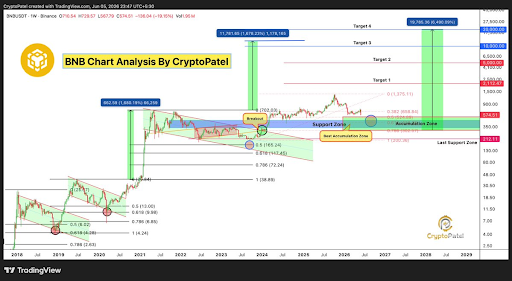
- 2029 Target: Crypto Patel’s long-term chart analysis suggests that if the current growth trajectory and burn rate continue, a $20,000 price point could be mathematically feasible by the end of the decade, provided the global crypto market cap reaches the double-digit trillions.
Implications for the Broader Crypto Market
The rise of BNB serves as a case study for the "Platform Token" model. If BNB can sustain a move toward $2,000 and beyond, it validates the idea that utility-driven tokens can compete with "pure" stores of value like Bitcoin. Furthermore, the success of the BNB Chain’s low-cost model has forced competitors like Ethereum to accelerate their own scaling solutions (Layer 2s) to remain competitive.
However, the "believable bull case" remains centered on the $2,000 to $3,000 range. This level would represent a 2x to 3x increase from previous highs and is consistent with the growth patterns seen in previous crypto cycles. Targets of $10,000 or more remain in the realm of long-term "macro-theses" that rely on the total transformation of the global financial system into a blockchain-based infrastructure.
Conclusion: A Measured Outlook for Investors
In summary, while the technical charts provided by analysts like Crypto Patel show a theoretical path to $20,000 by 2029, the immediate focus for the market remains on the asset’s ability to break through the $1,000 resistance level. The path to a $1 trillion market cap is fraught with regulatory hurdles, competitive pressures from other Layer 1 blockchains, and the necessity of a massive expansion in global liquidity.
For BNB to reach its maximum potential, it must continue to shed its image as "the exchange token" and solidify its status as a foundational layer of the global decentralized internet. Until then, the $2,000 target remains the most logical milestone for the current cycle, while the $10,000 dream serves as a distant beacon for those betting on the total dominance of the Binance-led ecosystem.














