The global cryptocurrency landscape has undergone a profound transformation, evolving from a speculative asset class into a multifaceted financial infrastructure that serves diverse needs across different economic strata. According to the recently released seventh annual Geographies of Cryptocurrency report, the period between July 1, 2025, and June 30, 2026, represented one of the most volatile yet resilient chapters in the history of digital assets. While the market endured a staggering $2.1 trillion contraction in total capitalization—marking a 50% drawdown—the underlying economic activity remained remarkably stable. The world’s crypto economy, measured by service inflows, domestic peer-to-peer (P2P) activity, and cross-border transfers, shrank by a mere 1.6% to $9.4 trillion, compared to $9.5 trillion in the preceding twelve-month period.
This resilience signals a decoupling of price action from utility. For institutional allocators in Western markets, cryptocurrency has increasingly become a vehicle for tokenized asset trading and technological modernization. Conversely, for the Global South, digital assets, particularly stablecoins, have transitioned into a critical lifeline, facilitating rapid value transfer and providing a necessary hedge against local political and economic instability. This year’s data suggests that while "crypto winter" chilled speculative fervor, the practical application of blockchain technology for payments and savings reached an all-time high.

The 2026 Bear Market: A Study in Economic Fortitude
The 2026 reporting period witnessed a market correction of historic proportions. Bitcoin, the industry’s bellwether, reached a new all-time high before suffering its largest dollar-value retreat on record, plunging $67,000 from peak to trough. This volatility triggered memories of the 2022 collapses, yet the economic fallout in 2026 was significantly more contained. In the 2023 bear market, a much smaller market cap contraction of $0.3 trillion resulted in a 23% drop in global value flows. In contrast, the 2026 period saw a massive $2.1 trillion market cap loss, yet value flows only dipped by 1.6%.
This discrepancy is attributed to the growing diversity of use cases. In previous cycles, the crypto economy was almost entirely driven by speculative trading; when prices fell, activity vanished. In 2026, however, the "utility phase" of cryptocurrency appeared to have reached a critical mass. As prices halved, users were forced to move twice as much of an asset to settle the same dollar-denominated debt or payment, which paradoxically kept on-chain volume high despite the lower valuation of the assets.
The Stablecoin Surge and Cross-Border Commerce
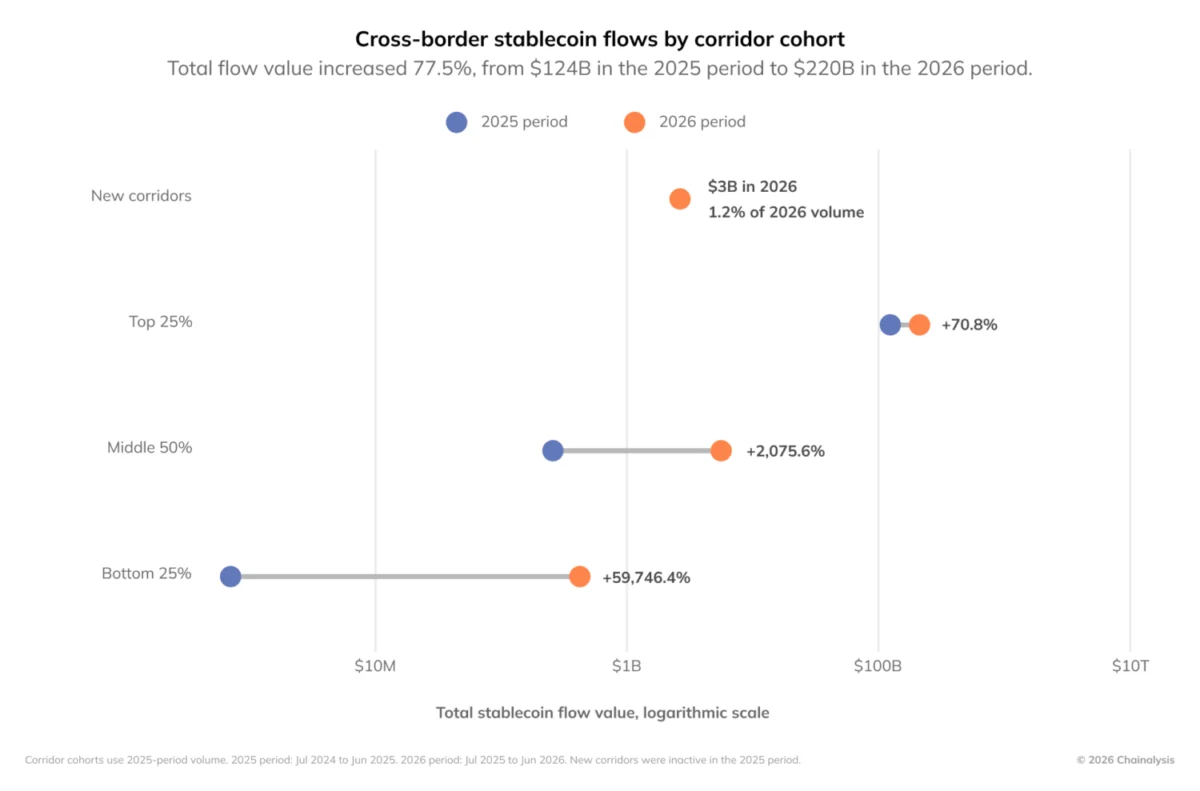
The primary engine of this economic stability has been the explosive growth of stablecoins. Once viewed merely as "on-ramps" for trading, stablecoins are now the primary medium for global commerce in emerging markets. Monthly cross-border stablecoin value more than doubled during the reporting period, rising from $11 billion in January 2025 to $24 billion by June 2026. On an annual basis, stablecoins moving across international borders rose 77.5%, reaching $220.3 billion.

These transfers are not driven by high-frequency institutional traders but by everyday business needs. The average transaction size for cross-border stablecoin flows hovered around $3,000, a figure consistent with small-to-medium enterprise (SME) supply chain payments, worker remittances, and personal savings transfers. Philip Gradwell, Vice President of Economics at Tether, noted that activity has become consistent and rhythmic rather than bursty. This steady pulse is the hallmark of trade and business activity rather than speculation.
The adoption of stablecoins has also been accelerated by a wave of global regulatory clarity. The implementation of the GENIUS Act in the United States, alongside the established Markets in Crypto-Assets (MiCA) framework in the European Union and proactive licensing regimes in Japan, Hong Kong, Singapore, and the United Kingdom, has provided businesses with the legal certainty required to integrate stablecoins into their balance sheets.
The Rise of Peer-to-Peer Economies and Self-Custody
A significant shift occurred in how users interact with the crypto economy during the 2026 drawdown. While value flowing into centralized exchanges and Decentralized Finance (DeFi) protocols fell by 4.3% ($9.30 trillion to $8.90 trillion), direct transfers between personal wallets—the P2P economy—surged by 302.9%. Domestic P2P activity grew from $56.8 billion to $228.7 billion, increasing its share of the total crypto economy in every one of the eight regions tracked.

This pivot toward P2P activity is largely a response to the "payment-ification" of crypto. Centralized exchanges are often price-sensitive; their volumes fluctuate with market sentiment. P2P transfers, which are now 96% denominated in stablecoins, are price-agnostic. A user sending $100 via a stablecoin is unaffected by the volatility of Bitcoin or Ethereum. This behavior suggests that in regions with high currency volatility, such as Sub-Saharan Africa and parts of Latin America, users are bypassing traditional financial intermediaries entirely, favoring the instant settlement and low cost of on-chain P2P transfers.
Regional Leaders: Brazil and the Latin American Pivot
Brazil has emerged as the global leader in grassroots crypto adoption for 2026. While the country did not rank first in any single sub-category, its consistent performance across service flows, P2P activity, and on-chain balances secured its top position. Brazil’s $252.5 billion crypto economy has become a model for how a large, developing nation can integrate digital assets into its formal financial system.
Latin America as a whole bucked the global trend, growing its crypto economy by 9.8% period-over-period. This growth was fueled by a collective regional pivot to stablecoins as a hedge against local currency devaluation. In countries like Argentina and Mexico, cryptocurrency is no longer a niche tech interest but a mainstream financial tool used to preserve purchasing power.

Sub-Saharan Africa also showed exceptional resilience, leading the world in P2P growth. In many African nations, the lack of traditional banking infrastructure has allowed mobile-based crypto wallets to become the primary method for both domestic and international value transfer.
Retail Participation and Institutional Resilience
Despite the "crypto winter" narrative, retail-level participation showed surprising growth. Transfers under $100 rose by 78.4%, while transfers between $100 and $1,000 rose by 58.6%. Although these small-dollar inflows represent a fraction of the total volume—roughly $273 billion—they indicate that the barrier to entry is lowering and that grassroots users are not being deterred by market volatility.
Institutional flows ($1 million or more) also proved resilient, dropping only 7.2% despite the 50% market cap contraction. The fact that institutional volume remained steady while the value of the underlying assets plummeted suggests that institutional players are not just holding assets but are actively utilizing them for settlement, liquidity provision, and cross-border arbitrage.

Methodology and Adoption Metrics
The 2026 report introduces a refined methodology for measuring grassroots adoption, designed to capture the "many identities" of crypto. The index ranks 117 countries based on a geometric mean of four sub-indexes:
- Service Inflows: Total value received by centralized and decentralized services.
- On-chain Balances: The total USD value of crypto held in wallets and on services.
- P2P Economy: Value moving directly between personal wallets within a country.
- Cross-border Flows: Value moving from a wallet in one country to a wallet in another.
To ensure accuracy, Chainalysis weights these values by purchasing power parity (PPP) and GDP per capita. This prevents high-wealth nations from dominating the rankings simply due to larger raw dollar volumes and highlights countries where crypto is making the most significant impact relative to the local economy. For example, while the United States ranks first in total raw volume, Brazil’s consistent performance across all metrics, including high P2P and cross-border usage, makes it the leader in grassroots adoption.
Implications for the Global Financial Future
The data from the 2026 reporting period suggests that the cryptocurrency market has entered a new phase of maturity. The decoupling of on-chain economic activity from asset prices indicates that the technology is being used for its intended purpose: as a decentralized, global financial rail.

Stablecoins, in particular, have established themselves as an "anchor" in the digital economy. While non-stablecoin balances fell by 55.6% during the drawdown, stablecoin balances remained steady between $98 billion and $109 billion. This stability has allowed for the opening of thousands of new "trade corridors"—economic pathways between countries that were previously underserved by traditional finance due to high costs or regulatory restrictions. Chainalysis tracked 4,708 new corridors in the 2026 period alone, carrying a cumulative $2.64 billion.
As the world moves toward 2027, the focus of the crypto industry appears to be shifting away from the "get rich quick" speculative cycles of the past and toward the "stay solvent" utility of the present. With Brazil leading the way and stablecoins providing the infrastructure, the 9.4 trillion dollar crypto economy is no longer just a digital experiment; it is a permanent and increasingly vital component of the global financial system.