


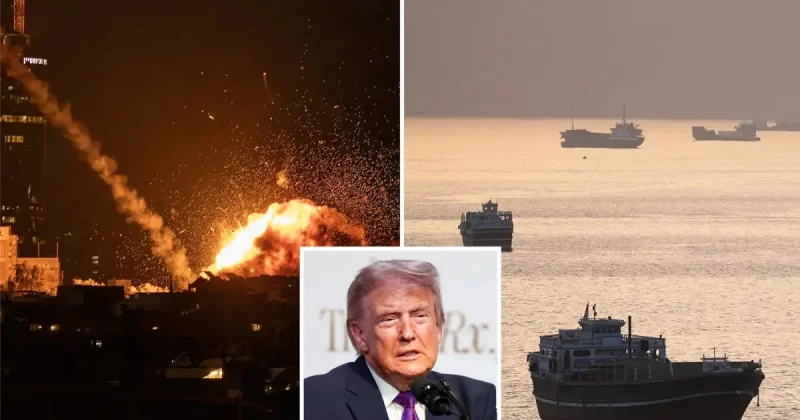
The Commodity Futures Trading Commission (CFTC) has initiated a comprehensive investigation into a series of oil futures transactions totaling more than $800 million that were executed just days before a significant policy shift was announced via social media by the Trump administration. The federal regulatory body is currently scrutinizing the timing and concentration of these trades to determine if they were the result of material non-public information (MNPI) leaked from within the government. The investigation centers on whether specific market participants had advanced knowledge of a reversal in U.S. military strategy toward Iran, a move that fundamentally altered global energy pricing within minutes of its public disclosure.
The transactions in question occurred on March 23, a period of heightened geopolitical friction. Only three days later, on March 26, a social media post from President Trump revealed that the United States had abruptly called back planned military strikes against Iranian targets. This revelation sent shockwaves through the global commodities markets, as the sudden pivot from imminent conflict to de-escalation immediately recalibrated the risk premium associated with Middle Eastern crude oil supply. For those who had positioned themselves in the futures market on March 23, the announcement represented a massive windfall, raising red flags within the CFTC’s market surveillance division.
The Mechanics of the Investigation and the Role of MNPI
At the heart of the CFTC’s inquiry is the concept of material non-public information. While the term "insider trading" is most commonly associated with the Securities and Exchange Commission (SEC) and the stock market, the commodities equivalent is governed by the Commodity Exchange Act. Under federal law, it is illegal to trade on the basis of non-public information that has been misappropriated or provided in breach of a duty. In this instance, the CFTC is attempting to trace the origin of the $800 million in trades to see if a "tip" originated from a government official, a military advisor, or a staff member with access to the President’s decision-making process.
The $800 million figure is particularly striking to analysts because of its density. While the oil market is one of the most liquid in the world, with billions of dollars in nominal value changing hands daily, a concentrated surge of nearly a billion dollars in specific futures contracts—landing precisely 72 hours before a major geopolitical reversal—is statistically anomalous. The CFTC’s surveillance systems are designed to detect these "spikes" in volume that occur in the absence of public news, as they often suggest that a segment of the market is acting on information that the broader public does not yet possess.
A Chronology of Geopolitical Volatility and Market Reaction
To understand the gravity of the investigation, one must look at the timeline of events that led to the market disruption. In the weeks leading up to March 23, tensions between Washington and Tehran had reached a boiling point. Military analysts and energy traders alike were pricing in a high probability of kinetic conflict, which typically drives oil prices higher due to the threat of supply disruptions in the Strait of Hormuz—a maritime chokepoint through which approximately 20% of the world’s petroleum passes.
On March 23, the suspicious trades were executed. At this time, the prevailing public sentiment was one of escalation. Consequently, the market was largely biased toward "long" positions (bets that prices would rise). However, if the $800 million in trades involved "short" positions or the closing of long positions, it would suggest the traders knew a de-escalation was coming.
On March 26, the social media post was published. The disclosure that strikes had been called off acted as a "dovish" shock to the market. Crude oil prices, which had been bolstered by a "war premium," saw an immediate and sharp correction. Traders who were "short" or had moved to the sidelines based on the March 23 activity avoided significant losses or secured massive profits. The three-day window between the trades and the announcement is the primary focus of the CFTC, as it represents a sufficient gap for information to travel from high-level government briefings to sophisticated trading desks.
Supporting Data: The Scale of the Oil Futures Market
The scale of the energy market provides context for why an $800 million trade is significant enough to warrant a federal probe. The West Texas Intermediate (WTI) and Brent Crude futures markets are the global benchmarks for oil pricing. A single futures contract represents 1,000 barrels of oil. An $800 million position, depending on the price of oil at the time, could represent tens of thousands of contracts.
In a standard trading session, such volume might be distributed among thousands of participants. However, if this volume was concentrated among a few entities, it suggests institutional-level conviction. The CFTC uses "Large Trader Reporting" data to see who holds these positions. If the data shows that the entities behind the March 23 trades do not typically trade at that scale, or if they have links to political circles, the case for an MNPI violation strengthens.
Furthermore, the volatility index for oil (OVX) often spikes during such events. On March 26, the volatility was not just a result of the news itself, but of the speed at which the news was delivered. Traditional policy changes are often vetted through the State Department or the Pentagon and released via formal press conferences, allowing the market to absorb the information in a structured manner. The use of social media for such disclosures creates a "low-latency" environment where those with even a five-second head start can gain a multi-million dollar advantage.
Official Responses and Regulatory Precedents
While the CFTC has declined to comment on the specifics of the ongoing investigation, sources familiar with the agency’s protocols indicate that the Market Surveillance Division is working alongside the Division of Enforcement. This suggests that the inquiry has moved beyond a routine check and into a formal investigation.
Historically, the CFTC has been aggressive in pursuing "front-running" and the misuse of government information. In previous years, the agency has investigated suspicious trading activity surrounding OPEC (Organization of the Petroleum Exporting Countries) meetings and Department of Energy inventory reports. However, the "Presidential Social Media" variable introduces a new challenge for regulators. Unlike a corporate board, where the flow of information is strictly documented, the White House is a more fluid environment. Proving that a specific individual leaked a decision to a trader requires a "smoking gun," such as encrypted messages, phone logs, or testimony from a whistleblower.
Market participants have expressed a mix of concern and pragmatism. "The markets rely on the integrity of the information flow," stated one senior commodities strategist at a major New York firm. "If there is a perception that certain players have a direct line to policy shifts before they hit the wires, it undermines the entire price discovery mechanism. It turns a transparent market into a rigged game."
Broader Implications for Governance and Market Integrity
The outcome of this investigation could have lasting implications for how government communications are handled. If the CFTC finds evidence of wrongdoing, it may lead to stricter protocols regarding how and when sensitive geopolitical decisions are shared with the public. It also highlights the growing risk of "information asymmetry" in the digital age.
For investors, the investigation is a reminder that the commodities market is increasingly influenced by "headline risk." In the past, oil prices were driven by supply and demand fundamentals—drilling reports, refinery utilization, and global consumption data. Today, a single post on a social media platform can be more impactful than a month’s worth of fundamental data. This shift has forced hedge funds and algorithmic trading firms to develop tools that scrape social media in real-time, but even the fastest algorithm cannot compete with someone who has the information three days in advance.
Finally, the $800 million probe underscores the CFTC’s evolving role. As the agency expands its oversight into digital assets and more complex derivatives, its ability to police the traditional energy markets remains its cornerstone. The investigation is not just about oil; it is about the intersection of statecraft and finance. If the "calendar-like" timing of these trades is proven to be the result of a leak, the resulting enforcement action would likely be one of the most significant in the history of the CFTC, serving as a warning to both government insiders and the institutional traders who court them.
As the probe continues, the industry awaits a determination that will define the boundaries of "fair play" in an era where the most valuable commodity is not the oil itself, but the knowledge of when the next policy shift will be broadcast to the world. For now, the $800 million question remains: was it a brilliant hedge, or a coordinated exploit of state secrets? The CFTC’s final report will be the definitive word on a case that has captivated the financial world.














