


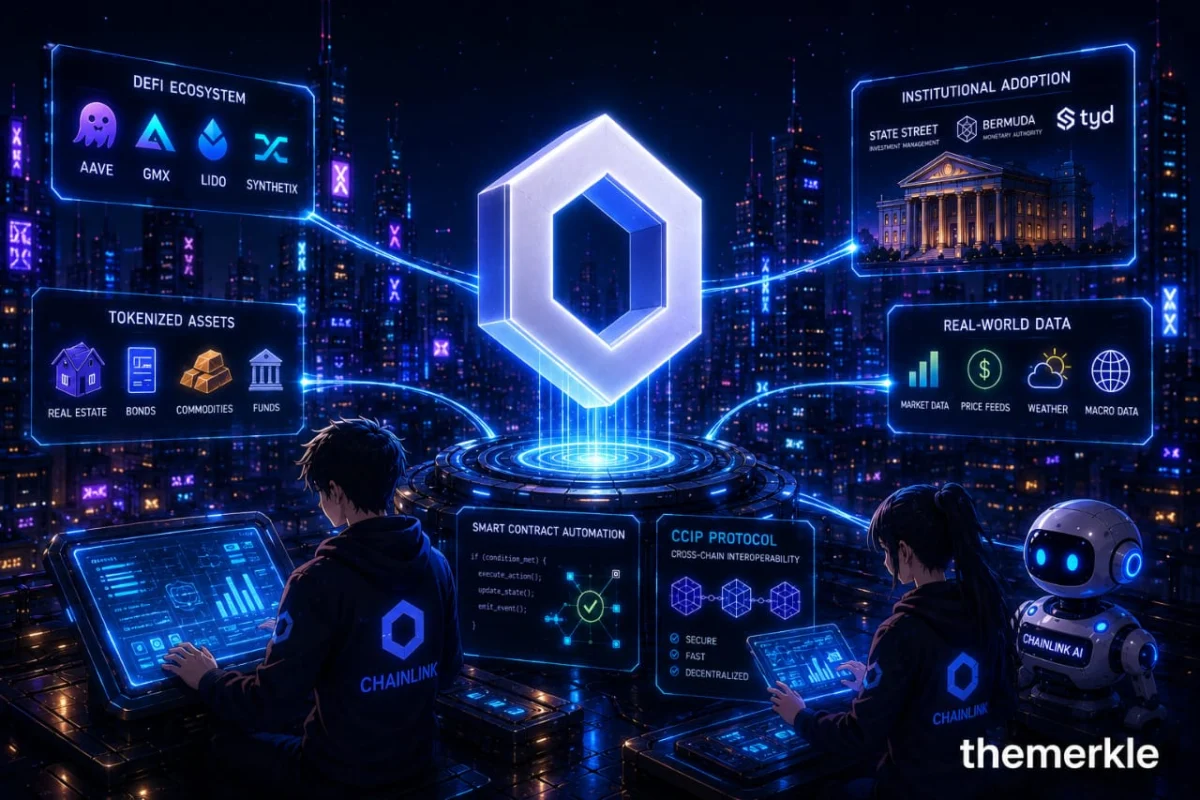
Chainlink is significantly expanding its footprint as a foundational infrastructure layer within the cryptocurrency ecosystem, announcing 10 new integrations that span six distinct services across 14 different blockchains. This latest wave of adoption underscores a growing reliance from both established DeFi protocols and prominent institutional actors on Chainlink’s robust infrastructure, particularly for managing tokenized assets, securing data oracles, enabling smart contract automation, and facilitating critical cross-chain communication.
The developments were unveiled in Chainlink’s official new adoption report, which highlighted several high-profile institutions and platforms actively implementing Chainlink standards into their operational frameworks. Among the noteworthy recent integrations are financial behemoths like Galaxy and State Street Investment Management, alongside innovative DeFi protocols such as KelpDAO, Solv Protocol, and Tyd, and even regulatory bodies like the Bermuda Monetary Authority. This diverse set of adoptions signals a critical maturation point for the blockchain industry, where reliable, secure, and interoperable infrastructure is becoming paramount for future growth.
Chainlink’s Evolving Role in a Tokenized Future
The expansion of Chainlink’s network arrives amidst a broader industry push towards establishing interoperable blockchain infrastructure specifically designed to support tokenized finance, institutional-grade products, and the representation of real-world assets (RWAs) on-chain. As the movement of assets and applications onto blockchain networks accelerates, the demand for dependable data feeds and secure cross-chain messaging solutions has become urgent, paving the way for the next evolution of the crypto economy.
Chainlink, originally recognized primarily as a decentralized oracle network provider, has strategically evolved its mission. The network now positions itself as a comprehensive decentralized computing platform, serving as a critical layer for decentralized finance (DeFi), institutional settlement solutions, and multi-chain tokenized asset ecosystems. This shift reflects a deliberate strategy to move beyond its initial niche, addressing a wider array of challenges in connecting on-chain and off-chain environments.
A key trend highlighted by the recent integrations is the migration of significant core infrastructure from top protocols directly onto Chainlink. The adoption report notes that the expanding network effect within Chainlink’s ecosystem is further amplified by four protocols, collectively holding over $3 billion in total value locked (TVL), migrating substantial parts of their operations to Chainlink’s infrastructure across various key ecosystems. This consolidation signifies a growing trust in Chainlink’s security, reliability, and scalability, as major players seek to leverage battle-tested solutions rather than develop bespoke, potentially vulnerable, in-house alternatives.
Institutional Momentum: Bridging Traditional Finance and Blockchain
Perhaps the most significant characteristic of this latest stage of adoption is the increasingly large number of institutional and regulated entities integrating Chainlink’s services. While Chainlink initially captured significant market share through its indispensable role in DeFi applications, its continuous development has expanded its applicability to banks, asset managers, regulatory bodies, and enterprise platforms seeking a robust and secure connection point between traditional finance (TradFi) and blockchain ecosystems.
The integration of State Street Investment Management, a global asset manager with a long-standing and substantial footprint in traditional capital markets, is particularly noteworthy. State Street Corporation, a financial services and bank holding company, is one of the oldest financial institutions in the United States and one of the largest asset managers globally, with trillions of dollars under management. Its engagement with Chainlink signals a strategic recognition of blockchain’s potential for tokenization, real-time settlement, and programmable financial infrastructure. This move by such a prominent institution underscores the growing demand among institutional participants for secure, proven middleware capable of managing complex financial data and settlements at scale within a blockchain context. These institutions require the highest standards of operational assurance, data integrity, and compliance, which Chainlink’s decentralized oracle networks and interoperability solutions are designed to provide.
Equally significant is the engagement of the Bermuda Monetary Authority (BMA). Bermuda has positioned itself as a progressive jurisdiction for digital assets, establishing clear regulatory frameworks for digital asset businesses. The BMA’s integration identifies a higher regulatory scrutiny on blockchain infrastructure providers, and its decision to adopt Chainlink standards validates the network’s robust governance, security, and interoperability capabilities. When regulatory agencies evaluate blockchain technology, their focus invariably includes issues of systemic risk, data accuracy, and the ability to operate within established legal and compliance frameworks. Chainlink’s long-standing track record and commitment to security make it an attractive partner for regulators exploring the digital asset space.
Analysts interpret this trend as a slow but inexorable blending of traditional finance with decentralized networks. For many financial institutions, blockchain technology is no longer an experimental curiosity but a strategic imperative. They are actively working towards implementing tokenization strategies, exploring real-time settlement mechanisms, and building programmable financial infrastructure. Chainlink’s ability to provide secure external data feeds, bundled with standardized interoperability tools like its Cross-Chain Interoperability Protocol (CCIP), makes it a uniquely appealing option in this evolving landscape. For institutions to confidently enter and operate within blockchain markets, a reliable piece of infrastructure that seamlessly connects on-chain systems with off-chain financial data is essential, providing the necessary operational assurance and facilitating continuous improvements based on the consensus of monitored networks.
Such increasing levels of institutional interest are crucial for sustaining Chainlink’s pivotal role in the tokenized physical world asset (RWA) sector. Analysts widely predict that RWAs, which involve representing tangible assets like real estate, commodities, or even intellectual property on a blockchain, are poised to become one of the largest crypto markets by volume in the coming years. Chainlink’s secure oracles are vital for bringing real-world data – such as asset valuations, legal statuses, or environmental metrics – onto the blockchain, enabling the trustworthy operation of tokenized RWA platforms.
DeFi Protocols Consolidate and Migrate to Proven Infrastructure
Simultaneously with rising institutional adoption, decentralized finance protocols are increasingly consolidating their core infrastructure onto Chainlink. The latest report highlights that several customers from the largest DeFi platforms, representing multi-billion-dollar TVL, have migrated to Chainlink’s services, solidifying its position as a focal point for decentralized systems.
The migration announcement specifically called out projects like KelpDAO, Solv Protocol, ‘re’, and Tydro. These integrations significantly expand Chainlink’s footprint within critical areas of DeFi, including liquid staking derivatives (e.g., KelpDAO for restaking), yield generation platforms (both Web2 & Web3), tokenized Bitcoin infrastructure, and sophisticated cross-chain financial applications. For instance, Solv Protocol focuses on institutional DeFi and tokenized funds, while ‘re’ (formerly Realio Network) is involved in tokenizing real-world assets. Tydro aims to build cross-chain liquidity solutions. These diverse applications demonstrate the breadth of Chainlink’s utility beyond simple price feeds.
Chainlink has emerged as a de facto industry standard for secure price oracles, smart contract automation, cryptographic proof systems, and robust interoperability for a vast array of DeFi platforms. Protocols operating in high-stakes environments rely on the assurance that Chainlink’s infrastructure can handle extreme market conditions, a capability proven through years of operation and stress-tested resilience during periods of high volatility and network congestion.
As the DeFi ecosystem matures, protocols are becoming more selective about their infrastructure providers. They increasingly prioritize partners with an established operational history, a proven track record of security, and the ability to withstand complex cyber threats. The crypto landscape has seen billions of dollars lost over the years due to vulnerabilities in poorly designed oracle systems or unreliable cross-chain messaging solutions, making security a non-negotiable requirement.
Consequently, many projects now prefer to integrate with mature, battle-tested infrastructure providers like Chainlink rather than undertaking the costly, time-consuming, and risky endeavor of building custom solutions in-house. This preference represents a massive boon for Chainlink, given its current support for dozens of blockchain networks and thousands of smart contracts globally, offering a standardized, secure, and widely adopted solution.
The movement of several billion-dollar protocols to Chainlink also signifies a broader consolidation trend in crypto infrastructure. Rather than piecing together fragmented systems across different chains, many platforms are opting for standardized infrastructure layers that can scale efficiently across multiple blockchain environments, streamlining development, reducing complexity, and enhancing overall security.
Accelerating Cross-Chain Expansion and Interoperability
The new adoption report emphatically underscores that interoperability is no longer a niche concern but a primary area of focus and competition for blockchain developers. Chainlink’s integration across 14 different chains is a direct reflection of the escalating demand for infrastructure that can seamlessly transfer real-world assets, data, and arbitrary messages using secure protocols across various blockchain platforms.
For the past few years, blockchain ecosystems have been steadily moving away from operating in isolated silos. Instead, liquidity, applications, and users increasingly flow between networks, driven by factors such as transaction costs, processing speed, and the availability of specific opportunities. This dynamic environment creates a strong and continuous demand for robust interoperability solutions that actively help to avoid fragmentation within the wider crypto economy and unlock the full potential of a multi-chain future.
Chainlink has dedicated substantial resources to building specific tools tailored for this complex landscape, most notably its Cross-Chain Interoperability Protocol (CCIP). CCIP is a groundbreaking framework that enables smart contracts and decentralized applications to communicate securely and reliably across various disparate blockchain networks without relying on insecure or centralized bridges, which have historically been a major source of exploits and financial losses in the crypto space. CCIP employs a decentralized network of Chainlink oracle nodes to verify cross-chain transactions, ensuring integrity and security.
The new integrations signal that an increasing number of projects are actively preparing themselves for this inevitable multi-chain future. Instead of limiting their ecosystems to a single blockchain, they are seeking infrastructure that is inherently scalable across numerous environments while maintaining uncompromised performance and security. This strategic foresight allows projects to tap into broader liquidity pools, reach wider user bases, and build more resilient applications.
Chainlink Strengthens its Infrastructure Dominance
This wave of adoption represents yet another significant step in cementing Chainlink’s position as one of the most deeply embedded and critical infrastructure networks in the entire crypto industry. In contrast to many other middleware projects that offer similar services but often within specific, sometimes nascent, ecosystems with limited users and liquidity, Chainlink provides solutions that are widely adopted and integrated across nearly all prominent areas of the crypto economy.
Today, Chainlink provides essential services across a broad spectrum of on-chain activity, including decentralized finance (DeFi), stablecoins, tokenized assets, institutional settlement solutions, AI-integrated applications, and sophisticated cross-chain interoperability. This continually growing scope and breadth of services magnifies the powerful network effects upon which the Chainlink ecosystem thrives, attracting more users, developers, and institutions, which in turn further enhances its utility and security.
As aptly summarized in an official update, Chainlink’s vision is to "LINK everything," articulating the belief that "Chainlink has the potential to become a key layer of connective infrastructure for the blockchain economy." By gradually expanding its capabilities and integrations into nearly every major category of on-chain activity, rather than focusing solely on a single niche, Chainlink is positioning itself as the foundational backbone for the future of decentralized and tokenized global finance. This strategic expansion and deep integration across diverse sectors reinforce its role as an indispensable component of the evolving digital economy.
Disclosure: This is not trading or investment advice. Always conduct thorough research before engaging in any cryptocurrency investments or services.














