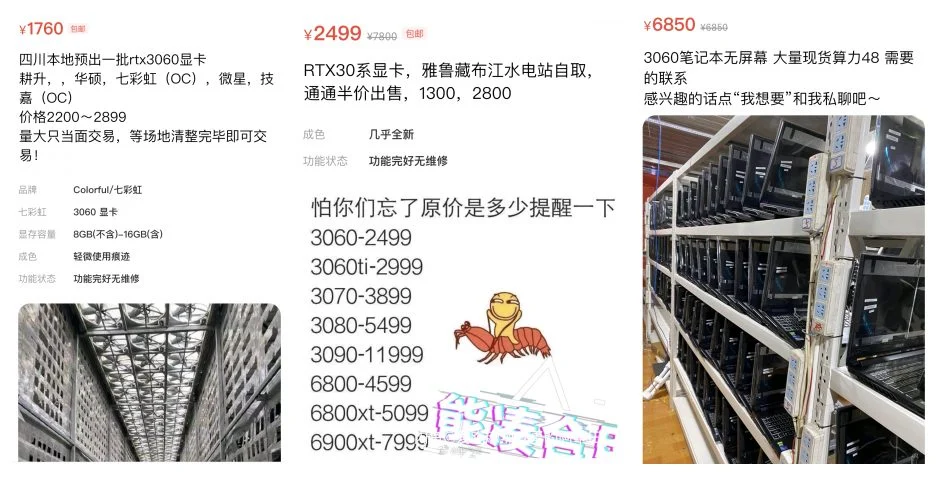
The secondary market for graphics processing units (GPUs) in China is currently witnessing an unprecedented influx of hardware as cryptocurrency miners liquidate their inventories in response to the government’s intensifying regulatory offensive. Following a series of sweeping bans on digital asset mining and trading, thousands of high-end graphics cards, including the highly sought-after Nvidia RTX 30-series and AMD RDNA2 architectures, are flooding online marketplaces at prices significantly below their original retail valuations. This mass exodus of hardware marks a pivotal shift in the global cryptocurrency landscape, signaling the end of China’s long-standing dominance in the mining sector and offering a potential reprieve for a global gaming community that has been besieged by supply shortages for nearly two years.
Reports from various Chinese e-commerce platforms and regional secondary markets indicate that Nvidia RTX 3060 units are being listed for as low as $270. To put this in perspective, the RTX 3060 carried an official launch price of $329, but due to the global semiconductor shortage and the height of the mining boom, these cards frequently commanded prices exceeding $800 on the open market. The current fire sale also extends to more powerful hardware; the RTX 3070 is being spotted for approximately $400, while the RTX 3060 Ti is fetching around $350. These prices represent a dramatic correction from the inflated figures seen earlier this year, reflecting a desperate attempt by mining operations to recoup capital as their domestic business models become legally and logistically untenable.
The Catalyst: China’s Regulatory Iron Fist
The sudden availability of these GPUs is the direct result of a coordinated campaign by the Chinese government to dismantle the domestic cryptocurrency mining industry. For years, China was the undisputed center of the Bitcoin mining world, at one point accounting for over 65% of the global hashrate. This dominance was fueled by access to inexpensive hydroelectric power in provinces like Sichuan and Yunnan, as well as coal-fired plants in Inner Mongolia and Xinjiang.
The tide turned decisively in mid-2021 when the State Council’s Financial Stability and Development Committee, led by Vice Premier Liu He, announced a crackdown on Bitcoin mining and trading activities. The government cited concerns over financial stability, the environmental impact of energy-intensive mining, and the potential for money laundering. Following this directive, local authorities moved with startling speed. In Inner Mongolia, "snitch" hotlines were established for citizens to report mining operations. In Sichuan, often referred to as the "mining capital of the world," power companies were ordered to immediately cease supplying electricity to any entity suspected of mining digital assets.
This regulatory environment has left Chinese miners with two primary options: relocate their operations abroad—a process dubbed the "Great Migration"—or liquidate their assets. For smaller and medium-sized operations, the logistical hurdles and costs associated with moving thousands of machines to regions like Texas, Kazakhstan, or Russia are insurmountable, leading to the massive sell-off currently observed in the used GPU market.
Market Dynamics and the "Bulk Buy" Caveat
While the headline-grabbing prices of $270 for an RTX 3060 are enticing, the reality for the average consumer is more complex. Most of these transactions are not occurring on a single-unit basis. Sellers are primarily targeting large-scale distributors or international wholesalers, often requiring minimum orders of 100 to 200 units. This bulk-only approach is designed to clear out massive inventories as quickly as possible before further regulatory measures or price drops occur.
Furthermore, the liquidation is not limited to traditional desktop cards. In a peculiar twist of the mining boom, some operators had turned to high-end gaming laptops when desktop GPUs became unavailable. These "mining laptops," equipped with mobile versions of the RTX 3060, are now appearing on the used market for roughly $1,000 per unit. Despite the steep discounts, these items are not selling as quickly as anticipated. The hesitation among buyers stems from a combination of technical concerns and the sheer volume of supply currently saturating the market.

Technical Risks: The Stigma of Mining-Used Hardware
For the gaming community and hardware enthusiasts, the prospect of cheap GPUs comes with significant caveats. Graphics cards used in professional mining operations are typically subjected to extreme conditions. Unlike gaming, where a card might experience variable loads for a few hours a day, mining requires the GPU to run at 100% load, 24 hours a day, seven days a week.
While many professional miners undervolt their cards to maximize efficiency and reduce heat, they also frequently overclock the video memory (VRAM) to improve hashing performance. Prolonged exposure to high temperatures can lead to several issues:
- VRAM Degradation: The constant heat can cause the solder joints on memory chips to become brittle or the chips themselves to fail prematurely.
- Fan Failure: Cooling fans are mechanical components with finite lifespans; a year of continuous mining is equivalent to several years of typical gaming usage.
- Thermal Paste and Pad Wear: The interface materials used to transfer heat from the silicon to the heatsink often dry out or leak silicone oil under constant thermal stress, necessitating immediate maintenance by the buyer.
- Lack of Warranty: Most manufacturers explicitly state that using a consumer-grade card for industrial mining voids the warranty. Buyers of these Chinese "dump" cards have virtually no recourse if the hardware fails shortly after purchase.
Broader Industry Implications and the Shift to Proof-of-Stake
The influx of used cards from China coincides with broader shifts in the cryptocurrency ecosystem that are further dampening the demand for GPU mining. Most notably, Ethereum—the primary cryptocurrency mined using GPUs—is in the final stages of its transition from a Proof-of-Work (PoW) consensus mechanism to Proof-of-Stake (PoS). Known as "The Merge," this transition will render GPU mining for Ethereum obsolete, removing the single largest driver of global graphics card demand.
Nvidia CEO Jensen Huang recently addressed these market shifts, noting that the combination of increased supply and the Ethereum transition would naturally lead to better availability for gamers. To further protect the gaming market, Nvidia introduced "Lite Hash Rate" (LHR) versions of its RTX 30-series cards, which utilize software and hardware limiters to reduce mining efficiency. The combination of these LHR cards and the flood of used non-LHR cards from China is creating a "perfect storm" for price normalization.

The Rise of the Digital Yuan
As China clears the field of decentralized cryptocurrencies, it is aggressively accelerating the rollout of its own Central Bank Digital Currency (CBDC), the digital yuan (e-CNY). By eliminating the competition from Bitcoin and other private digital assets, the People’s Bank of China (PBOC) aims to create a state-controlled digital payment ecosystem that offers the efficiency of blockchain technology without the volatility or anonymity associated with traditional crypto. Recent pilot programs in cities like Shanghai and Beijing have seen millions of dollars in digital yuan distributed to citizens, signaling that the "void" left by the mining ban is being systematically filled by state-backed alternatives.
Global Market Outlook and Bitcoin Price Action
The global impact of the Chinese crackdown is already being felt beyond the hardware market. In Western nations, Bitcoin miners are seeing increased profitability as the global hashrate dropped, reducing the difficulty of mining new blocks. This has led to a surge in investment in North American mining infrastructure, with companies like Riot Blockchain and Marathon Digital Holdings expanding their operations to capture the market share vacated by Chinese firms.
From a price perspective, Bitcoin continues to experience significant volatility. At the time of reporting, Bitcoin (BTC) is trading near the $33,000 mark, showing a modest 2% gain over a 24-hour period but remaining down approximately 1% on the weekly chart. The market appears to be in a consolidation phase, struggling to break through the $35,000 resistance level. Analysts suggest that until the uncertainty surrounding global regulations and the environmental impact of mining is resolved, the market may remain range-bound.
In conclusion, the fire sale of GPUs in China is a landmark event in the history of the semiconductor and cryptocurrency industries. While it offers a glimpse of hope for gamers looking to upgrade their systems, it also serves as a stark reminder of the power of state intervention in the digital economy. As the "Great Migration" continues and the used market stabilizes, the industry is moving toward a new era where mining is more geographically distributed and, increasingly, decoupled from the consumer graphics card market. For now, the "Golden Age" of Chinese mining has ended, leaving behind a mountain of discounted silicon and a transformed global landscape.