


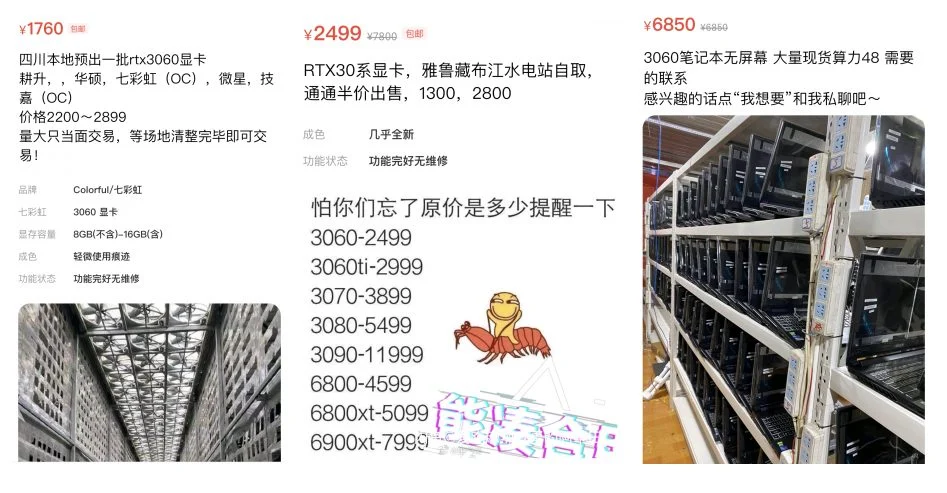
The landscape of the global graphics processing unit (GPU) market is undergoing a seismic shift as Chinese cryptocurrency miners begin liquidating their hardware inventories at a scale rarely seen in the technology sector. Following a series of aggressive regulatory maneuvers by the Chinese government to dismantle the domestic mining industry, the second-hand market in East Asia has been flooded with thousands of Nvidia and AMD graphics cards. This sudden influx of supply has driven prices for popular models, such as the Nvidia RTX 3060, to as low as $270, a figure significantly below their previous market value during the height of the crypto-mining boom.
The mass sell-off serves as a direct consequence of Beijing’s intensifying hostility toward decentralized digital assets. As provincial governments across China—from Sichuan to Inner Mongolia—enforced power cuts and shuttered mining facilities, operators were left with a stark choice: relocate their entire infrastructure abroad or liquidate their hardware to recoup capital. For many small-to-mid-sized operations, the logistical hurdles and costs of international migration have proven insurmountable, leading to the current fire sale of high-end computer components.
The Economics of the GPU Fire Sale
The sheer volume of hardware entering the secondary market has created a buyer’s market with unprecedented price drops. Recent listings on Chinese e-commerce platforms and specialized hardware forums show a dramatic depreciation in value for the Nvidia Ampere and AMD RDNA2 architectures. The RTX 3060, which frequently commanded prices upwards of $800 during the peak of the global chip shortage, is now being spotted for approximately $270. Higher-tier cards are following a similar trajectory, with the RTX 3070 and RTX 3060 Ti being listed for roughly $400 and $350, respectively.
However, these attractive price points come with a significant caveat: the "bulk-only" requirement. Most sellers are not interested in individual consumer transactions. Instead, they are offloading their inventory in lots ranging from 100 to 200 units. This strategy is designed for a quick exit, targeting large-scale resellers or international buyers who can manage the logistics of moving massive quantities of hardware. Furthermore, the liquidation extends beyond desktop components; even gaming laptops equipped with RTX 3060 GPUs, which were repurposed for mining due to the scarcity of standalone cards, are being sold for around $1,000 per unit.
Chronology of the Chinese Regulatory Crackdown
The current market saturation is the result of a multi-month campaign by Chinese authorities to eliminate cryptocurrency activities within their borders. To understand the scale of the sell-off, one must look at the timeline of events that led to this hardware exodus:
- May 2021: The Financial Stability and Development Committee of the State Council, led by Vice Premier Liu He, announced a crackdown on Bitcoin mining and trading activities. This marked the first time the central government explicitly targeted mining at a high level.
- June 2021: Following the central government’s directive, major mining hubs including Xinjiang, Qinghai, and Yunnan began issuing shut-down orders. The most significant blow came when Sichuan, a province known for its abundant hydroelectric power, ordered the closure of 26 major mining projects.
- Late June 2021: China’s oldest cryptocurrency exchange announced it would cease its Bitcoin business, signaling a broader retreat of the industry from the mainland.
- July 2021: The People’s Bank of China (PBOC) intensified its pressure on banks and payment institutions to cut off links to crypto-related transactions, effectively choking the financial on-ramps and off-ramps for miners.
This systematic dismantling of the industry has forced an estimated 50% to 70% of the global Bitcoin hash rate to go offline or migrate, resulting in the "Great Mining Migration" and the subsequent hardware glut.
Technical Concerns: The Hidden Cost of Used Mining Cards
While the low prices are tempting for gamers and workstations users who have been priced out of the market for over a year, industry experts warn of the risks associated with "ex-mining" GPUs. Unlike cards used for gaming, which experience fluctuating workloads, mining cards are typically run 24 hours a day, seven days a week, often under overclocked conditions to maximize hash rates.
The primary concern for potential buyers is the longevity of the hardware. Constant heat cycles and high-speed fan operation can lead to several issues:
- VRAM Degradation: Cryptocurrencies like Ethereum are highly memory-intensive. Constant high temperatures on the Video RAM (VRAM) can lead to stability issues and artifacts over time.
- Fan Failure: Cooling fans are mechanical parts with a finite lifespan. Mining cards often exhaust the bearing life of fans much faster than typical usage.
- Thermal Pad Wear: The thermal pads used to dissipate heat from memory chips often leak silicone oil or dry out under the sustained high-heat conditions of a mining rig, necessitating immediate maintenance by the buyer.
These technical risks, combined with the lack of manufacturer warranties for cards sold in the second-hand market, have contributed to the slow movement of stock despite the aggressive pricing.

Broader Market Implications and the Global Chip Shortage
The influx of used Chinese GPUs coincides with a broader easing of the global semiconductor shortage. In regions like Europe, particularly Germany and Austria, retail prices for new graphics cards have reportedly dropped by as much as 40% from their May peaks. The combination of increased retail supply and the flood of used cards from China is creating a "perfect storm" that could finally bring GPU prices back toward their original Manufacturer’s Suggested Retail Price (MSRP).
Furthermore, the cryptocurrency industry itself is undergoing a fundamental shift that reduces the demand for GPUs. Ethereum, the most profitable coin for GPU mining, is in the process of transitioning from a Proof-of-Work (PoW) consensus mechanism to Proof-of-Stake (PoS). This transition, often referred to as "The Merge," will eliminate the need for graphics cards to secure the network. Nvidia CEO Jensen Huang has acknowledged this shift, noting in recent interviews that the availability of GPUs for gamers is likely to improve as the mining craze subsides.
The Rise of the Digital Yuan in the Crypto Void
As China clears the field of decentralized cryptocurrencies, it is aggressively filling the vacuum with its own Central Bank Digital Currency (CBDC), the digital yuan (e-CNY). The crackdown on mining is viewed by many analysts as a strategic move to eliminate competition for the e-CNY and to maintain strict control over capital flows. By removing the energy-intensive mining industry, China also moves closer to its stated goal of achieving carbon neutrality by 2060, as the mining sector was heavily criticized for its reliance on coal power in certain provinces.
Impact on the Bitcoin Network and Price Action
The hardware sell-off is a physical manifestation of the volatility currently facing the Bitcoin network. At the time of this report, Bitcoin (BTC) continues to struggle with a significant resistance level at $35,000. The digital asset has been trading in a range-bound fashion, oscillating around the $33,000 mark. While the network’s difficulty has adjusted downward to account for the loss of Chinese miners—making it more profitable for Western miners to operate—the market sentiment remains cautious.
Western mining companies, particularly those based in North America and Kazakhstan, are the primary beneficiaries of this shift. As Chinese miners dump their hardware or sell their operations, North American firms are scaling up, capitalizing on the reduced global competition and the availability of cheaper hardware. However, the immediate "dumping" of GPUs on the Chinese market suggests that many smaller players are simply exiting the space rather than attempting to compete on a global stage.

Conclusion: A Turning Point for the Hardware Industry
The massive liquidation of GPUs in China marks the end of an era for the cryptocurrency industry in the region and a potential turning point for the global PC hardware market. For over two years, the "mining tax" on graphics cards made high-end gaming and professional rendering prohibitively expensive for the average consumer. The current flood of used inventory, while risky for the uninitiated buyer, signals a return to a more balanced supply-and-demand dynamic.
As China continues to test its digital yuan and enforce its ban on decentralized mining, the global distribution of hashing power will continue to decentralize, moving toward regions with more stable regulatory environments and renewable energy sources. In the meantime, the second-hand markets of East Asia remain a testament to how quickly a multi-billion dollar industry can be dismantled by the stroke of a regulator’s pen. Whether the global market can absorb this hardware without a total price collapse remains to be seen, but for the first time in years, the "GPU drought" appears to be reaching its conclusion.














