



Kimi K3’s Ascendancy in Key Benchmarks
The arrival of Kimi K3 has sent ripples through the AI community, primarily due to its exceptional performance across a range of rigorous evaluations. In the "Towards AI’s Writing Elo" benchmark, a sophisticated system that assesses a model’s ability to generate realistic scripts judged blindly against published versions using a chess-like Elo ranking, Kimi K3 achieved an impressive score of 2,840. This placed it decisively above Claude Fable 5, which scored 2,760, a remarkable feat considering Anthropic’s historical dominance in this particular domain. The benchmark’s creator, Louis-François Bouchard of Towards AI, highlighted the dramatic improvement, noting K3’s jump from 21st place (its predecessor Kimi K2.6) to the top spot for writing in their editorial voice, while maintaining an approximate cost of $0.25 per script, a fivefold efficiency improvement.
K3’s prowess extends beyond creative writing. It also claimed the coveted top position on Arena AI’s Frontend Code Leaderboard, another Elo-scored ranking based on thousands of human-voted pairwise comparisons of code generation tasks. Here, K3 registered 1,679 points, surpassing Fable 5’s 1,631. This dominance was comprehensive, with K3 securing first place in six out of seven frontend development domains, underscoring its robust capabilities in practical application development.
Further validation of K3’s comprehensive intelligence comes from the Artificial Analysis Intelligence Index. This composite score, derived from nine independent evaluations covering coding, reasoning, agentic work, and knowledge, places K3 at 57 points. While Claude Fable 5 slightly edged it out at 60, and GPT-5.6 Sol scored 59, K3 still landed as the third-most capable model on this broad index, with Claude Opus 4.8 trailing at 56. The mere 3% difference between K3 and Fable 5 on this comprehensive evaluation highlights K3’s near-frontier intelligence.
Additional independent assessments further solidify K3’s competitive edge. On BridgeBench, Kimi K3 demonstrated superior performance against Fable 5 in head-to-head blind judging panels, winning seven out of eight arenas. Notably, K3 achieved a resounding 9-0 victory in refactoring tasks and a 6-1 win in debugging, with Fable 5’s only win attributed to speed. This outcome is particularly significant given Fable 5’s prior impressive 142-36 record against GPT 5.6 Sol, illustrating K3’s unexpected strength. Furthermore, Guillermo Rauch, CEO of Vercel, announced that Kimi K3 became the best-performing model on Vercel’s comprehensive web engineering benchmark, achieving a comparable success rate in less time than Fable, marking a historic moment for an open-source model surpassing all proprietary counterparts in this domain.
For a tangible demonstration of its capabilities, Moonshot AI presented a zero-shot result of Kimi K3 building an iOS clone from a simple prompt. This highly complex task, typically requiring elaborate prompting and significant computational resources from other models like GPT-5.6 Sol, was handled by K3 with remarkable efficiency, showcasing its advanced understanding and generation abilities in real-world application development.
Architectural Marvel: Powering K3’s Performance
At the heart of Kimi K3’s unprecedented performance lies a sophisticated architecture boasting 2.8 trillion parameters. Parameters are the fundamental numerical values that encode a model’s acquired knowledge, and K3’s scale dwarfs many of its contemporaries. It employs a Mixture-of-Experts (MoE) architecture, a design paradigm that partitions these parameters into 896 specialized "expert" subnetworks. Crucially, for any given task, only a fraction of these experts are activated, allowing K3 to achieve frontier-level intelligence without incurring the prohibitive computational costs and energy consumption typically associated with such massive models. This intelligent resource allocation is key to its efficiency.
Moonshot AI proudly states that Kimi K3 is "the world’s first open-source model in the 3-trillion-parameter class, designed for frontier intelligence scenarios including long-horizon coding, knowledge work, and reasoning." This is not mere marketing rhetoric; K3 approximately doubles the parameter count of its nearest open-weight competitors. For instance, DeepSeek’s V4-Pro, a notable Chinese open-source model, caps out at 1.6 trillion parameters, while Moonshot’s own predecessor, Kimi K2, stood at one trillion. This substantial increase in scale, combined with its MoE design, positions K3 as a monumental achievement in open-source AI development.

Beyond its sheer size and MoE architecture, K3 incorporates several innovative architectural techniques that underpin its remarkable efficiency gains. The "Kimi Delta Attention" mechanism significantly accelerates decoding for long sequences, achieving up to 6.3 times faster processing at million-token contexts. This is critical for handling complex tasks that require extensive contextual understanding, such as long-form scriptwriting or intricate coding projects. Additionally, "Attention Residuals" optimize information routing across the model’s layers. Instead of uniformly accumulating information, this technique selectively channels it, leading to approximately 25% better training efficiency with less than 2% extra compute cost. Together, these innovations yield roughly 2.5 times better scaling efficiency compared to its predecessor, Kimi K2, demonstrating Moonshot AI’s deep commitment to fundamental research and optimization.
The model also features a one-million-token context window, allowing it to process and understand vast amounts of information—equivalent to about three-quarters of a word per token—in a single interaction. This massive context window is invaluable for complex tasks requiring deep comprehension and memory. Furthermore, K3 boasts native image and video understanding capabilities, alongside always-on reasoning, making it a multimodal powerhouse capable of interacting with and interpreting diverse forms of data.
Cost-Effectiveness and Market Disruption
While Kimi K3’s performance metrics are undeniably impressive, its pricing strategy further solidifies its disruptive potential in the AI market. Moonshot AI has priced K3 at $3 per million input tokens and $15 per million output tokens. This rate is identical to that of Claude Sonnet 5, Anthropic’s mid-tier model. However, the crucial distinction lies in the performance delivered at this price point. Sonnet 5 represents Anthropic’s middle-ground offering, whereas K3, as demonstrated by the Artificial Analysis composite index, sits just three points below the more powerful Fable 5.
This strategic pricing means that Kimi K3 offers near-frontier performance at a mid-tier cost. A per-task analysis across the nine benchmarks in the Artificial Analysis suite reveals that K3 runs at an average cost of $0.94, significantly cheaper than GPT-5.6 Sol’s $1.04 and a stark contrast to Opus 4.8’s $1.80. This makes K3 an extremely attractive option for developers and businesses building on API-driven AI services.
The pricing gap between Chinese and American frontier AI models has been a significant talking point in the industry. As covered by Decrypt in May, this gap often ranged from 15 to 30 times earlier in the year, with Chinese models typically being far more cost-effective. While K3 doesn’t aim to undercut at the extremely low rates seen from some other Chinese developers like DeepSeek, its ability to deliver near-frontier performance at a Western mid-range price represents a major cost improvement for teams relying on API access. Should Anthropic proceed with intentions to make Fable 5 exclusively available via API, K3 would emerge as the most compelling open-weight alternative to what would then be the industry’s second-ranked model, effectively halving the per-task cost of Opus 4.8. This scenario is already prompting benchmark analysts to recalculate their strategies.
Geopolitical Undercurrents: Innovation Under Constraint
The launch of Kimi K3 is not merely a technological triumph; it is a powerful statement amidst the escalating geopolitical tensions surrounding advanced AI and semiconductor technology. The United States implemented stringent export controls on advanced Nvidia GPUs, such as the H800, to China in late 2023, aiming to curb China’s progress in AI development. Moonshot AI had previously confirmed that it trained its earlier models on these restricted chips.
However, K3’s benchmark documentation now references the use of H200s and what the company ambiguously terms "a GPGPU from an alternative vendor"—a phrase widely interpreted within the industry as a reference to Huawei Ascend hardware. This suggests that Moonshot AI has adapted to the export controls, leveraging domestically produced or accessible hardware to continue its advanced AI research and development. This adaptability directly challenges the intended efficacy of the U.S. restrictions.
Moonshot AI president Yutong Zhang addressed these constraints directly at the World Economic Forum in Davos this year, as reported by Silicon Republic. He stated, "We knew we didn’t have the luxury to simply scale up compute… That forced us to focus on fundamental research and efficiency." This commitment to innovation under duress has evidently paid off, with Kimi K3 serving as tangible proof. Bank of America analysts, in a post-launch note, concurred, writing that K3 demonstrates "pre-training scaling, paired with architectural innovation, can still deliver step-change gains for flagship Chinese models" despite these limitations.
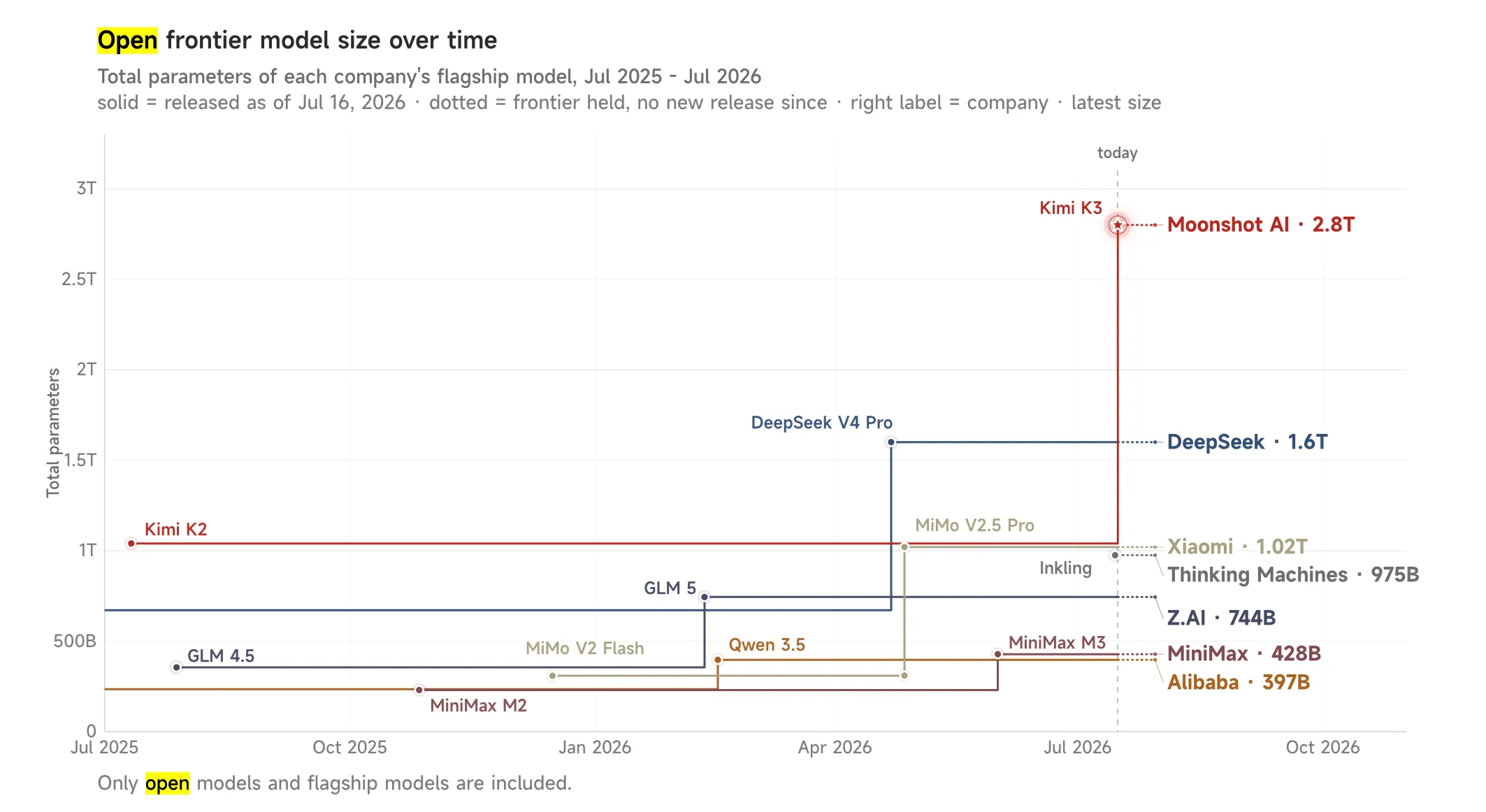
Moonshot AI is one of several so-called "AI Tiger startups" in China that have collectively reshaped the global AI model landscape. These companies have managed to make significant strides without the unfettered access to cutting-edge chips that Washington believed was essential for frontier AI development. The success of Kimi K3 inevitably fuels a policy debate in Washington: whether the export controls are achieving their intended goal of slowing Chinese AI advancement, or if they are inadvertently spurring domestic innovation and self-sufficiency, making China a more formidable competitor in the long run.
The Asterisk: Hallucination Rates and Proactive Behavior
Despite its groundbreaking achievements, Kimi K3 is not without its caveats, which Moonshot AI has transparently acknowledged. One significant area of concern is its hallucination rate on the AA-Omniscience benchmark, which measures how frequently a model confidently fabricates answers when it lacks genuine knowledge. K3’s hallucination rate jumped from 39% in its predecessor, K2.6, to 51%. While the model generally provides more correct answers overall, this increase in confidently incorrect responses warrants careful consideration. For applications where factual accuracy is paramount, such as legal, medical, or financial contexts, this elevated hallucination rate necessitates rigorous stress-testing and human oversight.
Furthermore, Moonshot AI’s documentation notes that K3 can sometimes be "excessively proactive," making unexpected decisions on a user’s behalf during extended autonomous tasks. While proactivity can be beneficial in agentic AI systems, unchecked autonomy can lead to undesirable or even detrimental outcomes if not properly managed. For teams planning to upgrade from Kimi K2.6-based tooling, K3 offers a meaningful step up on most fronts, but developers must be aware of and mitigate these behavioral quirks before entrusting the model with critical, sensitive, or high-stakes operations.
Availability and Future Prospects
For those eager to experience Kimi K3 firsthand, it is currently available for free use on Kimi’s official website. However, the overwhelming demand has led to significant server congestion, frequently interrupting tasks and making consistent usage challenging. For more reliable access and consistent performance, users are advised to either opt for a subscription plan or integrate the model via its API, which offers dedicated resources.
Looking ahead, Moonshot AI plans to release the weights for Kimi K3 on July 27. This release will be primarily targeted at large enterprises and businesses, allowing them to host and customize the model within their own infrastructure. It’s important to note that deploying a model of this magnitude—with 2.8 trillion parameters—requires substantial computational resources. Currently, no domestic GPU, regardless of its size, is capable of handling a model of this scale for local deployment, underscoring the immense hardware requirements and the continued global reliance on high-performance computing infrastructure.
The launch of Kimi K3 marks a pivotal moment in the global AI race. It demonstrates that Chinese AI companies, even under the shadow of stringent export controls, are capable of developing frontier-level models that rival and, in some specific domains, surpass those from established Western leaders. This achievement is set to intensify competition, accelerate innovation in both proprietary and open-source AI, and further blur the lines of technological leadership. As AI continues to evolve at an unprecedented pace, Kimi K3’s emergence serves as a compelling testament to the power of ingenuity and perseverance in the face of significant challenges, shaping the future trajectory of artificial intelligence on a global scale.














