Wall Street banking giant Citi Group has dramatically revised its short-to-medium term price outlook for Bitcoin, now projecting the flagship cryptocurrency to reach $113,000 by the end of 2027 and potentially surge to $181,000 within the next 12 months. This optimistic forecast marks a significant shift from earlier, more conservative predictions, reflecting a renewed confidence in Bitcoin’s market trajectory driven by anticipated macroeconomic tailwinds and substantial institutional capital inflows.
Citi’s Evolving Bitcoin Forecast: A Timeline of Adjustments
Citi’s engagement with Bitcoin price forecasting has been dynamic, characterized by significant upward and downward revisions throughout the year. In January, the institution initially set a bullish 12-month target of $143,000 for Bitcoin. However, by July, this projection was notably reduced to $82,000. This downward adjustment was attributed to several factors, including the waning momentum of the CLARITY Act in the Senate, consistent outflows from Bitcoin Exchange Traded Funds (ETFs), and the ongoing uncertainty surrounding regulatory frameworks in the United States, which contributed to a broader market stagnation.
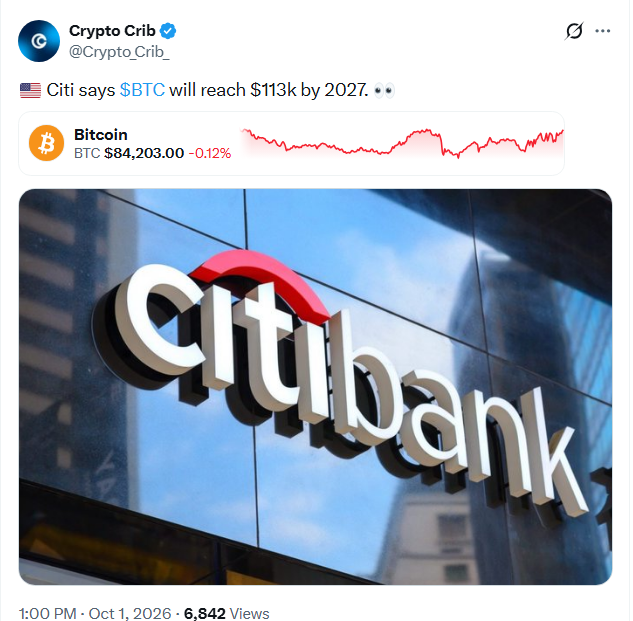
The latest assessment, issued on October 1, signals a strong reversal in Citi’s sentiment. The bank has not only reverted to an optimistic stance but has also significantly elevated its price targets. The updated 12-month projection now stands at $113,000, with an even more ambitious forecast of $181,000 within the subsequent year. This recalibration underscores Citi’s conviction that Bitcoin is poised to capitalize on a recovering market and enter a new phase of aggressive growth.
Underpinnings of the Bullish Outlook: Macroeconomic Forces and Institutional Demand
Citi’s analysts attribute their revised, bullish outlook to a confluence of positive developments. A primary driver is the anticipation of robust inflows into digital asset markets, fueled by broader economic recovery trends. The bank’s projections suggest that institutional capital is increasingly being channeled into cryptocurrencies, signaling a maturing market and a growing acceptance of Bitcoin as a legitimate asset class.
The report highlights that the anticipated surge in institutional investment is expected to be substantial. Citi projects that crypto capital inflows could reach as high as $5 billion within the next 12 months. This influx is seen as a critical catalyst for Bitcoin’s price appreciation, driven by a growing appetite among traditional financial players for exposure to digital assets.
Furthermore, Citi’s analysts note that Bitcoin is becoming increasingly attractive to institutional clients amidst prevailing economic uncertainties. This heightened interest is not limited to speculative trading; major participants, including corporate treasuries, pension funds, and hedge funds, are reportedly demonstrating a stronger enthusiasm for Bitcoin as a long-term investment. This trend suggests a fundamental shift in how institutional investors perceive and allocate capital towards digital assets.

The Role of Bitcoin ETFs and Regulatory Clarity
While previous concerns about ETF outflows contributed to downward revisions, the current optimistic forecast likely factors in the potential for significant ETF inflows. The approval and performance of Bitcoin spot ETFs in various jurisdictions have been pivotal in bridging the gap between traditional finance and the cryptocurrency market. These financial products offer a regulated and accessible avenue for institutional investors to gain exposure to Bitcoin without directly managing the underlying asset, thereby reducing operational complexities and custodial risks.
The persistent ambiguity surrounding U.S. cryptocurrency regulations has historically acted as a drag on market sentiment. However, Citi’s renewed optimism may indicate an expectation of greater regulatory clarity or a growing belief that the market can thrive even with existing regulatory uncertainties. As major economies navigate evolving financial landscapes, the role of digital assets like Bitcoin as potential hedges against inflation or as alternative stores of value is gaining traction, further bolstering institutional interest.
Bitcoin’s Potential Transition: From Trading Asset to Reserve Asset
Citi’s analysts suggest that if the current momentum of institutional adoption continues, Bitcoin could embark on a new chapter of widespread adoption. This evolution could see Bitcoin transcending its current role as primarily a trading asset and emerging as a recognized reserve asset. Such a transition would signify a profound shift in its status within the global financial system, akin to gold’s historical role as a store of value and a hedge against economic instability.
The implications of Bitcoin being adopted as a reserve asset are far-reaching. It would necessitate a significant increase in its market capitalization to accommodate global demand for reserves. This would invariably drive its price to unprecedented levels, making the $181,000 target within the next 12 months a plausible, albeit ambitious, scenario. The integration of Bitcoin into institutional reserve strategies would not only validate its utility but also cement its position as a critical component of diversified investment portfolios.
Analyzing the Broader Impact and Implications
Citi’s bold predictions carry significant weight, given the institution’s standing in the global financial arena. Such forecasts from a major bank can influence investor sentiment and potentially attract further capital into the cryptocurrency market. The increased institutional participation, as anticipated by Citi, has several implications:
- Market Maturity: Greater institutional involvement often leads to increased market liquidity, reduced volatility, and more sophisticated trading strategies. This can contribute to a more stable and predictable market environment.
- Legitimacy and Adoption: When established financial institutions like Citi express confidence in Bitcoin’s future, it lends greater legitimacy to the asset class. This can encourage broader adoption among retail investors and other institutions that may have previously been hesitant.
- Technological Integration: Increased capital flowing into the crypto space can accelerate the development and adoption of blockchain technology and its associated applications, fostering innovation across various sectors.
- Regulatory Scrutiny: As institutional interest grows, so too does the attention from regulators. This could lead to more comprehensive regulatory frameworks, which, while potentially creating short-term challenges, are crucial for long-term market stability and investor protection.
- Diversification of Portfolios: The inclusion of Bitcoin as a potential reserve asset suggests a paradigm shift in how investors approach portfolio diversification. It offers an alternative asset class with potentially uncorrelated returns to traditional financial markets.
Historical Context: Bitcoin’s Journey and Market Cycles
Bitcoin’s journey has been characterized by periods of rapid price appreciation followed by significant corrections, often referred to as bull and bear cycles. The cryptocurrency market is known for its volatility, influenced by a range of factors including technological advancements, regulatory news, macroeconomic conditions, and investor sentiment.
The period leading up to Citi’s latest forecast has been one of recovery for Bitcoin. After a period of consolidation and significant price drops in previous years, the cryptocurrency has shown resilience and a renewed upward trend. The approval of Bitcoin ETFs in the US earlier this year was a landmark event, facilitating easier access for traditional investors and reigniting optimism in the market.
The sustained period of Bitcoin trading above the $10,000 mark for over 100 days in previous cycles (as alluded to in the initial image caption) has historically served as a strong indicator of bullish sentiment and a potential precursor to significant price rallies. This historical pattern suggests that extended periods of stability at higher price levels can build a foundation for further growth.
Challenges and Considerations
Despite the optimistic outlook, several challenges remain for Bitcoin. The regulatory landscape, particularly in the United States, continues to evolve, and any adverse developments could impact market sentiment. Additionally, the inherent volatility of cryptocurrencies means that price targets, even from reputable institutions, should be viewed with a degree of caution.
The broader macroeconomic environment also plays a crucial role. Factors such as inflation rates, interest rate policies by central banks, and geopolitical stability can significantly influence investor appetite for riskier assets like Bitcoin. While Citi anticipates a recovery, unexpected economic downturns could alter the projected trajectory.
Furthermore, competition from other cryptocurrencies and emerging blockchain technologies could also influence Bitcoin’s market dominance. However, as the first and most established cryptocurrency, Bitcoin benefits from significant network effects and brand recognition, which are crucial advantages.
Conclusion: A New Era for Bitcoin?
Citi Group’s revised price targets of $113,000 by 2027 and $181,000 within the next 12 months represent a strong endorsement of Bitcoin’s potential. These projections are underpinned by a belief in increasing institutional adoption, favorable macroeconomic conditions, and the potential for Bitcoin to solidify its position as a significant global asset. While the path forward may encounter volatility and regulatory hurdles, the sentiment from a major financial institution like Citi suggests that Bitcoin may be entering a new and potentially transformative phase of its evolution, moving closer to mainstream financial integration and widespread acceptance as a store of value. The coming months and years will be critical in determining whether these ambitious forecasts materialize, shaping the future of digital assets within the global financial ecosystem.