The Cronos blockchain is poised for a significant infrastructure overhaul with its EVM v1.8 mainnet upgrade, scheduled for deployment on October 22, 2026. At the heart of this update is the full embedding of its parallel execution engine, which has demonstrated benchmark speeds of up to 60,000 transactions per second (TPS) under optimal test conditions. This theoretical capacity stands in stark contrast to the network’s current operational throughput, which averages approximately 79,000 transactions over a 24-hour period – an execution rate of less than one transaction per second. This substantial disparity between potential and current utilization provides a crucial starting point for analyzing the implications of the v1.8 upgrade, particularly its claims regarding enhanced scalability through parallel execution.
A comprehensive review of Cronos’s official release notes, developer blog posts, and underlying code changes is essential to accurately distinguish between new architectural advancements and previously existing features. This methodical approach also helps in establishing verifiable metrics for independently assessing the impact of parallel execution on the network’s performance and developer ecosystem.
The Cronos EVM v1.8 Upgrade: A Deep Dive into Architectural Enhancements
The v1.8 upgrade represents a pivotal moment for the Cronos blockchain, aiming to bolster its foundational infrastructure and developer appeal. Beyond the parallel execution engine, the update encompasses several critical enhancements. A primary focus is the expansion of Ethereum API coverage, with over 80 additional methods being integrated. This push brings Cronos’s EVM API equivalence above 90%, a crucial factor for attracting and retaining developers accustomed to the Ethereum ecosystem. Increased equivalence means that Ethereum-native tools, dApps, and smart contracts can be deployed on Cronos with minimal code modification, significantly lowering the barrier to entry for developers.
Furthermore, the upgrade involves a significant overhaul of the network’s communication layer. The legacy networking stack is being replaced with libp2p, a modular peer-to-peer networking framework widely adopted in the blockchain space. This transition is expected to improve peer discovery, enhance connection stability, and reduce overall network latency, contributing to a more robust and responsive blockchain environment. Another notable addition is an application-side mempool pre-verification layer, designed to filter out invalid transactions before they consume valuable network resources, thereby increasing efficiency and reducing spam. The v1.8 release also addresses over 40 protocol bugs, ensuring greater stability and reliability across the network. Official announcements from the Cronos team estimate these collective improvements will result in a simulated block turnaround improvement of approximately 20%, translating to faster transaction finality under certain conditions.
For node operators, the upgrade path necessitates careful attention. Early release candidates are flagged for rigorous testing before full network coordination, and the official documentation will provide a designated migration guide to ensure a smooth transition for validators and full node operators.

The Evolution of Parallel Execution on Cronos: Understanding Block-STM
A critical detail often overlooked in the discussion of the v1.8 upgrade is that parallel execution is not a completely novel feature for Cronos. The network initially integrated Block-level Software Transactional Memory (Block-STM) during its v1.4 Pallene upgrade. This earlier update marked a significant shift in how transactions were processed, moving from a strictly sequential model to concurrent execution. Block-STM was designed to automatically resolve state conflicts that arise when multiple transactions attempt to modify the same data simultaneously.
The v1.8 upgrade, therefore, does not introduce parallel processing to the Cronos chain for the first time. Instead, its significance lies in a fundamental architectural shift: the parallel engine, which was launched during the Pallene upgrade and has since matured, is now being directly embedded into the Cosmos SDK layer. This integration means the parallel execution capabilities are no longer an add-on but an intrinsic part of the core framework stack. This deeper integration is expected to enhance efficiency, stability, and future extensibility of the parallel processing capabilities.
How Block-STM Functions in Practice: Optimistic Concurrency
Block-STM operates on a principle known as optimistic concurrency. Within a given block, transactions are executed concurrently under the initial assumption that their state interactions will not overlap or conflict. Once this concurrent processing is complete, the engine proceeds to validate the state changes for each transaction.
If, during this validation phase, two or more concurrent transactions are found to have attempted to alter the same state variable in an invalid or conflicting sequence, the Block-STM engine does not halt or fail the entire block. Instead, it intelligently re-executes the conflicting transaction (or transactions) sequentially, ensuring data integrity and correct state transitions. This mechanism allows the network to maximize parallel throughput while guaranteeing atomic execution.
This execution model originated from pioneering research conducted by Aptos Labs, specifically for their Aptos blockchain. The effectiveness of Block-STM hinges on a statistical probability: in typical blockchain workloads, the vast majority of transactions within a single block do not contend for identical state storage. This means that most transactions can indeed be processed in parallel without conflict, allowing for significant gains in throughput compared to purely sequential execution.

Distinguishing Official Release Notes from Announcement Metrics
To accurately evaluate protocol updates, it is imperative to differentiate between documented repository changes and external performance benchmarks or marketing announcements. The official v1.8 release notes from the Cronos GitHub repository primarily highlight three core technical developments: the native SDK embedding of the Block-STM engine, the achievement of EVM API equivalence exceeding 90%, and the reduction of peer-to-peer latency through the adoption of libp2p.
Metrics such as the estimated 20% block turnaround improvement and the specific October 22, 2026, target date for mainnet deployment are typically derived from secondary announcement posts, developer blogs, or official team statements rather than being explicitly detailed within the core release notes. While these figures are important for understanding the project’s goals and timeline, technical reviews should attribute these performance estimates to official team communications rather than directly to the immutable change logs of the repository. This distinction ensures accuracy and proper sourcing of information.
Verifying Node Operator Engine Configurations for Parallel Execution
The theoretical capabilities of parallel transaction execution within a protocol are one thing; their practical implementation and realized benefits are another. For parallel execution to be active and effective, it often requires explicit configuration at the node operator level. The Cronos repository’s code changes related to v1.8 prominently feature specific operator settings that govern the parallel engine’s behavior.
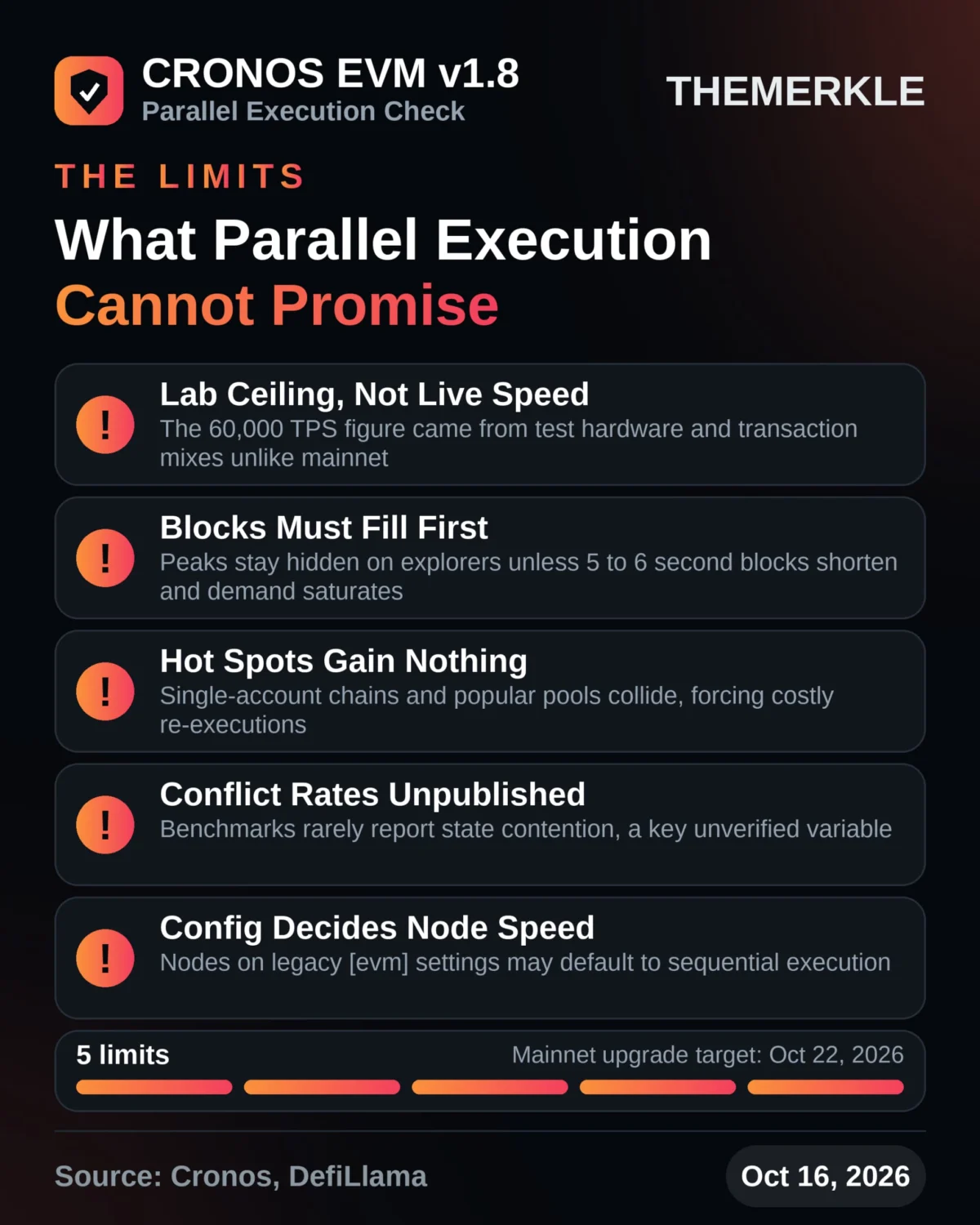
These settings include the selection of the executor via block-executor, the allocation of worker threads through block-stm-workers, and toggles for pre-estimation capabilities via block-stm-pre-estimate. The presence of these configurable parameters indicates that simply upgrading to v1.8 does not automatically guarantee parallel execution. Configuration guidelines explicitly state that nodes relying solely on legacy [evm] settings may default to sequential execution. This distinction underscores a critical point: while the protocol provides native support for parallel execution, the actual throughput achieved by an individual node or the network as a whole is directly dependent on active and correct operator configuration. Validators and node runners must ensure their settings are optimized to leverage the new capabilities.
Analyzing Benchmark Parameters and Understanding Testing Limits

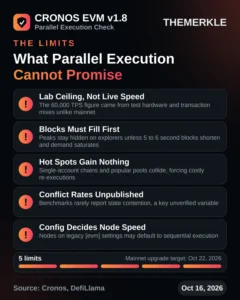
The impressive benchmark results from the initial Pallene release, which indicated Block-STM could enable execution ceilings of up to 60,000 transactions per second, provided an exciting glimpse into Cronos’s potential. These figures represented a monumental leap from sequential baselines, which often registered below 100 TPS. However, it is crucial to understand that these benchmarks were conducted under very specific, controlled test conditions.
For instance, the throughput achieved for single transfers was often lower than that for batched transactions. This discrepancy was primarily due to constraints imposed by the load generator used in the testing environment, which could feed batched transactions more efficiently to saturate the network. Furthermore, these peak TPS figures do not immediately translate to visible changes on block explorers or a direct improvement in user experience unless two critical conditions are met: block times must significantly shorten from the current average of 5–6 seconds, and user transaction volume must increase sufficiently to consistently saturate the available block space.
The hardware specifications and transaction mixes used in test environments rarely perfectly replicate live mainnet conditions. Test scenarios often involve simplified transaction types, uniform loads, and ideal network latency, which are not always representative of the diverse and often unpredictable nature of real-world blockchain activity. Therefore, while peak benchmark figures serve as valuable indicators of maximum theoretical execution limits, they should not be conflated with current or immediate real-world network speeds. They primarily illustrate the network’s potential capacity under extreme, optimized load.
Cross-Referencing On-Chain Metrics Against Theoretical Capacity
To provide objective context to the theoretical performance limits, it is essential to compare them against live ledger activity. According to network data from DefiLlama, Cronos currently processes approximately 79,000 transactions daily. When averaged over a 24-hour period, this translates to an average execution rate of less than one transaction per second. Given an average block time hovering around 5.6 seconds, live blocks on Cronos currently average approximately five transactions.
The Cronos protocol has a block gas target of 40 million. With average smart contract executions consuming roughly 220,000 gas, the theoretical layer-1 capacity of the protocol sits near 35 transactions per second. This inherent capacity threshold is significantly higher than the current daily demand, yet it remains well below the synthetic laboratory benchmarks of 60,000 TPS. This disparity highlights that while Cronos possesses ample latent capacity, current network usage does not come close to saturating it. The v1.8 upgrade, therefore, positions Cronos for future growth and prepares it for substantially higher transaction volumes, rather than addressing an immediate bottleneck.
Identifying Scenarios Where Parallel Processing Enhances Throughput

Parallel execution mechanisms like Block-STM offer maximum efficiency and throughput gains under specific conditions. The most ideal scenario is when blocks contain a high proportion of independent, non-conflicting transactions. This includes:
- Multiple distinct users interacting with separate smart contracts: For example, user A interacts with a DEX, while user B interacts with an NFT marketplace, and user C interacts with a lending protocol, all within the same block.
- Executing isolated token transfers across independent addresses: Numerous users sending tokens to different recipients, where no single account balance is being simultaneously debited or credited by multiple transactions.
Under these conditions, concurrent execution effectively prevents processing bottlenecks, as transactions do not have to wait for others to complete before being processed. This allows the network to absorb sudden demand spikes more gracefully. Parallel engines are particularly effective in mitigating temporary traffic surges, enabling validators to process rapid bursts of transactions without accumulating extensive mempool backlogs, thereby maintaining smoother network operation during periods of high activity.
Identifying Scenarios Where Parallel Processing Offers No Acceleration
Conversely, there are several common transaction types and network conditions where parallel execution offers little to no speed advantage, and in some cases, might even introduce minor overhead due to conflict resolution mechanisms:
- Sequential dependencies: Transactions that inherently depend on the outcome of a preceding transaction within the same block. For example, approving a token spending limit and then immediately spending those tokens.
- High state contention: Scenarios where a large number of transactions attempt to modify the same state variable or interact with the same "hot" smart contract simultaneously. Examples include:
- Many users trying to mint the same popular NFT collection at the exact same block.
- Numerous arbitrage bots competing for a price discrepancy on a single liquidity pool.
- Multiple users attempting to update a single global counter or state variable within a smart contract.
In such cases, Block-STM’s optimistic execution would frequently encounter conflicts, leading to re-execution of transactions sequentially. This negates the benefits of parallelism for those specific conflicting transactions.
- Single-threaded contract logic: Smart contracts designed with internal sequential logic or those that perform complex operations on a single, shared state will not benefit from parallel execution for those specific operations.
- Low network utilization: As seen with Cronos’s current on-chain metrics, if the transaction volume is consistently low and blocks are rarely full, the network is not operating near its capacity limits. In such scenarios, even sequential execution can handle the demand without any significant latency, making the added complexity of parallel execution less impactful on perceived speed.
Published benchmarks often focus on ideal conditions and rarely include metrics for state conflict rates or the performance of "hot-spot" contracts under contention. Therefore, evaluating the true efficiency and practical benefits of a parallel engine under real-world state contention remains a critical variable that requires ongoing monitoring and analysis.
Evaluating the Impact of Expanded EVM API Equivalence
For application developers, the expanded EVM API coverage arguably represents one of the most immediate and tangible functional upgrades in v1.8. Cronos has demonstrated a consistent commitment to enhancing its Ethereum tool compatibility through iterative updates. Previous versions, such as v1.7.5, introduced crucial methods like eth_simulateV1, which allows developers to simulate transaction outcomes before submission, significantly improving development and testing workflows. Similarly, v1.7.7 brought configurable JSON-RPC batching limits, offering greater flexibility and efficiency for dApp interactions.

By expanding coverage across more than 80 additional API methods in v1.8, Cronos is pushing its total EVM equivalence beyond 90%. This high degree of compatibility is a powerful incentive for the vast ecosystem of Ethereum-native developer tooling, infrastructure providers, and decentralized applications. It means that developers can deploy their existing Solidity smart contracts and frontend dApps on Cronos with minimal, if any, code modifications. This significantly reduces the friction and cost associated with migrating from Ethereum or deploying multi-chain applications, fostering greater innovation and adoption within the Cronos ecosystem.
A Reusable Verification Checklist for Parallel Execution Claims
To objectively assess the real-world impact of parallel execution claims on any blockchain, a systematic verification checklist is invaluable:
- Distinguish between theoretical benchmarks and actual on-chain performance: Understand the conditions under which benchmarks are achieved and compare them against live network metrics like average TPS, block finality, and transaction counts.
- Verify node operator configurations: Confirm that parallel execution is actively enabled and properly configured by a significant portion of validators and nodes on the network, as it may not be the default setting.
- Analyze transaction mix and state contention: Evaluate the types of transactions prevalent on the network. A network dominated by highly interdependent or state-contending transactions may see less benefit from parallel execution than one with a diverse mix of independent operations.
- Monitor block fill rates and gas utilization: If blocks are consistently underutilized, even a highly performant parallel engine will not translate into a noticeable increase in transactions per second, as demand is the limiting factor.
- Track developer adoption and ecosystem growth: A truly impactful upgrade should lead to increased developer activity, new dApp deployments, and a growing user base, ultimately driving higher transaction volume that can truly test and leverage the enhanced throughput.
Ultimately, while the embedded Block-STM engine provides robust execution infrastructure and significant theoretical capacity for the Cronos network, evaluating its true impact requires diligent tracking of real-world, block-by-block ledger performance, combined with an understanding of network demand and developer adoption. The v1.8 upgrade positions Cronos for a scalable future, but its full potential will only be realized as the ecosystem matures and transaction volumes grow to truly stress its advanced parallel processing capabilities.
Disclosure: This is not trading or investment advice. Always do your research before buying any cryptocurrency or investing in any services.
Follow us on Twitter @themerklehash to stay updated with the latest Crypto, NFT, AI, Cybersecurity, and Metaverse news!