Bloomberg Intelligence senior commodity strategist Mike McGlone has presented a compelling, albeit contrarian, outlook for the cryptocurrency market, suggesting that a significant "flippening" event is on the horizon, driven by the ascendance of stablecoins. His analysis indicates that Bitcoin (BTC), the progenitor of digital assets, could see a substantial retracement, potentially revisiting levels around $10,000 by 2026. This projection diverges sharply from prevailing bullish sentiment, attributing the potential downturn to evolving market dynamics and the growing influence of stable digital currencies.
McGlone’s assertion is rooted in historical price action and the evolving landscape of digital asset utility. He posits that Bitcoin may be reverting to its pre-bull market price point, recalling its trading range near $10,000 in the period preceding the significant market expansion of 2020-2021. This price level also holds significance as Bitcoin’s most traded price since 2017, the year futures contracts were introduced, marking a critical juncture in its institutional adoption.
The Rise of Stablecoins: A New Paradigm
The core of McGlone’s argument for a "flippening" lies in the robust growth and increasing utility of stablecoins, particularly those pegged to the U.S. dollar. He identifies "crypto dollars" as representing one of the most enduring trends within the digital asset ecosystem. The rising assets under management (AUM) for dollar-backed tokens, with Tether (USDT) often cited as a leading example, underscore this point. McGlone suggests that the "unlimited crypto supply and use-case rivals" pose significant headwinds for Bitcoin, which, despite its fixed supply, faces competition for capital and attention from these more stable and utility-focused digital assets.
This perspective challenges the common narrative that Bitcoin’s scarcity is its primary strength. McGlone implies that in an increasingly crowded digital asset space, where "millions of cryptos" now exist, only a select few, notably stablecoins, are tracking tangible value and offering demonstrable utility beyond speculative investment. The implication is that as the crypto market matures, investor focus may shift from pure scarcity-driven assets to those that provide stability and facilitate transactions within the burgeoning digital economy.
The "Flippening": A Shift in Dominance
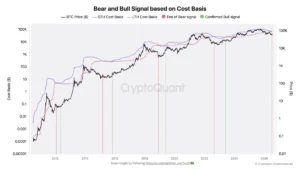
McGlone’s "flippening" prediction is multi-faceted. He anticipates a scenario where Tether’s AUM could surpass that of Ethereum in 2026, and ultimately, challenge Bitcoin’s market capitalization. This projection is visualized through a graphic illustrating key drivers, including a potential stock market rollover and a resurgence in volatility. The strategist suggests that Bitcoin’s potential for consecutive down years in 2026 might be an early indicator of this broader market shift.
The concept of a "flippening" in the crypto space has historically referred to the potential for a different cryptocurrency to overtake Bitcoin in market capitalization. However, McGlone’s interpretation extends this to include stablecoins, highlighting a fundamental re-evaluation of what constitutes valuable and dominant digital assets. This shift implies that the definition of "market leadership" might evolve from being solely based on market cap driven by speculative demand to one that also considers utility, stability, and the facilitation of economic activity.
Macroeconomic Headwinds and Bitcoin’s Vulnerability
Beyond the internal dynamics of the crypto market, McGlone also points to broader macroeconomic factors that could exacerbate downward pressure on digital assets. The prospect of a stock market downturn and an increase in market volatility are identified as key catalysts. In an environment of heightened economic uncertainty, investors often de-risk, moving capital away from more speculative assets. Bitcoin, despite its growing institutional adoption, is still often viewed as a high-risk asset class, making it susceptible to such macroeconomic shifts.
The historical correlation between Bitcoin’s price movements and broader risk assets, such as equities, has been a subject of extensive analysis. While some argue for Bitcoin’s role as a digital gold or a hedge against inflation, its price action in recent years has often mirrored that of technology stocks, suggesting a significant correlation with risk appetite in the market. A sustained downturn in global equity markets, therefore, could trigger a sell-off in Bitcoin as investors seek safer havens.
Historical Context and Data Supporting McGlone’s Thesis
To contextualize McGlone’s $10,000 Bitcoin projection, it’s essential to examine historical data. Bitcoin’s journey has been marked by significant volatility and cyclical booms and busts.
- Pre-2020 Levels: In the period leading up to the 2020-2021 bull run, Bitcoin indeed traded in the range of $10,000. For instance, in early 2020, before the global economic disruptions caused by the COVID-19 pandemic spurred unprecedented monetary stimulus, Bitcoin was trading around the $8,000-$10,000 mark.
- 2017 Futures Launch: The launch of Bitcoin futures in December 2017 marked a significant step towards institutional acceptance. Following this, Bitcoin experienced a sharp price correction from its all-time high of nearly $20,000. The subsequent period saw Bitcoin consolidate and trade in a range that, at times, included levels around $10,000.
- Market Cycles: The cryptocurrency market is characterized by distinct bull and bear cycles. McGlone’s prediction of a potential reversion to $10,000 by 2026 could be interpreted as a cyclical downturn, a natural correction after periods of rapid appreciation. The notion of "consecutive down years" aligns with the cyclical nature of many asset classes.
Data on Stablecoin Growth:
The growth of stablecoins has been exponential. As of early 2024, the total market capitalization of stablecoins has reached hundreds of billions of dollars, with Tether and USD Coin (USDC) being dominant players.
- Tether (USDT): Tether’s market capitalization has consistently been in the tens of billions, often exceeding $80 billion. Its primary function as a stable store of value and a medium of exchange within the crypto ecosystem has cemented its position.
- USD Coin (USDC): Circle’s USDC has also experienced substantial growth, with a market cap often in the tens of billions, rivaling Tether in certain periods.
The increasing adoption of stablecoins for trading, remittances, and as a bridge between traditional finance and decentralized finance (DeFi) underscores their growing importance and utility. This utility is what McGlone believes will drive their ascendancy.
Broader Implications for the Crypto Ecosystem
McGlone’s analysis suggests a potential paradigm shift in the cryptocurrency market. If stablecoins indeed begin to challenge Bitcoin’s dominance, it would signify a move towards greater utility and stability within the digital asset space.
- Maturity of the Market: A shift towards stablecoins as leading digital assets could indicate a maturation of the crypto market, moving beyond speculative fervor towards practical applications. This could lead to increased adoption by a wider range of users and institutions seeking reliable digital currency solutions.
- Impact on Bitcoin’s Narrative: For Bitcoin, this would necessitate a recalibration of its narrative. While its scarcity remains a fundamental attribute, its role as the primary store of value might be challenged if stablecoins offer a more liquid and transaction-friendly alternative for everyday use. Bitcoin might increasingly be viewed as a long-term speculative asset or a digital gold, while stablecoins facilitate the day-to-day economic activity within the digital realm.
- Regulatory Scrutiny: The rise of stablecoins has also attracted significant regulatory attention globally. Governments and financial watchdogs are scrutinizing their reserves, transparency, and potential systemic risks. Any regulatory actions could have a profound impact on the stablecoin market and, by extension, the broader crypto ecosystem.
Expert Reactions and Counterarguments (Inferred)
While McGlone’s perspective is a significant one, it’s important to acknowledge that the crypto market is characterized by a wide range of opinions. Many analysts and investors remain bullish on Bitcoin’s long-term prospects, citing its first-mover advantage, network effects, and its increasing adoption as a hedge against inflation and a store of value, often dubbed "digital gold."
- Bullish Bitcoin Advocates: Proponents of Bitcoin often highlight its decentralized nature, its finite supply, and its growing adoption by institutional investors as key drivers of future price appreciation. They may argue that any significant drop in price would be a buying opportunity, a temporary correction in a long-term upward trend. They might also point to the increasing development of Bitcoin-based technologies, such as the Lightning Network, which enhance its transaction capabilities.
- Ethereum’s Role: While McGlone predicts Tether topping Ethereum, many view Ethereum as the backbone of the decentralized web and a platform for a vast array of applications, from DeFi to NFTs. Its upcoming upgrades and its utility as a gas token for numerous decentralized applications position it as a strong contender in the digital asset space.
- Diversification of Crypto Assets: The crypto market is no longer solely about Bitcoin. The rise of altcoins, layer-1 blockchains, and specialized tokens has created a diverse ecosystem where different assets serve different purposes. This diversification might mean that the success of stablecoins does not necessarily come at the direct expense of Bitcoin’s long-term value proposition, but rather represents a parallel growth trajectory for a different segment of the market.
Conclusion: A Period of Transition
Mike McGlone’s projection of Bitcoin potentially falling to $10,000 by 2026 and the ascendancy of stablecoins leading a significant "flippening" presents a thought-provoking, albeit bearish, outlook for the cryptocurrency market. His analysis emphasizes the growing utility and adoption of stablecoins as a key driver of change, alongside potential macroeconomic headwinds.
While this perspective challenges prevailing optimism, it underscores the dynamic and evolving nature of the digital asset landscape. The interplay between Bitcoin’s scarcity, the utility of stablecoins, and broader economic forces will continue to shape the future of cryptocurrency. Investors and market participants alike will be closely watching these trends as the crypto market navigates what could be a period of significant transition. The potential for a re-evaluation of dominance, driven by utility rather than solely speculation, could redefine leadership within the digital capital planet.
Disclaimer: Opinions expressed at The Daily Hodl are not investment advice. Investors should do their due diligence before making any high-risk investments in Bitcoin, cryptocurrency or digital assets. Please be advised that your transfers and trades are at your own risk, and any losses you may incur are your responsibility. The Daily Hodl does not recommend the buying or selling of any assets including cryptocurrencies, nor is The Daily Hodl an investment advisor. Please note that The Daily Hodl participates in affiliate marketing.
Generated Image: Midjourney