


The cryptocurrency market is experiencing a surge of speculation following unconfirmed reports that e-commerce magnate Jeff Bezos might be considering a significant investment in Bitcoin. This buzz coincides with a period of substantial Bitcoin outflows from BlackRock’s IBIT Bitcoin ETF, leading to renewed attention on institutional and high-net-worth individual interest in digital assets.
BlackRock’s IBIT Sees Substantial Bitcoin Outflows Amidst Market Volatility
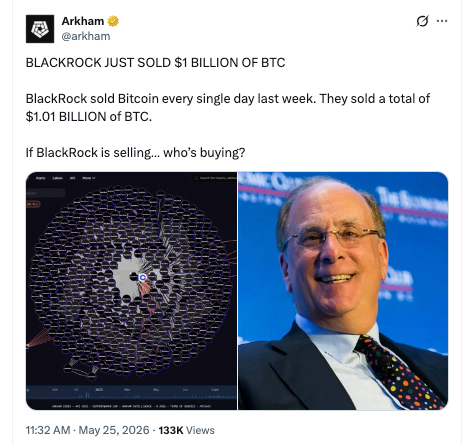
Recent data from blockchain analytics firm Arkham reveals that BlackRock’s iShares Bitcoin Trust (IBIT), one of the leading spot Bitcoin Exchange Traded Funds (ETFs) in the United States, has offloaded approximately $1 billion worth of Bitcoin over the past week. This significant withdrawal comes as the cryptocurrency market faces renewed selling pressure, with Bitcoin recently struggling to maintain its position above the crucial $80,000 resistance level that it had breached earlier in the month.
Arkham, a prominent blockchain intelligence platform, shared its findings via a post on the social media platform X (formerly Twitter). The firm’s analysis indicates that BlackRock’s associated wallets, which are closely monitored by third-party observers due to their significant holdings, saw a net outflow of roughly $1.01 billion in Bitcoin during the seven-day period ending recently. This movement of funds by a major institutional player has naturally drawn the attention of the wider crypto community, prompting discussions about the underlying reasons for such a large divestment.
Decoding the Outflows: Investor Sentiment and Market Dynamics
The question naturally arises: if a titan like BlackRock is reducing its Bitcoin holdings through its ETF, who is absorbing this supply? It is crucial to understand that BlackRock, as the issuer of the IBIT ETF, does not unilaterally decide to buy or sell the underlying Bitcoin. Instead, these transactions are driven by the actions of the ETF’s investors. When investors decide to redeem their shares in the IBIT ETF, BlackRock is obligated to sell a corresponding amount of Bitcoin to meet these redemption requests. Therefore, the outflows from IBIT reflect investor sentiment and capital rotation rather than a direct decision by BlackRock to divest from Bitcoin.
The recent selling pressure could be attributed to a confluence of factors. Bitcoin had experienced a significant rally, pushing its price to unprecedented highs. This ascent created a scenario where many investors, particularly those who entered the market at lower price points, were sitting on substantial unrealized profits. When Bitcoin surged above the $80,000 mark, reports indicated that the total unrealized profit on Bitcoin purchases exceeded 60%. This presented a compelling opportunity for many to "take profit," selling their holdings to secure gains and potentially waiting for a market correction before re-entering.
Furthermore, the broader macroeconomic environment continues to play a significant role. Inflationary concerns, interest rate policies from central banks, and geopolitical uncertainties can all influence investor risk appetite, leading to shifts in asset allocation. For some investors, especially those with a more conservative approach, the recent price surge may have signaled a opportune moment to reduce exposure to volatile assets like Bitcoin.
Who is Stepping In? Alternative Accumulators in the Market
While BlackRock’s IBIT has seen outflows, other significant entities continue to actively accumulate Bitcoin, providing a counterbalancing bid in the market. Michael Saylor’s MicroStrategy (MSTR) remains a prominent and aggressive buyer. The business intelligence software company has consistently added to its Bitcoin reserves, often acquiring substantial amounts. In fact, with its ongoing acquisition strategies, MicroStrategy has emerged as a larger holder of Bitcoin than BlackRock’s IBIT in certain periods, demonstrating a strong conviction in the long-term prospects of the cryptocurrency.
Beyond MicroStrategy, other crypto treasury firms and even notable figures associated with traditional finance have been reported to be accumulating Bitcoin. This includes entities linked to Donald Trump’s son, Eric Trump, who has reportedly been investing in the digital asset. The presence of these persistent buyers suggests that despite the outflows from some ETFs, there is still robust demand for Bitcoin from various segments of the market, particularly from those with a long-term investment horizon and a belief in Bitcoin’s potential as a store of value or a hedge against inflation.
The Jeff Bezos Speculation: A Catalyst for Renewed Interest?
The timing of these BlackRock outflows has coincided with a rumor circulating within the crypto community that Jeff Bezos, the founder of Amazon and one of the wealthiest individuals globally, might be considering a substantial Bitcoin purchase. While this remains unconfirmed and is largely based on speculative online discussions and anecdotal evidence, the mere suggestion has ignited considerable excitement.
Bezos, known for his strategic investments and for building one of the world’s largest e-commerce empires, has historically maintained a relatively low public profile regarding his personal investments in cryptocurrencies. However, his vast wealth and influence mean that any significant foray into Bitcoin would undoubtedly send ripples across the financial markets, potentially attracting more institutional and retail interest.
The speculation about Bezos’s potential Bitcoin acquisition gained traction following reports of his significant offloading of Amazon stock. While the sale of Amazon shares is a common practice for executives to diversify their portfolios and manage personal finances, the scale of these transactions has led some to ponder about the reallocation of these substantial funds. If even a fraction of the capital divested from Amazon were to find its way into Bitcoin, it could represent a significant influx of capital into the cryptocurrency market.
Historical Context of High-Profile Bitcoin Investments
The possibility of a billionaire like Jeff Bezos investing in Bitcoin is not an isolated phenomenon. Over the past few years, numerous high-net-worth individuals and prominent companies have publicly announced their Bitcoin holdings or investments. Companies like Tesla, under the leadership of Elon Musk, have invested heavily in Bitcoin, though their holdings have seen fluctuations. Payment giants such as PayPal and Square (now Block) have integrated Bitcoin trading and payment functionalities, signaling a growing acceptance of the digital asset within the mainstream financial infrastructure.
Furthermore, the approval of spot Bitcoin ETFs in the United States in January 2024 marked a watershed moment, providing a regulated and accessible avenue for institutional investors and the general public to gain exposure to Bitcoin. The subsequent inflows into these ETFs, prior to the recent outflows, demonstrated a strong demand from a broad range of investors.
Analysis of Implications: What Could a Bezos Investment Mean?
Should Jeff Bezos indeed decide to invest in Bitcoin, the implications could be far-reaching:
- Increased Legitimacy and Mainstream Adoption: A high-profile endorsement from a figure like Bezos would lend significant legitimacy to Bitcoin as an asset class. It could further accelerate mainstream adoption, encouraging more individuals and institutions to consider Bitcoin as a part of their investment portfolios.
- Potential Price Impact: While the cryptocurrency market is complex and influenced by numerous factors, a substantial investment from an individual of Bezos’s stature could lead to increased demand and potentially a positive impact on Bitcoin’s price. However, the exact impact would depend on the size of the investment and the prevailing market conditions at the time of the announcement.
- Renewed Scrutiny and Regulatory Attention: Significant investments by billionaires often attract increased attention from regulators and policymakers. This could lead to further discussions about the regulation of cryptocurrencies and the role they play in the global financial system.
- Diversification of Investor Base: Such an investment could help to further diversify the investor base for Bitcoin, reducing reliance on a few large institutional players and broadening its appeal across different demographic and economic segments.
The Future Outlook: Navigating Market Cycles
Despite the recent outflows from BlackRock’s IBIT and the ongoing speculation surrounding Jeff Bezos, the long-term outlook for Bitcoin remains a subject of intense debate and analysis. The cryptocurrency market is inherently volatile, characterized by cycles of rapid price appreciation followed by corrections.
The current situation, with institutional outflows coinciding with rumors of new high-profile interest, exemplifies this dynamic. While profit-taking and capital rotation are normal market behaviors, especially after significant price run-ups, the underlying technological advancements and the growing adoption of blockchain technology continue to underpin the long-term potential of cryptocurrencies.
Entities like MicroStrategy, with their unwavering commitment to Bitcoin accumulation, demonstrate a conviction that transcends short-term market fluctuations. Their continued aggressive buying strategy acts as a stabilizing force, absorbing supply and signaling confidence in Bitcoin’s future value proposition.
As the market navigates these currents, the actions of prominent figures and the strategic decisions of major financial institutions will continue to be closely watched. The potential involvement of Jeff Bezos, while speculative at this stage, serves as a potent reminder of the enduring fascination and investment potential that Bitcoin continues to hold for some of the world’s most influential individuals and entities. The coming weeks and months will likely provide more clarity on market trends and the potential impact of these unfolding narratives on the broader cryptocurrency landscape.














