


The cryptocurrency market is currently witnessing a significant structural shift as data-driven indicators suggest the long-awaited "altseason" may finally be approaching after a period of prolonged Bitcoin dominance. For the better part of the current market cycle, investors have faced a challenging environment characterized by a lack of capital rotation from Bitcoin into smaller-cap assets. While Bitcoin repeatedly reached new milestones, the broader altcoin market remained largely stagnant or entered deep corrective phases, leading to widespread exhaustion among retail participants. However, recent on-chain metrics and exchange volume trends indicate that the underlying mechanics of the market are evolving, signaling that the "frustrating trade" of the last year may be nearing its conclusion.
According to a comprehensive analysis by CryptoQuant, altcoin trading volume across centralized exchanges has begun to accelerate in a manner that distinguishes current activity from previous "noise" or isolated price spikes. This increase in volume is specifically observed when excluding the top five crypto assets, suggesting a broad-based rise in interest across mid-cap and small-cap tokens. Historically, such a synchronized rise in volume across a wide array of assets is a prerequisite for a genuine market rotation. This shift implies that capital is no longer merely cycling between Bitcoin and stablecoins but is actively seeking exposure in the wider digital asset ecosystem.
The Rise of the AltSeason Index and Behavioral Shifts
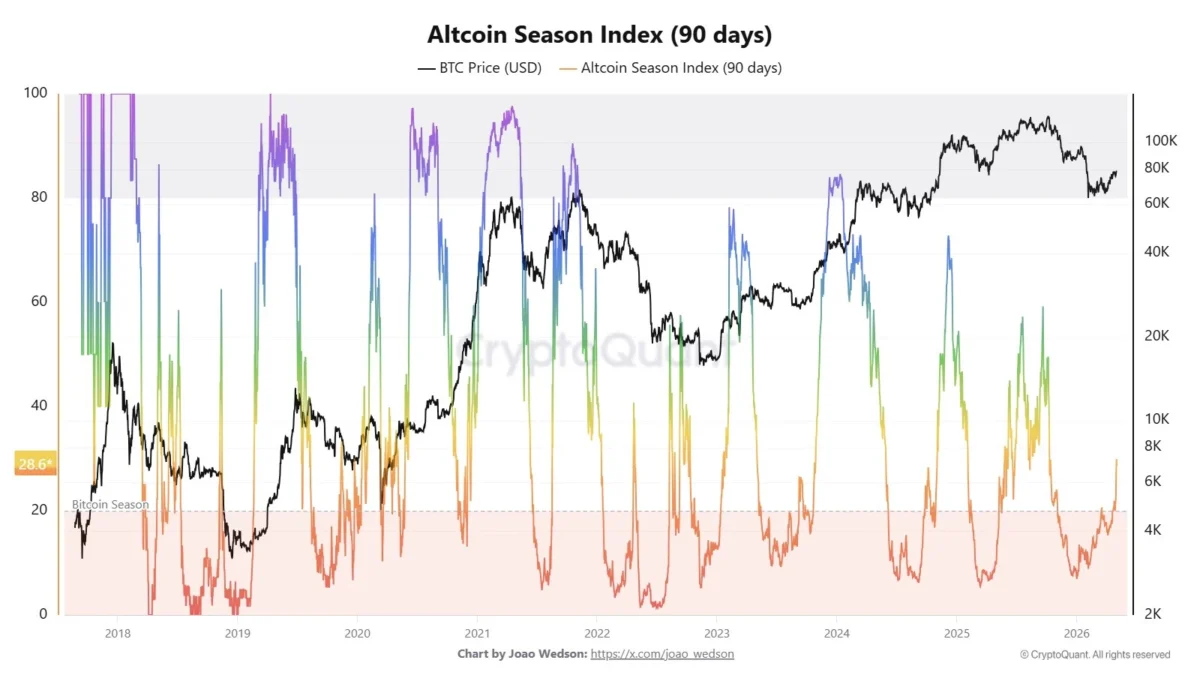
Central to this thesis is the 90-day AltSeason Index, a metric designed to track whether Bitcoin or altcoins are providing better risk-adjusted returns over a three-month window. The index recently climbed to 28.6, reflecting a rapid upward trajectory. While a reading of 75 or higher is typically required to declare a full-blown "altseason," the momentum of the index is often more telling than the absolute value. The current move suggests a behavioral shift among market participants, transitioning from a "Bitcoin-only" defensive posture to a more speculative and diversified approach.
This shift comes at a critical juncture. Throughout 2024, the AltSeason Index failed to reach the heights seen in previous bull cycles, such as those in 2017 and 2021. The early 2024 peak was notably modest, leading to a "fakeout" where many investors positioned themselves for a rotation that never materialized at scale. The lack of a significant altcoin rally in 2024 has resulted in what analysts describe as "pent-up rotation." This refers to the accumulation of capital and psychological anticipation that has been building without a proper release, potentially making the next move more explosive than it would have been otherwise.

A Historical Perspective: The 2024 Gap and Pent-Up Demand
To understand the significance of the current signal, one must examine the chronology of the current cycle. In previous bull markets, the path to altseason followed a predictable pattern: Bitcoin would lead the initial rally, followed by Ethereum, then large-cap "blue-chip" altcoins, and finally the broader market. In 2024, this cycle was interrupted. The introduction of Bitcoin Spot ETFs in the United States funneled institutional capital almost exclusively into Bitcoin, distorting the traditional flow of funds.
Furthermore, the rise of memecoins on networks like Solana and Base fragmented the available liquidity. Rather than a tide that lifted all boats, the market saw isolated pockets of extreme volatility while fundamentally sound utility projects languished. This deviation from the historical norm created a backlog of value. The CryptoQuant report suggests that the "altseason that never was" in early 2024 has effectively primed the market for a more significant discharge of capital. As Bitcoin’s dominance begins to plateau, the vacuum created by months of underperformance in the altcoin sector is starting to attract value-oriented buyers.
Ethereum’s Nine-Year Technical Convergence
Perhaps the most compelling evidence for a sustained altcoin rally lies in the technical setup of Ethereum (ETH). As the largest altcoin by market capitalization and the primary platform for decentralized finance (DeFi) and non-fungible tokens (NFTs), Ethereum serves as the primary liquidity gatekeeper for the rest of the market. When Ethereum outperforms, it generally provides the "wealth effect" necessary to drive capital into smaller ecosystems.
Technical analysts have identified a nine-year technical convergence in Ethereum’s price structure that is currently approaching a resolution. This setup involves long-term trendlines and moving averages that have governed Ethereum’s price action since its early years. A breakout from this multi-year consolidation would represent a structural shift that has not been seen in nearly a decade. If Ethereum successfully reclaims its role as a market leader, the historical correlation suggests that the "OTHERS" index—representing the total crypto market cap excluding the top 10 assets—will follow suit with significant upward momentum.
Analyzing the OTHERS Index and Key Technical Thresholds
The "OTHERS" index is currently testing a vital inflection zone. After a prolonged corrective phase that saw many altcoins lose 50% to 70% of their value from their 2024 highs, the index is attempting to stabilize in the $190 billion to $200 billion range. This region is not arbitrary; it aligns with the 200-week moving average, a level that has historically served as a definitive pivot point between bear and bull cycles.

Recent price action shows the index reclaiming short-term moving averages and testing the 100-week moving average, which currently acts as dynamic resistance. While the 50-week moving average has begun to curl upward—a bullish signal indicating that downside momentum is dissipating—the broader market structure remains in a neutral-to-constructive phase. A decisive break above the $220 billion to $240 billion resistance zone is required to confirm a new "higher high" on the weekly timeframe, which would technically validate the start of a new macro uptrend for altcoins.
Volume behavior during this stabilization phase adds a layer of nuance to the analysis. The capitulation events observed earlier in the year were characterized by high-volume selling, whereas the current recovery has occurred on lower, albeit rising, volume. This suggests that the initial phase of the recovery was driven by a "supply vacuum"—a lack of sellers—rather than aggressive, massive inflows. For the rally to transition into a full-blown altseason, the market will need to see a surge in "buy-side" volume as retail and institutional investors re-enter the space.
Implications for Market Participants and Institutional Sentiment
The potential for a genuine altseason carries significant implications for the broader industry. For retail investors, it represents an opportunity to recover losses sustained during the Bitcoin-dominant phase. For developers and ecosystem founders, a rising market provides the necessary treasury value and user attention to launch new products and scale existing ones.
From an institutional perspective, the narrative is also shifting. While the focus in 2024 was almost exclusively on Bitcoin ETFs, the approval and subsequent trading of Ethereum ETFs have laid the groundwork for a more diversified institutional appetite. As traditional finance players become more comfortable with the digital asset class, the search for "alpha" or outperformance will naturally lead them toward the altcoin market, particularly those projects with clear revenue models or technological advantages.
However, risks remain. The "altseason" narrative has been a source of disappointment for many over the past year, and a failure to break above the $240 billion resistance level for the OTHERS index could lead to a retest of the $160 billion support zone. Furthermore, macroeconomic factors, such as interest rate decisions by the Federal Reserve and global liquidity conditions, continue to exert influence over high-risk assets.

Conclusion: A Quiet Start to a Loud Transition
The data provided by CryptoQuant and the technical setups visible on major charts suggest that the transition from Bitcoin season to altcoin season is starting quietly. Unlike the explosive, hype-driven rallies of the past, the current move appears to be a calculated structural rebalancing. The combination of rising volume in mid-cap assets, an ascending AltSeason Index, and a once-in-a-decade technical setup for Ethereum provides a data-backed foundation for optimism.
While the market has yet to see the "parabolic" phase typically associated with altseasons, the groundwork of accumulation and base-building is visibly underway. For those who have navigated the "expensive patience" of the current cycle, the data suggests that the market may finally be ready to reward diversification. As the OTHERS index tests its key resistance levels, the coming months will determine if this shift is merely a temporary relief rally or the beginning of the real altseason that the cycle has been missing. In either case, the shift from distribution to potential accumulation marks a definitive end to the period of stagnant altcoin price action, ushering in a new chapter of market volatility and opportunity.














