


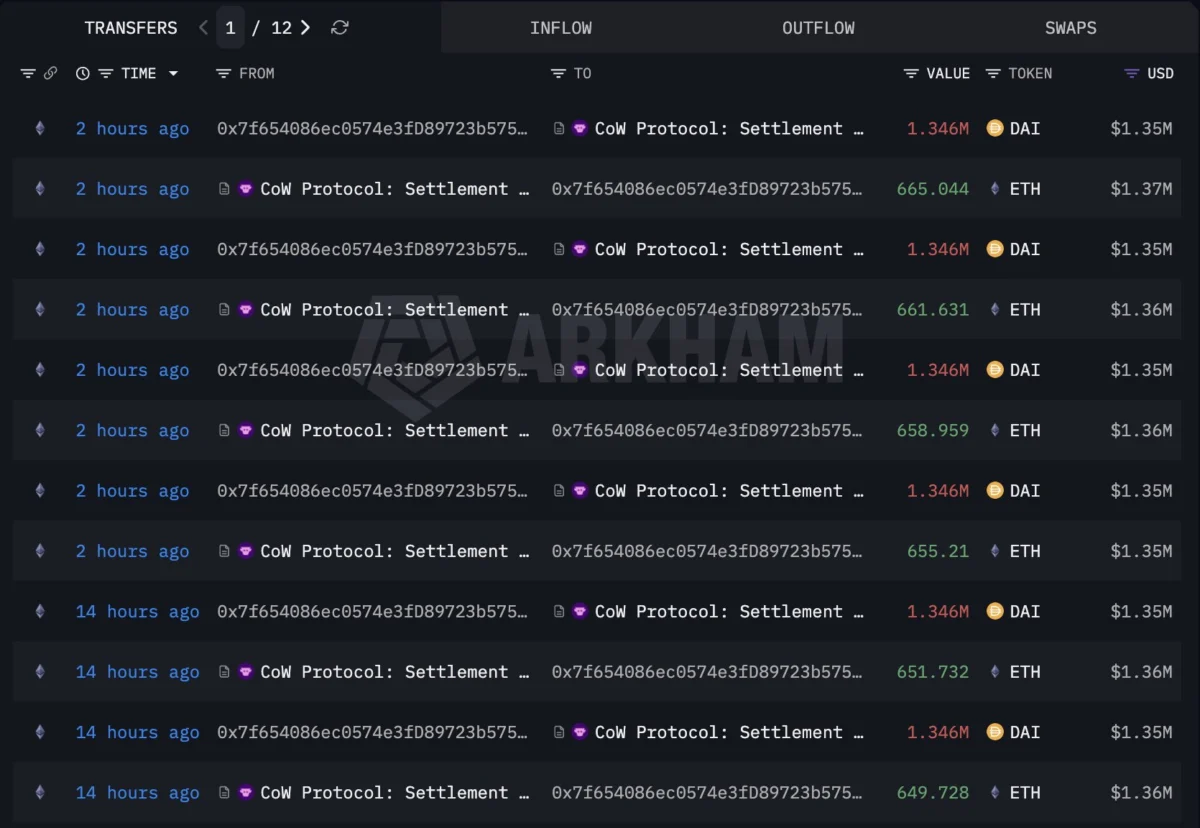
A prominent early investor in Ethereum, who transformed a modest initial ETH purchase into over $34 million in profit, has strategically re-entered the market, resuming aggressive accumulation after Ethereum’s recent price depreciation. This move, observed through on-chain tracking data, has quickly captured the attention of the broader crypto community, signaling potential renewed confidence in the asset’s long-term trajectory.
The Genesis of a Crypto Fortune: A Decade of Vision
The story of this particular investor is a testament to the long-term potential and strategic patience required in the nascent days of cryptocurrency. Approximately a decade ago, when Ethereum was a relatively unknown entity trading at a mere $7.58 per token, this early adopter received a substantial 12,001 ETH from ShapeShift. The total outlay for this foundational investment was just over $90,000, a sum that, while significant for an experimental asset at the time, pales in comparison to the eventual returns. This initial acquisition positioned the investor as an "Ethereum OG" (Original Gangster), a term often used in the crypto space to describe individuals who recognized and invested in Ethereum during its infancy. The decision to commit capital to such a nascent technology, years before its widespread adoption, highlights a remarkable degree of foresight and conviction in the underlying blockchain’s potential.
For years, this substantial holding remained largely dormant, a silent testament to a long-term investment strategy. The crypto market, during this period, experienced multiple cycles of extreme volatility, including parabolic rallies and severe downturns. Navigating these turbulent waters without capitulating or prematurely exiting required exceptional discipline. This period of holding spanned significant developmental milestones for Ethereum, from the launch of its mainnet to the emergence of the Decentralized Finance (DeFi) ecosystem, Non-Fungible Tokens (NFTs), and the increasing institutional interest in blockchain technology. Each phase brought new challenges and opportunities, yet the investor maintained their position, allowing the initial seed investment to mature significantly.
The Profitable Exit: Cashing Out at Peak Valuations
The long-term holding strategy culminated in a highly profitable exit approximately 13 months ago. The same wallet liquidated its entire 12,001 ETH holdings, converting them into approximately $34.3 million in USDC stablecoins. This transaction occurred at an average price of circa $2,856 per ETH. The numbers speak volumes about the success of this strategy: an initial investment of just over $90,000 yielded a net profit of roughly $34.2 million. This represents a staggering 376x return on the original trade, cementing the investor’s status as one of Ethereum’s most successful early backers. The timing of this sale was particularly astute, occurring during a period of elevated market valuations, allowing the investor to realize substantial gains before any significant market corrections.
Such a monumental profit underscores the transformative wealth-creation potential that early participation in groundbreaking technological shifts like blockchain can offer. It also exemplifies a common pattern among "smart money" investors: accumulating assets with strong fundamental potential at low valuations, holding through volatility, and then strategically de-risking by taking profits when market conditions are favorable. The conversion to USDC, a stablecoin pegged to the US dollar, further indicated a move to lock in gains and protect against potential market downturns, rather than immediately re-investing in other volatile assets.
The Strategic Re-entry: Buying the Dip

Fast forward to the present, and the narrative takes another compelling turn. Following Ethereum’s recent price decline, this long-dormant yet highly profitable holder has re-engaged with the market. On-chain tracking data, publicly accessible via platforms like Arkham Intelligence, reveals a significant purchase of 3,942 ETH, valued at approximately $8.08 million, as Ethereum began to push towards the $2,000 level. This renewed activity signals a strategic "buy the dip" maneuver, with the investor opening their new ETH position at an estimated average entry price close to $2,049. This entry point is notably below the previous exit price of $2,856, demonstrating a disciplined approach to re-accumulation at a more favorable valuation after having already secured substantial profits at higher levels.
The timing of this re-entry is particularly noteworthy, coinciding with a period of wider market weakness across many major digital assets. While many investors might be hesitant during downturns, experienced traders often view such periods as prime opportunities to acquire assets at discounted prices. This behavior aligns with the investment adage of "being greedy when others are fearful," suggesting a conviction that the current price decline represents a temporary correction rather than the onset of a prolonged bear market. The substantial capital deployed in this recent purchase underscores the investor’s belief in Ethereum’s continued long-term value proposition and potential for future appreciation.
Whale Activity as a Market Indicator
The movements of large wallets, often referred to as "whales" in the crypto sphere, are closely monitored by market participants for several reasons. Unlike smaller retail trades, whale activity involves significant capital flows that can materially impact market dynamics and sentiment. When an investor with a proven track record of successful, long-term plays makes a substantial move, it often serves as a powerful signal to the rest of the market. This particular investor’s history of banking $34 million in profit from an initial $90,000 investment lends immense credibility to their current actions.
Market analysts and observers widely interpret such aggressive accumulation during a price decline as a strong vote of confidence. It suggests that highly experienced traders believe the asset is undervalued at current levels and anticipates future growth. In the context of the broader crypto market, which is still prone to sentiment-driven fluctuations, such whale movements can influence collective psychology. Smaller traders, often referred to as "shrimp" or "fish," frequently attempt to emulate the behavior of these perceived "smart money" wallets, hoping to capitalize on their presumed superior market insights. This phenomenon contributes to the formation of market narratives, where observed large-scale capital movements can quickly drive sentiment, potentially leading to further buying pressure or, conversely, selling pressure if whales are seen to be offloading assets.
Ethereum’s Enduring Value Proposition and Ecosystem Growth
The renewed purchases by this seasoned investor underscore the enduring conviction many long-term holders have in Ethereum as a foundational asset, despite ongoing market turbulence and increasing competition. Over the past decade, Ethereum has evolved from a nascent, experimental smart contract platform into one of the largest and most critical blockchain ecosystems globally. Its network underpins a vast array of decentralized applications, effectively supporting:
- Decentralized Finance (DeFi): A burgeoning ecosystem of lending protocols, decentralized exchanges, and asset management platforms.
- Tokenization Frameworks: Standards like ERC-20 have enabled the creation of thousands of digital assets, from utility tokens to security tokens.
- Stablecoin Settlements: A significant portion of the world’s stablecoin transactions occur on the Ethereum blockchain, highlighting its role in global financial infrastructure.
- NFT Marketplaces: Ethereum remains the dominant blockchain for Non-Fungible Tokens, powering a multi-billion dollar digital art and collectibles market.
- Layer-2 Scaling Solutions: Innovations like optimistic rollups and zero-knowledge rollups are continuously enhancing Ethereum’s scalability and affordability, addressing its previous limitations.
This broad utility and foundational role support sustained institutional and retail interest, even amidst marked price volatility. Investors increasingly view Ethereum not merely as a speculative token but as exposure to the growing backbone of blockchain-based finance and the digital economy. The ongoing development roadmap, including future upgrades aimed at enhancing scalability, security, and sustainability, further bolsters this long-term perspective. While competition from alternative Layer-1 networks and rapidly expanding Layer-2 solutions is intensifying, it also signifies the maturation of the blockchain industry. Rather than threatening Ethereum’s existence, this competition pushes the ecosystem to innovate further, solidifying its position as a central hub for decentralized innovation.
On-Chain Transparency: A New Paradigm for Market Analysis
The ability to track such significant capital movements in real-time is a hallmark of the blockchain era and fundamentally distinguishes it from traditional financial markets. In conventional finance, institutional trades are often obscured, with details emerging only through delayed regulatory filings or retrospective disclosures. Public blockchains, however, offer unprecedented transparency, revealing large capital flows almost instantaneously to anyone with the tools and knowledge to track them.
This inherent transparency has given rise to new forms of market analysis, collectively known as "whale tracking," "smart money tracking," or "wallet activity analysis." A growing number of traders and analysts now leverage on-chain data to identify patterns of accumulation, profit-taking, or capital reallocation by large, influential wallets. In this instance, the wallet’s documented history of extreme profitability brought immediate and intense scrutiny to its recent acquisitions. The address itself has effectively become a sentiment indicator, its actions reflecting a high-conviction play within the Ethereum ecosystem.
Furthermore, on-chain transparency accelerates narrative formation within these markets. As soon as large positions become publicly visible, smaller traders often respond rapidly, attempting to emulate the behavior of perceived "high-apparent" wallets. This trend has become a defining characteristic of digital asset markets, where the real-time visibility of capital movements transforms into actionable on-chain market information that can almost instantly drive sentiment and trading decisions.
Ethereum’s Critical Market Structure Phase
The broader market structure facing Ethereum is currently in a critical phase, and the actions of whales like this early investor play a significant role in shaping its trajectory. Ethereum remains the largest blockchain ecosystem by far, boasting the most developers and the broadest range of applications. However, it is also navigating an increasingly competitive landscape, with numerous alternative Layer-1 networks and rapidly expanding Layer-2 solutions vying for market share by offering enhanced scalability and reduced transaction costs.
Simultaneously, institutional adoption of Ethereum continues to progress, driven by tokenized assets, stablecoin infrastructure, deeper decentralized finance integrations, and various enterprise blockchain experiments. This interplay of growing utility and unprecedented competition has brought Ethereum’s market structure to a level of maturation that was absent in earlier crypto cycles. Investors are now evaluating Ethereum within a broader context that includes ecosystem growth, developer activity, and its long-term importance as digital infrastructure, rather than solely focusing on short-term price momentum.
The move by this highly profitable, long-term holder can be interpreted as a powerful signal to restore confidence in Ethereum’s future, especially during periods of perceived weakness. It reinforces the narrative that strategic investors view current dips as opportunities, rather than reasons for concern. While it remains unclear if this specific wallet will further scale its position, these latest purchases have already ignited fresh discourse around "smart money" accumulation and discussions of conviction within the Ethereum ecosystem. As the crypto market remains somewhat unsettled, traders and analysts will be closely watching to see if other major, long-term holders follow suit, using the current correction as an opportunity to increase their exposure to Ethereum. This collective action, or lack thereof, will be instrumental in determining the immediate and medium-term sentiment for the asset.
Disclosure: This is not trading or investment advice. Always do your research before buying any cryptocurrency or investing in any services.














