


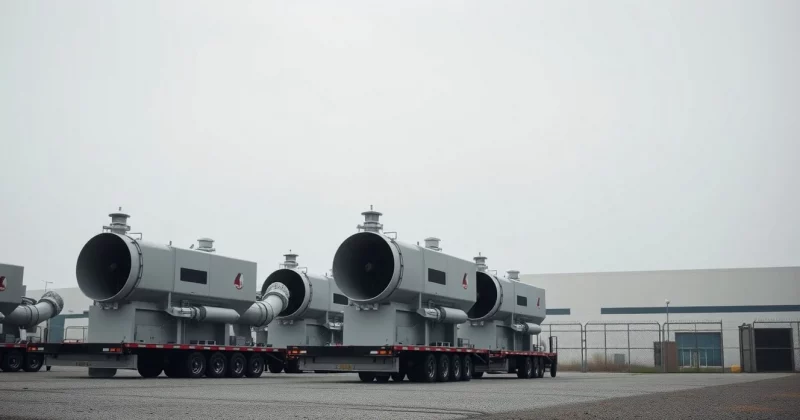
The rapid expansion of artificial intelligence infrastructure has reached a critical juncture where the demand for computational power is being outpaced by the availability of electricity from the national grid. Elon Musk’s artificial intelligence startup, xAI, is positioning itself as a major player in the energy sector to bridge this gap, with a massive $2.8 billion commitment to procure gas turbines over the next three years. This strategic move, revealed through a recent S-1 filing by SpaceX, underscores a significant shift in how Big Tech firms are approaching the energy crisis: by becoming their own utility providers. According to the filing, approximately $2 billion of this expenditure is specifically earmarked for mobile gas turbine units, which are designed to provide immediate, high-capacity power to data centers without the multi-year delays typically associated with traditional utility grid connections.
The scale of this investment marks xAI as one of the largest prospective buyers of gas turbines in the United States, highlighting the "insatiable appetite" for electricity within the generative AI sector. As xAI races to scale its "Colossus" supercomputer cluster in Memphis, Tennessee—a facility Musk has described as the most powerful AI training system in the world—the company is bypassing the conventional hurdles of the energy sector. However, this aggressive pursuit of power has placed xAI at the center of a burgeoning legal and environmental conflict that could reshape the regulatory landscape for both the AI and cryptocurrency industries.
The Strategic Shift to On-Site Power Generation
The decision to invest $2 billion in mobile gas turbines is a tactical response to the "power bottleneck" currently stifling the US tech industry. Traditional data center construction involves a complex dance with local utility boards, often requiring five to seven years for the necessary high-voltage infrastructure to be built or upgraded. For xAI, which operates on a timeline of months rather than years, waiting for the Tennessee Valley Authority (TVA) or local providers to upgrade the grid was not a viable option.
Mobile gas turbines, often referred to as "power plants on wheels," are aero-derivative engines—essentially modified jet engines—that can be transported by truck and deployed rapidly. These units can generate tens of megawatts of power within weeks of arriving at a site. By utilizing these mobile units, xAI can bypass the queue for grid interconnection, allowing the Colossus facility to scale its 100,000 Nvidia H100 GPUs immediately. This move reflects a broader trend among "Hyperscalers" like Meta, Google, and Microsoft, who are increasingly looking toward behind-the-meter (BTM) energy solutions to ensure their facilities remain operational regardless of grid stability or capacity.
The Memphis Controversy: Environmental and Legal Challenges
The centerpiece of xAI’s current operations is its massive data center in Memphis, housed in a former Electrolux manufacturing plant. While the facility represents a multi-billion dollar investment in the local economy, it has quickly become a flashpoint for environmental justice. The NAACP, alongside the Southern Environmental Law Center (SELC) and various local community groups, has filed a lawsuit seeking to halt the operation of the gas turbines at the site.
The core of the legal challenge lies in the projected emissions from the facility. Environmental advocates allege that the gas turbines, if run at the capacity required to power xAI’s supercomputers, are capable of emitting more than 2,000 tons of nitrogen oxide (NOx) annually. Nitrogen oxides are a primary precursor to ground-level ozone and smog, and they are linked to a range of respiratory illnesses, including asthma and chronic bronchitis. The plaintiffs argue that xAI has deployed industrial-scale power generation in a residential and historically underserved area without undergoing the rigorous environmental review process required by the Clean Air Act.
The lawsuit challenges the "emergency" or "temporary" classification often used to deploy mobile turbines. Critics argue that using these units as a permanent power source constitutes a major stationary source of pollution, which should trigger more stringent permitting requirements, including the installation of Best Available Control Technology (BACO) to mitigate emissions. If the court rules in favor of the NAACP, it could set a national precedent, forcing AI companies to undergo lengthy environmental impact assessments before firing up on-site generation.
Chronology of xAI’s Energy Expansion
The timeline of xAI’s energy maneuvers illustrates the speed at which the company is attempting to dominate the AI landscape:
- July 2023: Elon Musk officially launches xAI with the goal of "understanding the true nature of the universe."
- Spring 2024: xAI selects Memphis, Tennessee, for its "Colossus" supercomputer project, citing the availability of a large industrial site.
- June 2024: Reports emerge that xAI is installing a massive array of gas turbines at the Memphis site to supplement the 50 megawatts of power provided by the local utility, Memphis Light, Gas and Water (MLGW).
- August 2024: Local environmental groups and the NAACP voice concerns over air quality, noting that the turbines are operating without a standard air construction permit.
- Late 2024: The SpaceX S-1 filing publicly confirms the $2.8 billion commitment for gas turbines, revealing the true scale of xAI’s energy ambitions.
- Present: Legal proceedings continue as the community seeks a preliminary injunction to stop turbine operations pending a full environmental review.
Supporting Data: The Magnitude of AI Power Consumption
The energy requirements of modern AI models are staggering compared to traditional cloud computing. An H100 GPU from Nvidia has a peak power consumption of approximately 700 watts. When 100,000 of these units are networked together, as they are in the Colossus cluster, the base power draw for the chips alone is 70 megawatts. When accounting for cooling systems, networking hardware, and power conversion losses, the total facility demand can easily exceed 150 megawatts—enough to power roughly 100,000 to 150,000 homes.
The $2.8 billion investment in turbines suggests that xAI is planning for a future where its total power demand reaches into the gigawatt range. For comparison, a typical nuclear reactor produces about one gigawatt of power. The fact that xAI is willing to spend $2 billion on mobile units—which are generally more expensive to operate than fixed plants—indicates the extreme premium the company places on speed-to-market.
Broader Impact: The "Crypto-AI" Energy Nexus
The legal battle in Memphis has significant implications for the cryptocurrency mining industry. Like AI firms, Bitcoin mining operations often seek "behind-the-meter" arrangements, using natural gas turbines or "stranded gas" from oil wells to power their rigs. Companies like Marathon Digital Holdings and Riot Platforms have pioneered the use of on-site generation to lower costs and bypass grid constraints.
If the NAACP lawsuit against xAI gains traction and results in stricter federal or state oversight of on-site gas generation, the "regulatory shield" currently enjoyed by many mining operations could evaporate. A ruling that classifies mobile turbines as major pollution sources would increase compliance costs, necessitate expensive filtration systems, and potentially lead to the shuttering of operations located near residential areas. This creates a shared regulatory risk for both the AI and crypto sectors, potentially forcing a pivot toward renewable energy or small modular reactors (SMRs) sooner than planned.
Official Responses and Inferred Reactions
While xAI has remained relatively quiet regarding the specifics of the lawsuit, Elon Musk has frequently commented on the "electricity shortage" facing the tech industry. In various public forums, Musk has predicted that the transition to AI and electric vehicles will require a tripling of the US electrical grid’s capacity. His move to buy turbines is seen by analysts as a "self-help" measure in the face of what he perceives as bureaucratic inertia in the utility sector.
The Tennessee Valley Authority (TVA) has expressed a commitment to supporting industrial growth but has also noted the unprecedented nature of the demand. In a recent statement, local officials in Memphis emphasized the economic benefits of the xAI facility, including job creation and tax revenue, while acknowledging the need to balance industrial needs with community health. However, the lack of a formal environmental impact statement remains a point of contention that neither the company nor the city has fully addressed to the satisfaction of local advocates.
Fact-Based Analysis of Implications
The $2.8 billion turbine spree by xAI is a symptom of a larger structural problem in the United States: an aging and inflexible energy grid that is unprepared for the "compute-heavy" era. The implications of this event are three-fold:
- Energy Market Distortions: The entry of xAI as a massive buyer of turbines could tighten the supply chain for energy infrastructure. Other industries, including traditional utilities looking to modernize, may face higher prices and longer lead times for turbine components.
- Environmental Policy Shift: The Memphis lawsuit may force the Environmental Protection Agency (EPA) to update its definitions of "mobile" vs. "stationary" sources. If mobile turbines used for data centers are reclassified, it will trigger a wave of new federal permitting requirements across the country.
- The Rise of Independent Power Producers: Tech companies are no longer just consumers of energy; they are becoming producers. This "decentralization" of the power sector could undermine the traditional utility business model, leading to a future where the wealthiest corporations operate their own private, fossil-fuel-powered grids while the public grid struggles with maintenance and decarbonization goals.
In conclusion, Elon Musk’s $2.8 billion bet on gas turbines is a high-stakes gamble that prioritizes the rapid development of artificial intelligence over traditional environmental and regulatory norms. As xAI attempts to power the future of intelligence with the technology of the past, the outcome of the Memphis legal battle will likely determine whether the AI revolution will be fueled by a new era of unregulated industrial expansion or if it will be forced to adhere to the environmental standards of the communities it inhabits.














