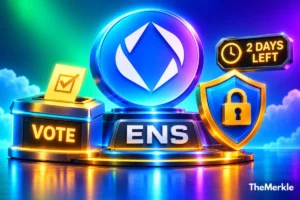
The Ethereum Name Service (ENS) Decentralized Autonomous Organization (DAO) is currently undertaking a pivotal "Governor Nexus Update" vote, a non-binding social signal vote running until November 3. This crucial initiative aims to introduce a significantly upgraded governance contract, Governor Nexus, designed to address fundamental security weaknesses identified in the DAO’s current operational framework. Built on the robust OpenZeppelin Contracts v5.6.1, the proposed system seeks to fortify ENS against potential exploits, enhance participant accountability, and introduce more flexible proposal pathways, thereby setting a new standard for decentralized governance in Web3.
The Imperative for Change: Fortifying ENS Governance
The Ethereum Name Service stands as a foundational pillar of the Web3 ecosystem, providing human-readable names for Ethereum addresses, decentralized websites, and other resources. Often dubbed the "DNS of Web3," ENS facilitates user-friendly interaction with the blockchain, making it an indispensable service. Given its critical role and the substantial value it secures – both in terms of user trust and the underlying assets managed by its DAO – robust and resilient governance is not merely an advantage but an absolute necessity. The integrity of ENS governance directly impacts the security and usability of countless decentralized applications and digital identities.
The existing ENS governance contract, deployed in 2021 and based on an older OpenZeppelin v4 Bravo-style governor, has served its purpose but has revealed inherent vulnerabilities that are no longer tenable in a rapidly evolving threat landscape. Among the most glaring issues is a dangerously short voting delay of a single Ethereum block, which translates to approximately 12 seconds. This minuscule window provides delegates with virtually no time to coordinate, analyze, or react to a newly submitted proposal before voting can commence. Such a bottleneck creates a significant attack surface, particularly susceptible to flash loan attacks or rapid-fire malicious proposals designed to bypass proper scrutiny.
Blockful, an ENS service provider and the developer behind Governor Nexus, explicitly highlighted this one-block window as one of three "critical" weaknesses. The potential for a hostile proposal to slip through before delegates can organize a counter-vote poses an existential risk to the DAO’s assets and its operational integrity. The Governor Nexus update is engineered to directly confront and neutralize these critical vulnerabilities, ushering in an era of heightened security and more deliberative decision-making.
A Phased Approach to Decentralized Security
The current "Governor Nexus Update" vote is a social signal, a non-binding Snapshot vote designed to gauge community support for the proposed design. This initial step is vital for establishing consensus before committing to resource-intensive and security-critical on-chain deployments. Unlike an executable vote that directly triggers contract changes, this Snapshot vote, which closes on November 3, merely signals the community’s endorsement of the conceptual framework and design principles of Governor Nexus.
The journey toward this significant upgrade began much earlier, underscoring a deliberate and methodical approach to governance evolution. The concept for Governor Nexus was first publicly introduced in March through a Request for Comments (RFC) on the ENS forums. Titled "RFC: Governor Nexus – Modular Security Upgrade for ENS Governance," Blockful’s initial proposal articulated a clear vision: to "modernize the ENS Governor while preserving full compatibility with the existing Timelock contract." This emphasis on compatibility is crucial, ensuring that the transition does not disrupt the core functions or historical integrity of the DAO’s operational mechanics.
Following extensive community feedback and iterative development, an "implementation report" was published on August 19, detailing the technical specifications and architectural choices for Governor Nexus. Concurrently, the public code was released in Blockful’s nexus repository on GitHub, allowing for transparent review and community vetting. This open-source approach aligns with the ethos of decentralized development and fosters trust within the ecosystem.
A key aspect of the upgrade’s validation process involves the Anticapture framework, a specialized security assessment tool for decentralized governance. The current ENS governance setup is rated "Stage 0" under this framework, indicating a rudimentary level of resilience against sophisticated governance attacks. Blockful’s assessment projects that the implementation of Governor Nexus would elevate ENS to "Stage 1," signifying a substantial improvement in its ability to withstand adversarial actions and protect against common attack vectors. This move from Stage 0 to Stage 1 represents a significant leap forward in the DAO’s defensive capabilities, particularly against coordinated attempts to manipulate or hijack its decision-making processes.
Key Innovations of Governor Nexus
Governor Nexus is not merely an incremental update; it represents a comprehensive overhaul, introducing several critical features designed to enhance security, accountability, and the overall efficiency of ENS governance. The contract is rebuilt on OpenZeppelin Contracts v5.6.1, a more modern and extensively audited framework than the v4 version currently in use. This shift leverages the latest advancements in smart contract security, with Blockful stating that custom code was only developed where OpenZeppelin lacked an equivalent, ensuring that the core "is composed from the standard audited Governor modules."
Addressing Critical Flaws: The One-Block Window and Proposal Floods
The most pressing security concerns addressed by Governor Nexus revolve around the speed at which proposals can be submitted and voted upon. The current one-block voting delay, as previously noted, is a critical vulnerability. Governor Nexus tackles this by implementing a significantly increased voting delay, moving from seconds to a minimum of 24 hours. This extended period grants delegates ample time to review, discuss, and coordinate their responses, dramatically reducing the risk of proposals being rushed through without proper scrutiny.
Furthermore, the existing governor lacks mechanisms to prevent a "proposal flood," where a malicious actor could submit numerous proposals simultaneously, overwhelming delegates and making it difficult to discern legitimate actions from harmful ones. Governor Nexus introduces proposal throttling, limiting an address to only one active proposal at a time. While developers acknowledge that a sophisticated attacker could circumvent this by distributing voting power across multiple wallets, it significantly raises the cost and complexity of such an attack, serving as a robust first line of defense against simple spam or coordination disruption.
Preventing Last-Minute Manipulations: The Anti-Snipe Extension
Another significant improvement targets "last-minute flips," rated as a "medium" severity weakness in the current system. Under the existing rules, a proposal could be failing for most of its voting period, only to pass in the final moments as a large block of votes is cast, leaving no time for opposing delegates to react. This "sniping" behavior undermines fair democratic process.
Governor Nexus introduces an "anti-snipe extension" mechanism. If a proposal’s status changes from failing to passing within the final 24 hours of its voting period, the voting window is automatically extended by an additional 48 hours. This provides a crucial window for the community to respond to sudden shifts in vote tallies, ensuring that all significant decisions are made with sufficient public awareness and delegate deliberation. To prevent gaming this feature, the extension is triggered only once per proposal, and the code also explicitly states that a last-minute withdrawal of a veto vote (which could cause a flip) would also trigger the extension, demonstrating a comprehensive approach to securing the voting process.
Enhanced Accountability for Proposers and Dynamic Voting
The current ENS governor allows proposers to submit a proposal and then immediately sell or move their ENS tokens, potentially leaving the DAO vulnerable if the proposer’s motivations were malicious or if they simply lose interest. Governor Nexus rectifies this by treating the proposal threshold as a continuous requirement. If a proposer’s voting power falls below the required threshold at any point while their proposal is pending or in active voting, any member of the community can cancel that proposal. This mechanism ensures that proposers remain invested in the outcome of their proposals, fostering greater accountability. Even a transient, one-block dip in token holdings is sufficient to trigger this cancellation right, emphasizing the rigor of this new requirement.
Additionally, Governor Nexus introduces the ability for voters to change their votes on an open proposal. Under the live governor, a vote is final once cast, creating a "no correction path if a voting interface is compromised" – a "medium" severity risk. The new system allows voters to cast a new vote, which replaces their earlier one. This flexibility is crucial for several reasons: it allows delegates to adapt to new information, correct accidental votes, or respond to evolving community sentiment. This dynamic voting capability also plays a critical role in the anti-snipe mechanism, as it means vote tallies can shift in both directions, necessitating the final window check to prevent sudden, unreactive changes.
Streamlined Proposal Management and Enhanced Transparency
Beyond these major security enhancements, Governor Nexus also introduces several quality-of-life improvements that streamline the governance process and enhance transparency. These include automatic generation of proposal IDs, standardized metadata fields for proposals, and clearer event logging for all governance actions. These seemingly minor changes contribute to a more organized, auditable, and user-friendly governance experience, reducing the potential for human error and making it easier for participants to track and understand ongoing proposals.
Diversifying Governance: Three New Proposal Types
Perhaps one of the most significant architectural shifts introduced by Governor Nexus is the replacement of the single, monolithic proposal path with three distinct proposal types, each tailored to different levels of criticality and community engagement. This modular approach aims to make governance more efficient, accessible, and responsive.
Standard Proposals
The "Standard" proposal type most closely mirrors the current governance mechanism. It requires a significant voting power threshold of 100,000 ENS to initiate, demands a simple majority for passage, and necessitates a quorum of 1% of the total ENS supply. This pathway is intended for major decisions, such as significant protocol upgrades, treasury allocations, or fundamental changes to the DAO’s structure, where broad consensus and extensive deliberation are paramount. It ensures that only proposals with substantial delegate backing can proceed, providing a high bar for critical actions.
Optimistic Proposals
A novel addition, "Optimistic" proposals are designed for faster decision-making on less controversial or routine matters. These proposals pass by default unless explicitly vetoed by a substantial opposing vote. Specifically, an Optimistic proposal will pass unless 500,000 ENS votes "Against" it by the deadline, with no quorum required for its passage. This mechanism aims to reduce governance friction for proposals that are expected to be uncontroversial, freeing up delegate attention for more complex issues.
To mitigate the inherent risks of such a "pass by default" system, several safeguards are in place:
- Higher Veto Threshold: The 500,000 ENS veto threshold is five times higher than the Standard proposal initiation threshold, ensuring that only significant opposition can halt an optimistic proposal.
- Longer Voting Periods: Optimistic proposals are likely to have longer voting periods to provide ample time for any potential opposition to materialize and organize.
- Anti-Snipe Integration: The anti-snipe rule applies to optimistic proposals as well. If a veto is withdrawn at the last moment, causing the proposal to flip from failing (due to a high veto count) to passing, it triggers the 48-hour extension, preventing last-minute manipulation.
Optimistic proposals represent a forward-thinking approach to scaling DAO governance, acknowledging that not all decisions require the same level of rigorous, time-consuming debate.
Bond Proposals
The "Bond" proposal type is perhaps the most innovative and democratizing feature, designed to lower the barrier to entry for proposing ideas within the ENS DAO. Under this system, anyone can submit a proposal by locking a relatively modest bond of 1,000 ENS, rather than needing to hold 100,000 ENS in voting power. This significantly broadens the pool of potential proposers, encouraging more community members to contribute ideas and initiatives.
To counter the potential for spam or malicious proposals that a lower threshold might invite, Bond proposals introduce a fourth voting option: "Against and Slash." This option allows voters to not only oppose a proposal but also to vote for the forfeiture of the proposer’s bond. The bond is forfeited to the ENS treasury only if two conditions are met: first, the proposal must be rejected (i.e., "Against" votes outweigh "For" votes), and second, the "Against and Slash" votes must outnumber plain "Against" votes. This mechanism directly implements a predicate approved by the DAO in EP 5.15, which established the principle of penalizing clearly malicious or frivolous proposals.
Blockful openly acknowledges the trade-offs inherent in Bond proposals:
- Increased Accessibility vs. Spam Risk: While lowering the proposal threshold democratizes the process, it also inherently increases the risk of frivolous or low-quality proposals. The "slash" mechanism is designed to mitigate this, but vigilance will be required.
- Complexity: The introduction of a fourth voting option and conditional bond forfeiture adds a layer of complexity to the voting process for delegates.
- Dispute Resolution: The success of Bond proposals relies on the community’s ability to effectively discern between valuable ideas and those warranting a slash, potentially leading to debates around what constitutes a "slash-worthy" offense.
Despite these considerations, Bond proposals represent a significant step towards fostering a more inclusive and dynamic governance environment, empowering a wider range of stakeholders to actively participate in shaping the future of ENS.
The Path Forward: From Social Consensus to On-Chain Reality
The current social vote, while critical for demonstrating community support, is merely the first step in a multi-stage process to implement Governor Nexus. A "Yes" vote on November 3 will not instantly replace the live governor contract. Instead, it will signal the community’s readiness to proceed with the subsequent, more technical, and security-intensive phases.
The contract’s own documentation clearly outlines the necessary steps that must follow:
- External Audit: This is a non-negotiable step. An independent, reputable smart contract auditing firm will meticulously review the entire Governor Nexus codebase. This audit is distinct from the internal Anticapture assessment and is crucial for identifying any potential vulnerabilities, bugs, or logical flaws that could compromise the security of the ENS DAO. Given the stakes involved, a thorough external audit is paramount to ensure the integrity of the new governance system.
- Executable Vote: Following a successful external audit and any necessary remediations, a separate, on-chain executable vote will be initiated. This vote, if passed by ENS token holders, will directly trigger the deployment of the new Governor Nexus contract and transfer control of the DAO’s timelock to this new, upgraded system. This is the definitive moment when the community formally endorses and activates the new governance mechanisms.
- On-Chain Deployment: Upon successful passage of the executable vote, the Governor Nexus contract will be deployed to the Ethereum blockchain, effectively replacing the old 2021 governor. At this point, all ENS governance actions will operate under the new rules, incorporating the extended voting delays, anti-snipe features, proposer accountability, and diversified proposal types.
Until these rigorous steps are completed, ENS will continue to operate under its existing 2021 governor, with its inherent limitations, including the one-block delay and irreversible votes. This phased approach underscores the DAO’s commitment to security and due diligence, ensuring that such a fundamental upgrade is implemented with the utmost care and community consensus.
Implications for ENS and the Broader Web3 Ecosystem
The successful implementation of Governor Nexus carries profound implications not only for the ENS DAO but also for the wider decentralized autonomous organization landscape.
- Increased Resilience and Security: By addressing critical vulnerabilities like the single-block voting delay and implementing anti-snipe mechanisms, ENS governance will become significantly more robust against various attack vectors, including flash loan exploits and coordinated manipulation. This enhanced security will instill greater confidence among ENS token holders, delegates, and the broader user base.
- Improved Efficiency and Adaptability: The introduction of Optimistic and Bond proposals will streamline decision-making processes. Routine matters can be handled more swiftly, reducing governance overhead, while Bond proposals empower a wider range of community members to initiate discussions and contribute ideas, fostering a more dynamic and inclusive environment.
- Setting a Governance Standard: As a leading Web3 protocol, ENS’s commitment to continuously improving its governance security and efficiency serves as a crucial precedent for other DAOs. The transparent development process, the phased deployment strategy, and the innovative features of Governor Nexus can provide a blueprint for other decentralized organizations grappling with similar challenges in scaling and securing their governance models.
- Enhanced Decentralization: By lowering the barrier to entry for proposing and empowering a more active and accountable delegate base, Governor Nexus aims to further decentralize influence and decision-making within the ENS ecosystem, moving closer to the ideal of truly autonomous and community-driven governance.
While no governance system is impervious to all forms of attack or perfect in its design, the Governor Nexus Update represents a monumental leap forward for the ENS DAO. It is a testament to the community’s dedication to continuous improvement, security, and the long-term viability of one of Web3’s most vital protocols. The ongoing social vote is not just about a contract upgrade; it’s about reaffirming the ENS DAO’s commitment to building a more secure, efficient, and truly decentralized future.
Disclosure: This is not trading or investment advice. Always do your research before buying any cryptocurrency or investing in any services.
Follow us on Twitter @themerklehash to stay updated with the latest Crypto, NFT, AI, Cybersecurity, and Metaverse news!