Ethereum, the second-largest cryptocurrency by market capitalization, is currently navigating a crucial and potentially pivotal period, with its price consolidating in a narrow range below the $2,700 mark. This prolonged period of indecision and apparent market exhaustion has drawn the attention of prominent market observers, who are closely monitoring key technical indicators and broader market sentiment for clues regarding Ethereum’s next significant price movement. The current trading environment presents a make-or-break scenario, with bulls and bears locked in a battle for control, the outcome of which could have substantial implications for the broader altcoin market.
Technical Indicators Signal Uncertainty and Potential for Volatility
The current price action of Ethereum suggests a lack of clear directional conviction. For approximately the past week, ETH has been unable to decisively break above a critical resistance level, indicating that upward momentum is faltering. This stagnation often precedes significant price adjustments, either to the upside or downside, as market participants reassess their positions.
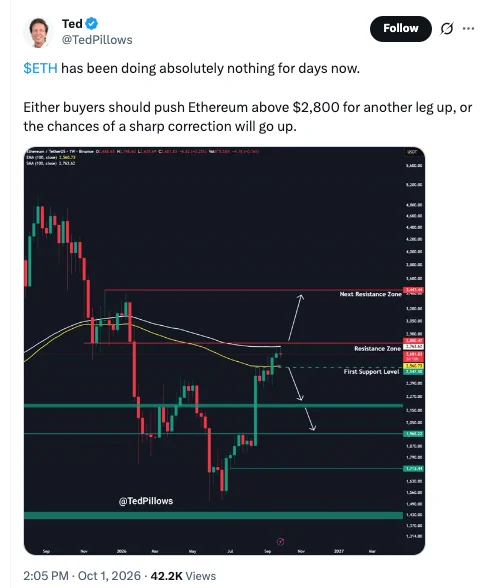
Prominent crypto analyst Ted Pillows, in a recent social media post, highlighted $2,800 as the next pivotal price level to watch. According to Pillows’ analysis, a sustained breach above this threshold would be a strong signal for bulls, potentially unlocking further upside potential and re-establishing a bullish trend. Conversely, a failure to overcome this resistance could pave the way for a sharp price correction, a scenario that current upward forces are keen to avoid. This technical observation underscores the immediate importance of the $2,800 level as a battleground for market sentiment.
At the time of reporting, Ethereum was trading around $2,620. This price point places ETH precariously between two significant moving averages. The 100-day Simple Moving Average (SMA) is situated around $2,780, acting as a potential resistance zone, while the 100-day Exponential Moving Average (EMA) hovers near $2,560, offering a level of support. The fact that the current spot price sits squarely between these two widely watched indicators amplifies the sense of indecision and suggests that a catalyst is needed to drive the price decisively in either direction. The proximity of these moving averages to the current price action creates a dynamic environment where even minor shifts in supply and demand could trigger significant price swings.
Bearish Scenarios and Potential Downside Targets
Should the bears successfully exert downward pressure and push Ethereum below its current support levels, several key price points come into focus as potential targets for further declines. Analysts have identified $2,547 as an immediate area of interest. A breach of this level could then lead to further testing of $1,965, a more significant psychological and technical support zone. In a more severe bearish scenario, the price could potentially fall to $1,713. These levels represent potential capitulation points if selling pressure intensifies and broader market sentiment turns decisively negative. The progression through these levels would indicate a significant shift in market dynamics, potentially signaling the start of a more prolonged downturn.
The "Uptober" Myth and October’s Market History
The month of October has historically been viewed with a degree of optimism within the cryptocurrency community, often referred to as "Uptober" due to a perceived tendency for bullish price action. Data suggests that in 13 out of the last 10 years, October has witnessed net positive returns for cryptocurrencies. This historical trend provides a psychological comfort for bulls, offering a potential tailwind for price appreciation.

However, this optimism must be tempered by recent historical events. Last October, the cryptocurrency market experienced one of its most significant derivatives liquidation events in history. This massive deleveraging, exceeding $15 billion, was widely interpreted as a premature end to the 2024-2025 bull market. This stark reminder serves as a cautionary tale, highlighting that historical trends are not guarantees and that unforeseen events can rapidly alter market trajectories. The memory of last year’s October serves as a crucial counterpoint to the "Uptober" narrative, emphasizing the inherent volatility and unpredictable nature of the crypto market.
Early October Signals and Broader Market Implications
The current start to October has not immediately inspired confidence among bullish observers. The initial week, often considered a critical period for setting the month’s tone, has seen major cryptocurrencies trading either sideways or experiencing slight declines. This sluggish performance is not an ideal indicator for those anticipating a strong bullish rally. While there is still ample time for bulls to regain control and assert their influence, the current sideways drift suggests a cautious or hesitant market.
The performance of Bitcoin (BTC) and Ethereum (ETH) is of paramount importance, as these two dominant cryptocurrencies often dictate the trend for the rest of the altcoin market. Ethereum’s significant market dominance and its central role in the burgeoning decentralized finance (DeFi) ecosystem mean that its price action and market sentiment have a disproportionately large impact on the overall health and direction of the altcoin sector. As ETH’s positioning begins to appear vulnerable, if not outright weak, the broader altcoin market faces increased risk. A sustained downturn in Ethereum could trigger a cascade of selling pressure across a wide array of smaller cryptocurrencies, amplifying losses and potentially ushering in a period of significant market contraction.
Broader Economic Context and Investor Sentiment
Beyond technical indicators and historical trends, several macroeconomic factors can influence cryptocurrency prices. Global inflation rates, interest rate policies set by central banks, geopolitical tensions, and regulatory developments all play a role in shaping investor sentiment towards risk assets like cryptocurrencies. For instance, a hawkish stance by the U.S. Federal Reserve, signaling further interest rate hikes, could lead investors to reduce their exposure to riskier assets, including digital currencies, in favor of safer havens. Conversely, dovish monetary policies or signs of economic recovery could encourage greater investment in growth-oriented assets.
The current economic landscape is characterized by persistent inflation in many regions and a cautious approach by central banks to monetary policy. This environment creates a degree of uncertainty for risk assets. Investors are closely watching economic data releases, such as inflation reports and employment figures, for indications of future policy direction. Any significant shifts in these indicators could have a ripple effect on the cryptocurrency market, influencing investor confidence and capital flows.
Furthermore, the evolving regulatory landscape for cryptocurrencies globally remains a significant factor. Increased regulatory clarity, while potentially stifling for some aspects of the industry, can also foster greater institutional adoption by providing a more predictable framework. Conversely, stringent or ambiguous regulations can create uncertainty and deter investment. The ongoing discussions and actions by regulatory bodies in major economies are closely scrutinized by market participants.
The Role of Decentralized Finance (DeFi) and Network Activity
Ethereum’s value proposition extends far beyond its price as a speculative asset; it is the foundational blockchain for a vast and growing decentralized finance ecosystem. The health and activity within DeFi protocols, such as decentralized exchanges (DEXs), lending platforms, and yield farming applications, are critical indicators of Ethereum’s underlying utility and demand.

Metrics such as Total Value Locked (TVL) in DeFi protocols, the number of active users, and transaction volumes on the Ethereum network provide insights into the real-world adoption and usage of the blockchain. A sustained decline in these metrics could signal waning interest in Ethereum-based applications, potentially impacting its long-term value. Conversely, continued growth in DeFi activity and network usage would suggest that Ethereum remains a vital and evolving technological platform, even amidst short-term price fluctuations.
The recent performance of Ethereum’s network has seen a notable increase in developer activity and innovation, particularly in areas like Layer 2 scaling solutions aimed at reducing transaction costs and increasing throughput. Projects like Arbitrum and Optimism have gained significant traction, processing a substantial portion of Ethereum’s transaction volume. This ongoing development and adoption of scaling technologies are crucial for Ethereum’s long-term viability and its ability to compete in an increasingly crowded blockchain landscape. The success of these scaling solutions can bolster confidence in Ethereum’s future, potentially mitigating some of the bearish sentiment driven by current price action.
Historical Precedents and Market Cycles
The cryptocurrency market is known for its cyclical nature, characterized by periods of rapid growth (bull markets) followed by significant downturns (bear markets). Ethereum, since its inception, has experienced several such cycles. Understanding these historical patterns can provide context for the current market conditions.
Following the highs reached in late 2021, the cryptocurrency market entered a prolonged bear market throughout 2022 and into early 2023. During this period, Ethereum experienced substantial price depreciation, mirroring the broader market trend. The subsequent recovery and rally in late 2023 and early 2024 saw ETH reach new multi-month highs, demonstrating its ability to rebound.
The current price consolidation below $2,700 could be interpreted in various ways within the context of market cycles. It might represent a healthy period of consolidation after a significant rally, allowing the market to digest gains and build a base for future upward movement. Alternatively, it could be an early indicator of a potential shift from a bullish or neutral phase back into a bearish trend, especially if key support levels are breached. The behavior of major market players, including institutional investors and large holders (whales), often provides clues about the underlying sentiment and potential direction of these cycles.
Expert Commentary and Future Outlook
The divergence of opinions among market analysts is a common feature of the cryptocurrency space. While some, like Ted Pillows, focus on specific technical levels, others adopt a broader macroeconomic or fundamental analysis approach.
Peter Schiff, a well-known gold advocate and vocal critic of cryptocurrencies, has frequently expressed bearish views on Bitcoin and, by extension, Ethereum. His pronouncements often coincide with periods of market downturn, and he has repeatedly declared that Ethereum is in a bear market when its price experiences significant declines. While Schiff’s predictions are often contrarian to mainstream crypto sentiment, his consistent bearish stance highlights the polarized views within the financial community regarding digital assets.
The future trajectory of Ethereum will undoubtedly be influenced by a confluence of factors: technological advancements within the Ethereum ecosystem, broader macroeconomic conditions, regulatory clarity, and the overall sentiment of investors. The upcoming weeks and months will be critical in determining whether Ethereum can break through its current resistance levels and resume an upward trend, or if it will succumb to bearish pressures and test lower support zones. The market’s ability to navigate these challenges will be a testament to its resilience and its evolving role in the global financial landscape. The ongoing developments in scalability, security, and the expansion of its DeFi and NFT (Non-Fungible Token) use cases will remain central to its long-term value proposition, irrespective of short-term market fluctuations.