NEAR Protocol marked its sixth anniversary today, releasing an insightful post that highlighted significant advancements and key performance indicators for its ecosystem. Central to this celebratory announcement was the remarkable growth of NEAR Intents, which has reportedly processed a cumulative volume of $34 billion. This figure represents an extraordinary increase from just $2 billion reported a year prior, underscoring a period of accelerated adoption and expansion for the protocol’s cross-chain capabilities. While the designation of "default" cross-chain infrastructure carries substantial weight, a deeper examination of independent tracker data is essential to contextualize NEAR Intents’ position relative to its formidable competitors in the rapidly evolving interoperability landscape.
A Six-Year Journey: The Evolution of NEAR Protocol
The journey of NEAR Protocol began with a vision to create a developer-friendly and scalable blockchain platform capable of supporting mainstream adoption of decentralized applications. Founded in 2018 by Illia Polosukhin and Alexander Skidanov, NEAR aimed to overcome the limitations of early blockchain designs, particularly concerning scalability and user experience. Its core innovation, sharding, was designed to enable the network to process transactions in parallel, significantly increasing throughput without compromising decentralization or security.
The mainnet officially launched in October 2020, ushering in an era of practical application for its novel technology. Over the past six years, NEAR has consistently focused on enhancing developer experience through features like JavaScript/TypeScript support and on improving user experience with innovations such as Account Abstraction and FastAuth, which simplify onboarding by allowing users to create accounts without traditional seed phrases. This commitment to usability has been a cornerstone of NEAR’s strategy, aiming to bridge the gap between complex blockchain technology and everyday users. Significant funding rounds from prominent venture capital firms throughout its early years provided the necessary capital for extensive research, development, and ecosystem growth. The adoption of a robust Proof-of-Stake consensus mechanism further solidified its foundation, ensuring network stability and security. The anniversary post serves not merely as a reflection on past achievements but as a strategic update, emphasizing the protocol’s continued evolution and its increasingly central role in the broader Web3 landscape, particularly through the development and deployment of NEAR Intents.
NEAR Intents: A Deep Dive into its Rapid Ascent
The official anniversary announcement from NEAR Protocol detailed several impressive metrics for NEAR Intents. Foremost among these was the cumulative processing of $34 billion in volume, a staggering leap from $2 billion recorded during the previous year. This substantial growth is attributed to its expansion across 35 distinct blockchain networks and integration with dozens of decentralized applications. Furthermore, the post highlighted the performance of Confidential Intents, a specialized offering within the NEAR ecosystem, which reportedly achieved $3 billion in volume and accumulated $170 million in Total Value Locked (TVL).

To verify these claims and provide additional context, independent public metrics trackers offer valuable insights. DefiLlama, a widely recognized data aggregator for decentralized finance, corroborates the cumulative volume figure, showing NEAR Intents nearing $33.6 billion. This close alignment places the protocol’s reported $34 billion within a reasonable rounding margin, lending credibility to the headline metric. However, independent confirmation for the $2 billion baseline from the previous year, the precise count of 35 supported chains, and the specific figures for Confidential Intents on third-party trackers remains limited, suggesting areas where more granular public data could enhance transparency.
Examining NEAR Intents’ recent performance on DefiLlama reveals a dynamic picture. Over the past 30 days, the protocol has recorded $4.74 billion in transaction volume, demonstrating robust ongoing activity. Its TVL stands at $227 million, marking a significant 66% increase over the preceding month, indicating growing confidence and liquidity within the system. During this 30-day period, gross fees amounted to approximately $7.99 million. A notable aspect of NEAR Intents’ economic model, as highlighted by DefiLlama, is its value capture mechanism: approximately $2.22 million of this protocol revenue is actively deployed towards open-market buybacks of the NEAR token. This direct link between network usage and token demand is a critical differentiator for investors and token holders. Looking at a broader timeframe, Q3 swap fees totaled $14.43 million. By dividing the total fees by the volume, an average execution cost of roughly 17 basis points is derived, meaning that for every dollar swapped through NEAR Intents, approximately 0.17 cents are generated in fees.
DefiLlama categorizes NEAR Intents under "bridge protocols," where it currently ranks 19th by TVL among 157 platforms. While TVL can be an indicator of trust and liquidity, for protocols designed primarily for asset transfer and transaction execution, transaction volume often provides a more accurate measure of actual utility and network activity. The substantial volume figures suggest that NEAR Intents is actively facilitating a significant amount of cross-chain movement, positioning it as a serious contender in the interoperability space.
Navigating the Cross-Chain Landscape: A Comparative Analysis
To truly understand NEAR Intents’ standing, it is imperative to benchmark its performance against established and emerging competitors in the cross-chain sector. A side-by-side comparison of 30-day transaction volumes, as compiled by DefiLlama’s bridges page, offers a clearer perspective on market positioning.
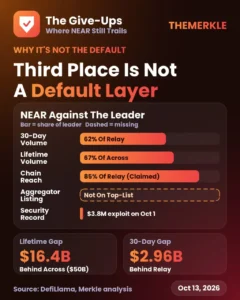
Leading the pack in 30-day volume is Relay, with approximately $7.7 billion in transfers. Closely following is Across, which registered around $6.8 billion. Other significant players include USDT0, processing $3.1 billion, and IBC (Inter-Blockchain Communication protocol), which moved $2.1 billion. Further down the list, Circle Gateway recorded $916 million, Stargate accounted for $897 million, and Mayan handled $631 million. The cumulative volume across all listed bridge infrastructure during this period amounted to $24.9 billion.
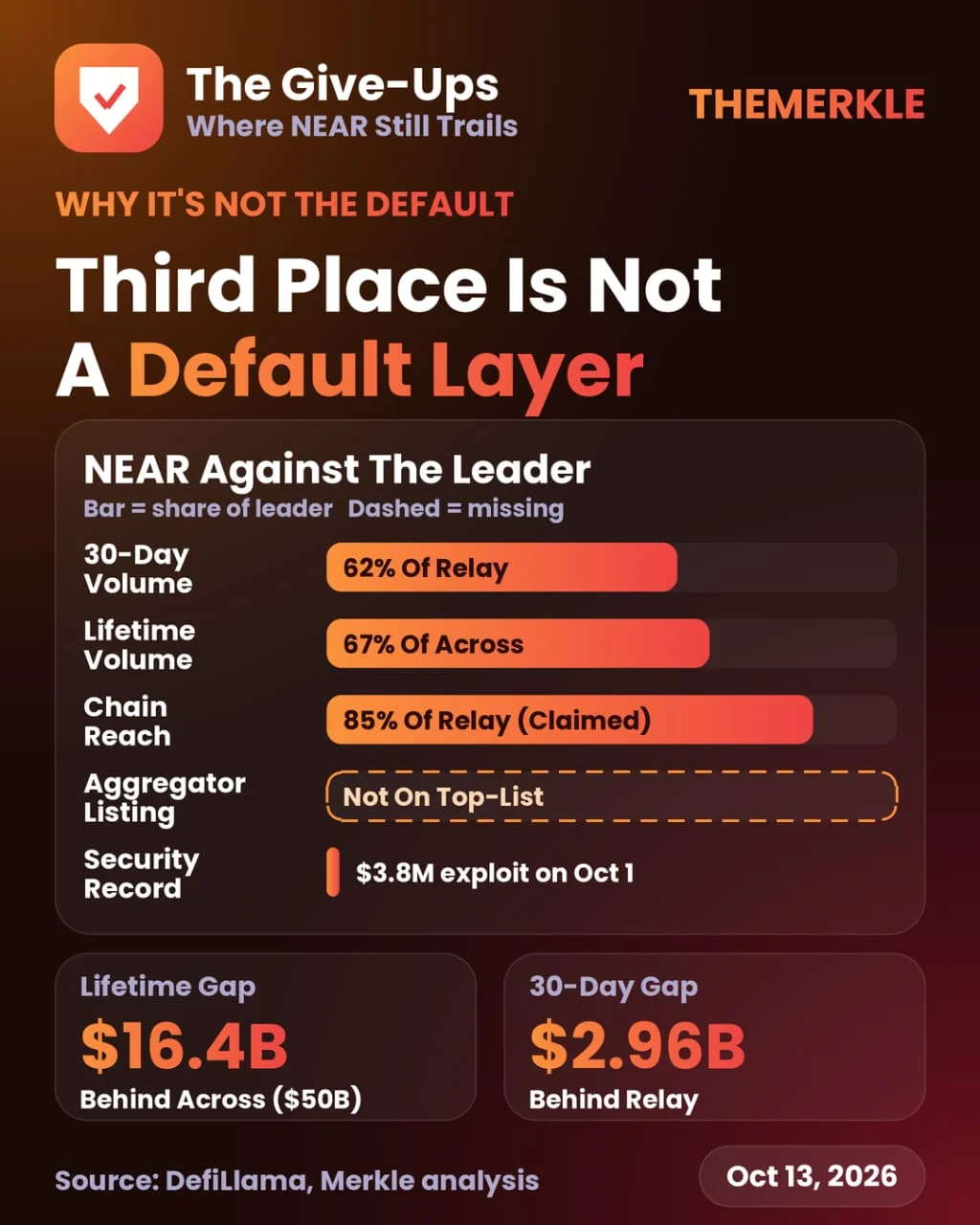
When NEAR Intents’ reported $4.74 billion in 30-day volume is placed alongside these figures, it secures the third-highest position overall. This places it notably ahead of major contenders like USDT0, IBC, Circle Gateway, Stargate, and Mayan, while trailing only Relay and Across. This strong market placement, especially given that the protocol is roughly eighteen months into its significant expansion phase, underscores its rapid traction. However, the aspirational status of a "default" cross-chain layer typically implies market leadership, necessitating that a protocol not merely compete but definitively lead its top rivals.

Beyond recent activity, lifetime volume totals provide a historical perspective. Since tracking began, DefiLlama records approximately $48 billion for Relay and $50 billion for Across. In contrast, NEAR Intents has accumulated $33.6 billion. While NEAR is a comparatively younger protocol in this specific domain and is actively narrowing the gap, it still trails in overall historical volume, indicating that there is ground to cover to establish long-term dominance.
Network Reach and Aggregators
Network reach, measured by the number of supported chains, is another critical benchmark for assessing a protocol’s potential as a "default" cross-chain infrastructure. DefiLlama metrics indicate that Relay currently supports 41 distinct chains, offering extensive connectivity. Across, another prominent player, connects 25 chains. NEAR’s reported coverage of 35 chains positions it effectively between these two leading benchmarks, suggesting a competitive breadth of integration. However, independent verification of the full list of these 35 chains would provide enhanced transparency and solidify this claim.
In the rapidly evolving aggregator category, platforms like Socket and LI.FI play a crucial role by routing transactions across multiple underlying bridges to find the most efficient path. Each of these aggregators logged roughly $1.2 billion in 30-day volume, within an aggregator market totaling approximately $5 billion. Notably, NEAR Intents does not currently feature on this list of leading aggregators. This absence indicates that NEAR Intents primarily operates as a direct settlement layer for cross-chain transactions rather than functioning as a front-end aggregation route. While this distinction does not diminish its utility, it defines its architectural role within the broader interoperability ecosystem.
The Nuance of Data Methodologies: A Critical Caveat
Interpreting these metrics requires a crucial understanding of the inherent complexities and potential inconsistencies in how different trackers categorize and measure blockchain activity. Trackers do not always apply identical methodologies across all platforms, which can lead to discrepancies in reported figures. For instance, DefiLlama categorizes NEAR Intents under "swap volume," whereas its dedicated bridge dashboard often measures "raw cross-chain transfers." This means that a cross-chain swap logged on one tracker, which might involve multiple steps, may not be represented identically or counted under the same category on another, which might focus solely on the movement of assets from one chain to another.
Consequently, these rankings, while highly indicative, should be evaluated as an assessment of relative scale and market presence rather than an absolute, perfectly uniform leaderboard. The nuances in data collection and categorization mean that direct, one-to-one comparisons can sometimes be misleading, and a holistic view, considering all available data and potential methodological differences, is essential for accurate analysis.

Economic Model and Value Capture: NEAR’s Differentiator
One of the most distinct and compelling elements of NEAR Intents’ performance, particularly from an economic perspective, lies in its innovative approach to value capture and revenue routing. As highlighted by DefiLlama, NEAR Intents’ protocol revenue, amounting to approximately $2.22 million in recent months, is explicitly dedicated to purchasing NEAR tokens on the open market. This mechanism directly ties the utility and usage of the platform to the demand for the native NEAR token. By creating a direct feedback loop where increased cross-chain activity translates into token buybacks, NEAR Intents establishes a robust economic model that benefits token holders by potentially reducing circulating supply and exerting upward pressure on the token’s value.
This model stands in stark contrast to some competitors. For instance, Across, a significant player in the bridge space, lists $0 in protocol revenue on the same DefiLlama dashboard. While this distinction may stem from how trackers classify relayer fees versus core protocol revenue, or how a protocol chooses to distribute or utilize its earnings, for token holders, NEAR’s approach represents a noticeable and transparent point of differentiation. This economic model aligns powerfully with the tokenomics updates and strategic vision frequently highlighted in NEAR’s anniversary releases and broader communications, emphasizing a sustainable and value-generating ecosystem for its participants.
Addressing Security Concerns: A Critical Examination
For any infrastructure aspiring to become a "default" layer, particularly in the sensitive domain of cross-chain asset transfers, an unblemished security record is paramount. In this context, NEAR Intents experienced an operational challenge in early October, a period that coincided with its rapid growth. DefiLlama documented a bridge exploit on October 1st, involving approximately $3.8 million on the BNB Chain.
Team statements, widely reported across various industry updates, indicated that the vulnerability was isolated to specific deposit and withdrawal infrastructure components. Following the incident, services were temporarily paused to address the issue and were subsequently restored. Crucially, affected users were promised full reimbursement for their losses. While the swift and responsible handling of the incident, including user reimbursement, is commendable and speaks to the protocol’s commitment to its community, a security breach of this nature inevitably draws scrutiny.
The broader history of blockchain bridges is unfortunately replete with high-profile exploits, resulting in billions of dollars in losses. This makes security a non-negotiable factor for user trust and widespread institutional adoption. While a single security incident, especially one that is promptly resolved and compensated, does not definitively define a protocol’s long-term trajectory, any infrastructure aiming to carry broad cross-chain volume and achieve "default" status will be rigorously evaluated on its ability to maintain resilience, prevent future vulnerabilities, and ensure the absolute safety of user assets at scale. This incident serves as a critical reminder of the ongoing challenges in securing interoperable blockchain systems and the continuous need for vigilance and robust security audits.

Statements and Reactions
In the wake of its sixth anniversary and the release of these performance metrics, NEAR Protocol leadership has expressed strong optimism regarding the platform’s trajectory. A spokesperson for NEAR Protocol, reflecting on the milestone, highlighted the remarkable growth of NEAR Intents as a testament to the team’s relentless innovation and the increasing demand for seamless, efficient cross-chain solutions. They emphasized the protocol’s commitment to further expanding its chain coverage and integrating with more decentralized applications, reinforcing its vision of a truly interoperable Web3. Regarding the October security incident, the leadership reiterated their unwavering commitment to user trust and security, assuring the community that lessons learned are being rigorously applied to enhance system resilience.
Industry analysts have largely viewed NEAR Intents’ trajectory as a significant development within the competitive cross-chain space. Many acknowledge its rapid ascent to a top-tier position by volume as impressive, particularly given the relatively short period of its aggressive expansion. The protocol’s unique value capture mechanism, routing revenue to NEAR token buybacks, has been particularly well-received by crypto economists and token holders, who see it as a sustainable model that aligns network utility directly with token value. However, some analysts also caution that the "default" status requires sustained market leadership, an unblemished security record over time, and irrefutable, independently verifiable metrics across all claims. The community’s response to the anniversary and the Intents’ performance has been largely positive, with discussions frequently revolving around the potential for NEAR to further solidify its position in the interoperability market.
Broader Impact and Future Outlook
NEAR Intents has undeniably carved out a prominent and compelling position within the complex and fiercely competitive landscape of cross-chain infrastructure. Independent tracker data solidly places it as a top-three contender by recent transaction volume, demonstrating robust and sustained growth. This performance is underpinned by an innovative economic model that directly converts execution fees into demand for the native NEAR token, offering a distinct advantage for its ecosystem and token holders.
However, despite these significant achievements, NEAR Intents has not yet attained the coveted status of the "default" cross-chain layer. Achieving this benchmark requires bridging the existing volume gap with current market leaders, Relay and Across, thereby establishing undisputed market dominance. Furthermore, it necessitates the independent verification of its ambitious chain expansion metrics to ensure comprehensive and verifiable network reach. Crucially, the protocol must demonstrate sustained, unblemished security performance across increasingly high transaction volumes, rebuilding complete confidence after its recent operational challenge.
The coming months will be pivotal. Continuous monitoring by independent trackers will provide a far clearer picture of NEAR Intents’ progress and its ability to maintain momentum, innovate, and secure its infrastructure against evolving threats. While the six-year anniversary marks a significant milestone for NEAR Protocol and highlights the impressive capabilities of NEAR Intents, the journey towards becoming the universally recognized default cross-chain solution is an ongoing endeavor that demands consistent excellence and strategic execution. The competitive landscape is dynamic, and only sustained performance will ultimately determine its long-term market leadership.