


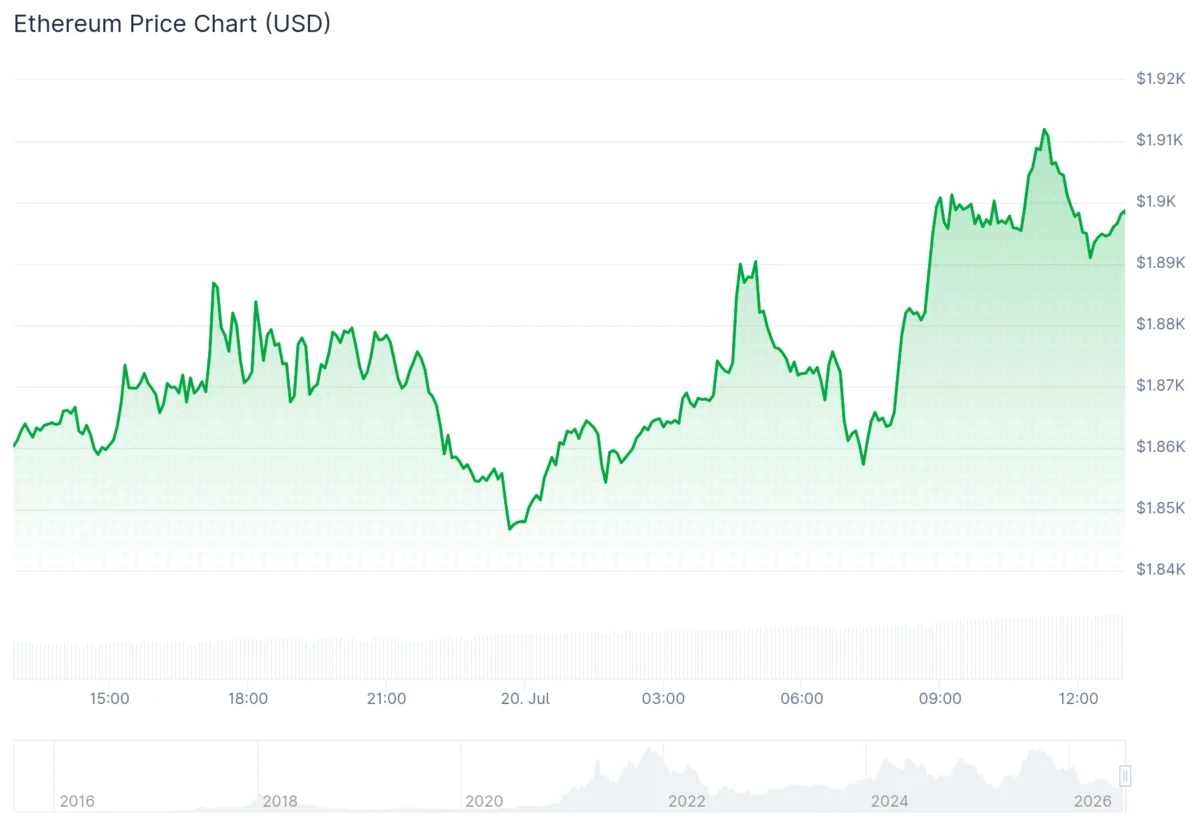
Ethereum, the second-largest cryptocurrency by market capitalization, has witnessed a significant surge in large-scale transactions involving Wrapped Ether (WETH), signaling a robust increase in activity among major holders, often referred to as "whales." Data from blockchain analytics firm Santiment reveals that over the past week, approximately 113,000 transactions exceeding $100,000 each were recorded for WETH. This marks the highest weekly level of WETH whale activity observed since May 2021, a period characterized by intense bull market momentum across the cryptocurrency landscape. This resurgence in high-value transactions coincides with Ether (ETH) trading near $1,892.84, having gained 1.85% over the preceding 24 hours, underscoring a growing confluence of positive market indicators.
The substantial movement of capital through WETH, an ERC-20 compliant version of Ether, highlights a profound engagement with Ethereum’s extensive decentralized finance (DeFi), lending, trading, and liquidity protocols. Unlike passive storage, these transactions represent active participation in the network’s financial rails. While not every transaction necessarily denotes a direct purchase, the timing strongly links this heightened WETH whale activity with a broader trend of escalating institutional demand for ETH and the continuous expansion of the Ethereum network’s utility. Santiment’s interpretation emphasizes that this activity reflects dynamic capital deployment rather than mere custodial holdings, suggesting a strategic utilization of Ethereum’s capabilities by large entities.
Understanding Wrapped Ether and Whale Dynamics
To fully appreciate the significance of this data, it is crucial to understand Wrapped Ether (WETH). Native Ether (ETH) itself does not conform to the ERC-20 token standard, which is the technical standard used for most tokens on the Ethereum blockchain. This compatibility issue historically limited ETH’s direct participation in many DeFi applications. WETH solves this by allowing users to "wrap" their ETH into an ERC-20 compatible token at a 1:1 ratio. This process typically involves sending ETH to a smart contract, which then issues WETH in return, effectively locking the native ETH. This mechanism enables ETH to seamlessly interact with a vast array of decentralized applications, exchanges, and lending platforms that require ERC-20 tokens.
The threshold of $100,000 per transaction is critical in identifying "whale" activity. Transactions of this magnitude are generally not attributed to retail investors but rather to institutional players, large individual investors, or sophisticated trading firms. A surge in such transactions indicates that significant capital is being actively deployed, moved, or reallocated within the Ethereum ecosystem. The comparison to May 2021 is particularly telling; that period saw a peak in cryptocurrency market euphoria, driven by retail and institutional adoption, alongside rapid growth in DeFi. Reaching similar levels now, in a more mature and regulated market environment, suggests a renewed and perhaps more sustainable wave of institutional confidence and engagement. This renewed interest is multifaceted, driven by a combination of factors including new investment products, corporate strategies, and the organic growth of the Ethereum ecosystem.

Institutional Inflows: The Spot Ether ETF Catalyst
A significant driver contributing to the bullish sentiment surrounding Ethereum is the recent influx of capital into U.S. spot Ether Exchange-Traded Funds (ETFs). These investment vehicles offer traditional investors a regulated pathway to gain exposure to ETH prices without the complexities of direct cryptocurrency custody. Following the successful launch of spot Bitcoin ETFs earlier in the year, the approval and subsequent trading of spot Ether ETFs have opened a new frontier for institutional investment.
Farside data provides a clear picture of this burgeoning demand. BlackRock’s ETHA fund, a prominent player in the ETF space, recorded substantial inflows. On July 14, ETHA attracted $58.3 million, followed by an additional $45.3 million on July 15. The momentum continued with another $31.7 million flowing into the fund on July 17. Across all spot Ether ETFs, the net inflows for July 17 alone totaled $36.7 million, indicating broad-based institutional interest. While these ETF flows, measured in tens of millions of dollars, may not directly match the scale of 113,000 individual WETH transactions (which could represent billions if each were exactly $100,000), their significance lies in the underlying trend. Both phenomena point towards increasing engagement by larger investors with Ethereum-linked products and the broader ecosystem. The simultaneous rise of these distinct demand channels — direct on-chain whale activity and regulated financial product inflows — amplifies the signal of growing institutional conviction in Ethereum’s long-term value proposition.
Corporate Treasury Strategies and ETH Supply Dynamics
Beyond direct ETF investments, corporate treasury activity continues to play a role in reducing the liquid supply of ETH, thereby influencing market dynamics. Companies are increasingly adopting strategies to hold cryptocurrencies on their balance sheets, either as an investment, a hedge against inflation, or for strategic operational purposes. BitMine, a notable entity in this space, has been particularly active in accumulating Ethereum.
During the week ending July 19, BitMine acquired an additional 7,430 ETH. This purchase elevated its total holdings to an impressive 5,777,468 ETH, which represents approximately 4.8% of the total circulating supply of Ethereum. A significant portion of these holdings, specifically 4,917,189 ETH, has been strategically staked. Staking involves locking up ETH to support the security and operations of the Ethereum blockchain (specifically, the proof-of-stake Beacon Chain) in exchange for rewards. This staking position accounts for roughly 85% of BitMine’s entire ETH treasury, effectively removing a substantial amount of Ether from immediate exchange trading and reducing its market liquidity.
BitMine’s rationale for this strategy is rooted in both long-term investment and yield generation. The company has publicly stated that its current staking operations are projected to generate an annualized revenue of $247 million. This provides a compelling financial incentive for holding and staking ETH. The company initiated its treasury strategy in June 2025 and has consistently purchased ETH on a weekly basis since then, demonstrating a sustained commitment to its Ethereum accumulation plan. This corporate strategy, replicated by other forward-thinking companies like SharpLink and Ethlabs (backed by Ethereum co-founder Joe Lubin, focusing on institutional adoption), highlights a growing trend where corporations not only invest in ETH but also actively participate in its network mechanics, further solidifying its utility and value.
Expanding Ecosystem: DeFi, Layer-2 Networks, and Network Utilization
The heightened WETH whale activity is intrinsically linked to the flourishing Ethereum ecosystem, particularly its decentralized finance (DeFi) applications and scaling solutions (Layer-2 networks). WETH serves as a crucial bridge, allowing large capital to flow seamlessly into and out of various DeFi protocols, including decentralized exchanges (DEXs), lending platforms, and yield farming initiatives. The surge in WETH transactions underscores the continued and perhaps accelerating adoption of these decentralized financial services by sophisticated market participants.
The growth of Layer-2 (L2) networks built on Ethereum is also a critical factor. L2s like Arbitrum and Base are designed to process transactions off the main Ethereum blockchain, significantly increasing transaction throughput and reducing fees, while still leveraging Ethereum’s underlying security. Bridge contracts for these L2s currently hold over 1.6 million ETH combined, representing the capital locked to facilitate asset movement between the mainnet and these scaling solutions. This substantial amount indicates robust activity and trust in L2 technologies, which are essential for Ethereum’s long-term scalability and widespread adoption. The recent launch of Robinhood Chain, for instance, which utilizes ETH for gas fees, has already generated heavy DEX activity, further illustrating how new platforms and L2s drive demand for ETH and WETH within the ecosystem. This interconnectedness means that as the utility of Ethereum’s L2s and DeFi applications grows, so too does the demand for the underlying asset, ETH, and its wrapped counterpart, WETH.
Ethereum’s Concentrated Supply Landscape and Market Implications
Analyzing Ethereum’s supply structure requires careful interpretation, especially concerning its largest addresses. The Beacon Deposit Contract, which secures the proof-of-stake mechanism, currently holds an immense 88.29 million ETH. However, this represents pooled validator deposits and does not behave like a discretionary whale wallet. Similarly, the WETH contract itself ranks as the second-largest holder, with approximately 2.44 million ETH locked as backing for Wrapped Ether. These are functional contracts, not individual actors.
Beyond these fundamental network contracts, a significant portion of ETH supply remains concentrated in exchange custody. Binance, for example, controls approximately 3.19 million ETH across three distinct wallets. Robinhood holds roughly 1.59 million ETH across two identified addresses. Other major exchanges like Upbit, Bitfinex, and Gemini also feature prominently among the largest exchange-linked wallets. This concentration implies that a considerable amount of ETH is held in centralized entities, often for liquidity and trading purposes, making these addresses significant points of interest for market observers.
The current price action for Ethereum places $1,850 as a critical immediate support level. Maintaining this level is crucial for sustaining bullish momentum and could potentially keep the 100-day Exponential Moving Average (EMA) near $1,938 within reach. A decisive daily close above the 100-day EMA could then pave the way for ETH to challenge the psychologically significant $2,000 mark, with potential upside targets extending towards $2,100. Conversely, a failure to hold the $1,850 support could shift market attention towards the 50-day EMA near $1,818, and potentially further down to the broader $1,775 support area. The confluence of increased whale activity, institutional ETF inflows, and strategic corporate accumulation suggests a strong underlying demand narrative that could provide resilience against downward price pressures and fuel future upward movements.

Broader Outlook and Future Trends
The resurgence in Ethereum whale activity, coupled with robust institutional interest through ETFs and strategic corporate treasury management, paints a compelling picture for the future trajectory of the Ethereum ecosystem. The data indicates a maturing market where sophisticated capital is increasingly comfortable engaging with digital assets. This is not merely speculative trading but a strategic deployment of funds into an ecosystem that is continuously expanding its utility and adoption.
The ongoing developments in Ethereum’s scalability solutions, particularly the advancements in Layer-2 networks, are crucial for sustaining this growth. As these networks become more efficient and user-friendly, they will attract even more users and developers, further increasing the demand for ETH as the base asset for gas fees and collateral. The commitment of organizations like Ethlabs, backed by influential figures like Joe Lubin, to prepare Ethereum for even wider institutional adoption underscores the long-term vision for the network to become a foundational layer of the global digital economy.
The confluence of these factors – renewed whale engagement, traditional finance integration via ETFs, corporate balance sheet allocation, and continuous technological innovation – suggests that Ethereum is entering a new phase of growth. This period is characterized by a more diversified and institutionalized demand base, which could contribute to greater price stability and sustained appreciation in the long run. Market participants will continue to monitor these on-chain metrics and institutional flows closely, as they offer invaluable insights into the evolving landscape of digital asset investment and the strategic positioning of major players within the Ethereum ecosystem.














