



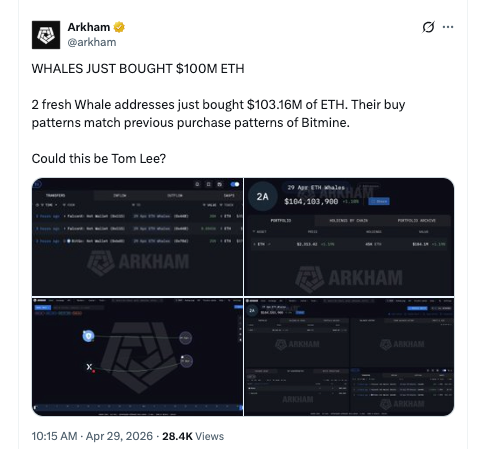
An Ethereum whale has reportedly purchased a staggering $103 million worth of ETH earlier today, a significant transaction that has captured the attention of the cryptocurrency market. The on-chain intelligence firm Arkham, known for its sophisticated tracking of blockchain activity, reported on the substantial acquisition. While the ETH was transferred to newly established wallet addresses, the origin of these funds traces back to established "hot wallets" associated with prominent institutional platforms, namely FalconX and BitGo. This strategic accumulation pattern has drawn comparisons to the buying habits of Tom Lee, a prominent figure in the financial analysis space, who has previously executed similar large-scale purchases through his firm, BitMine.
The detailed breakdown of the transaction, as shared by Arkham via their official X (formerly Twitter) account, revealed that the entity acquired a total of 45,000 ETH. At the time of reporting, this amount equated to a value close to $103 million. Specifically, 20,000 ETH were purchased from FalconX, a digital asset prime brokerage, and the remaining 25,000 ETH were acquired from BitGo, a custodian and security provider for digital assets. The ultimate destination of these freshly acquired ETH, whether for immediate use or further accumulation in the newly created wallets, remains to be definitively ascertained.
Arkham’s analysis highlighted a striking similarity between the transaction structure and earlier purchases executed by BitMine. This includes the characteristic use of newly minted wallets to receive substantial ETH inflows and the sourcing of these assets from reputable institutional liquidity providers. While these parallels are noteworthy, Arkham has cautioned that there is currently no concrete evidence or official press release from Tom Lee’s firm directly confirming their involvement in this specific transaction. This distinction is crucial in maintaining journalistic integrity, separating observed patterns from confirmed actions.
Tom Lee, a well-regarded Ethereum proponent, has consistently advocated for the long-term potential of the Ethereum network, even in the face of its inherent complexities and market volatility. His perspective often transcends the immediate price fluctuations, focusing on the fundamental utility and evolving capabilities of the platform. In a notable past statement, Lee described Ethereum as a "wartime store of value," a sentiment that gained traction amidst heightened geopolitical tensions and significant market uncertainty over the preceding six months, particularly influenced by the ongoing crisis in the Middle East. This strategic outlook mirrors, in principle, the accumulation strategy employed by Michael Saylor’s MicroStrategy, which is heavily invested in Bitcoin. However, BitMine’s ambition is specifically focused on Ethereum, with a long-term objective of holding approximately 5% of the digital currency’s total circulating supply.
As of the current market landscape, Ethereum’s total market capitalization hovers around $274 billion. BitMine, according to its stated goals, currently holds approximately 5 million ETH, representing roughly 4.21% of the total supply. To achieve its ambitious target of accumulating 5% of the total ETH supply, a milestone referred to as the "Alchemy of 5%," the firm would need to invest an additional estimated $1.7 billion at current market prices. This objective underscores a significant commitment to Ethereum’s long-term value proposition. For comparative context, Michael Saylor’s MicroStrategy, with its Bitcoin-centric strategy, faces a considerably larger investment requirement due to Bitcoin’s significantly higher market capitalization, which stands at approximately $1.5 trillion.

The Nuances of Whale Activity: Bitcoin vs. Ethereum
The phenomenon of "whale" activity—large-scale acquisitions by significant holders—is a recurring theme in the cryptocurrency market. While such large transactions are relatively commonplace and often observed within the Bitcoin ecosystem, the landscape for Ethereum presents a different narrative. The number of entities capable of executing such substantial ETH purchases is notably smaller, with only a handful of recognized organizations actively engaging in such large-scale commitments.
This difference is partly attributable to the varying stages of institutional adoption and the market’s perception of each asset’s immediate investment potential. For instance, the approval and subsequent performance of Ethereum Exchange-Traded Funds (ETFs) have not, to date, garnered the same level of fervent attention or widespread capital inflows as their Bitcoin counterparts. This disparity makes it somewhat easier to narrow down the potential identities of major buyers in the Ethereum market, especially during periods of market downturn or consolidation, as it is currently experiencing.
Institutional Interest and Ethereum’s Staking Economics
Irrespective of whether this specific $103 million purchase can be definitively attributed to BitMine, the transaction serves as a potent indicator of burgeoning institutional interest in Ethereum. This interest appears to be rooted in a deeper appreciation for the network’s long-term utility and its sophisticated staking economics. Unlike Bitcoin, which primarily offers value through its scarcity and store-of-value proposition, Ethereum provides investors with the opportunity to participate directly in the network’s security and operations through staking.
On-chain staking allows large players to not only accumulate ETH but also to actively lock up a portion of the circulating supply, thereby contributing to network security and potentially earning staking rewards. This passive income stream and active participation mechanism is a unique feature that differentiates Ethereum from Bitcoin and likely contributes to its growing appeal among institutional investors seeking diversified digital asset strategies. The ability to earn yield directly from holding an asset is a significant draw in the current investment climate, particularly for entities managing substantial portfolios.
The Broader Context of Ethereum’s Development
The recent significant ETH purchase occurs against a backdrop of continuous development and evolution within the Ethereum ecosystem. While the network has faced its share of challenges, including scalability concerns and high transaction fees at certain times, its ongoing upgrades, particularly the transition to Proof-of-Stake (PoS) through "The Merge," have fundamentally altered its economic and technical underpinnings. The shift to PoS has not only reduced the network’s energy consumption drastically but has also introduced a deflationary mechanism through ETH burning, which can potentially impact supply dynamics over time.
Furthermore, the development roadmap for Ethereum includes further enhancements aimed at improving scalability through Layer 2 solutions and future protocol upgrades like sharding. These advancements are designed to make the network more efficient, cost-effective, and accessible for a wider range of applications and users, from decentralized finance (DeFi) protocols to non-fungible token (NFT) marketplaces and beyond. The sustained interest from institutional players, as evidenced by this large ETH acquisition, suggests a belief in Ethereum’s capacity to fulfill its ambitious vision as a global, decentralized computing platform.
Analysis of Implications
The substantial purchase of ETH by a whale, originating from institutional wallets and exhibiting patterns similar to those of known accumulators like BitMine, carries several potential implications for the Ethereum market. Firstly, it signals strong conviction from sophisticated market participants regarding Ethereum’s future prospects. Such large-scale acquisitions can contribute to positive market sentiment and potentially influence price discovery.
Secondly, the focus on institutional platforms like FalconX and BitGo suggests a growing comfort level among traditional financial infrastructure providers with handling and facilitating large cryptocurrency transactions. This, in turn, can pave the way for increased institutional participation in the broader digital asset space.
Thirdly, the strategic use of new wallets, while not uncommon, can be interpreted in various ways. It might indicate a desire for anonymity or a specific strategy for managing a large, long-term holding. It could also be a preparatory move for future transactions or participation in staking pools.
The comparison to Tom Lee’s "wartime store of value" narrative and BitMine’s accumulation strategy further emphasizes the view of Ethereum not just as a speculative asset but as a fundamental component of a diversified investment portfolio, particularly in an environment characterized by macroeconomic uncertainty. The ability to generate yield through staking adds another layer of appeal that is distinct from Bitcoin’s primary role as a digital gold.
In conclusion, the recent $103 million ETH acquisition by an Ethereum whale, traced through institutional channels and exhibiting distinct accumulation patterns, underscores the persistent and evolving institutional interest in Ethereum. While definitive confirmation of the buyer’s identity awaits further transparency, the transaction itself serves as a significant data point, highlighting the network’s perceived long-term utility, its unique staking economics, and its growing importance within the broader digital asset landscape. The market will continue to observe such large-scale movements as key indicators of institutional sentiment and strategic positioning within the rapidly maturing cryptocurrency sector.














