



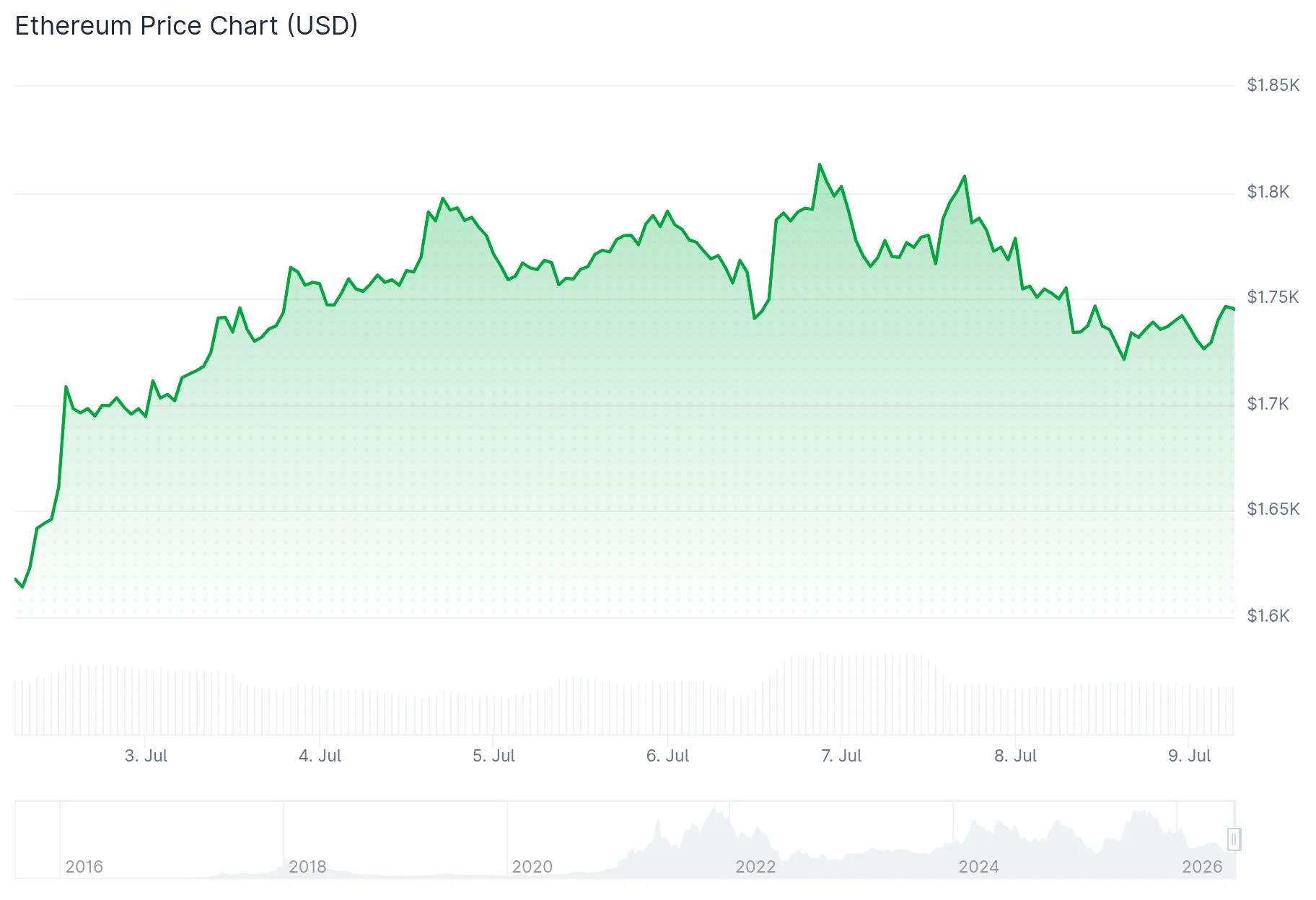
Ethereum (ETH) has registered a notable recovery of approximately 10% since the beginning of July, stirring cautious optimism among market participants. However, a deeper examination of various on-chain and market indicators reveals a complex landscape where this upward momentum appears increasingly fragile, signaling a potential lack of robust buyer conviction necessary for sustained price appreciation. While some metrics show improvement, others point to underlying weaknesses that could temper future gains.
A Month of Mixed Signals and Cautious Recovery
The cryptocurrency market, and Ethereum specifically, entered July with a degree of uncertainty following a period of fluctuating sentiment. The initial 10% climb provided a much-needed boost, pushing ETH prices into a range of $1,740 to $1,777, notably maintaining a position above its 20-day Exponential Moving Average (EMA) which currently stands at $1,714. This short-term technical support is a positive sign for immediate price stability, yet it coexists with broader market dynamics that suggest caution.
One key indicator, the Net Unrealized Profit/Loss (NUPL), has shown a modest improvement, moving from -0.46 to -0.30. The NUPL metric gauges the overall profitability of the Ethereum network by comparing the difference between market capitalization and realized capitalization. A negative NUPL signifies that, on aggregate, ETH holders are currently underwater on their positions. While the improvement from -0.46 to -0.30 suggests a contraction in overall unrealized losses, moving from a state often termed "capitulation" towards "hope" or "anxiety," it still firmly places the market in a territory where a significant portion of holders are waiting to break even. This underlying sentiment can contribute to selling pressure upon any significant price rallies, as long-term holders might seize the opportunity to exit at reduced losses. For a truly robust bull market, NUPL typically needs to cross into positive territory, indicating widespread profitability and stronger holding conviction.
The Evolving Landscape of Spot ETF Inflows
A significant development providing a glimmer of hope for Ethereum was the recent streak of positive net flows into spot Ethereum exchange-traded funds (ETFs) in the United States. These products, which allow traditional investors to gain exposure to ETH without directly holding the asset, recorded their first consistent four-day stretch of capital entry since early May. Data compiled by SoSoValue indicated that these combined inflows totaled an encouraging $91.5 million. The approval and launch of these spot ETFs earlier in the year were monumental, mirroring the enthusiasm seen with Bitcoin ETFs, and were widely anticipated to unlock significant institutional capital.
However, historical patterns and market analysis suggest that while these inflows are encouraging, they currently fall short of the threshold required to catalyze substantial, sustained price appreciation. The institutional adoption narrative, crucial for long-term growth, demands a more robust and continuous influx of capital over extended periods. The current figures, while positive, do not yet indicate the kind of overwhelming institutional demand that could fundamentally shift market dynamics and provide a strong, enduring bullish catalyst. For comparison, Bitcoin spot ETFs often saw hundreds of millions, sometimes billions, in daily inflows during their initial strong accumulation phases. Ethereum’s journey in this regard is still in its nascent stages, requiring further commitment from traditional financial players to truly impact price significantly.

Technical Hurdles and Critical Price Levels
The path upward for Ethereum is also encountering significant technical resistance. Renowned crypto analyst Ash Crypto highlighted on X (formerly Twitter) on July 8, 2026, that ETH had retreated 6% from its recent peaks after being rejected at the critical 50-day moving average (MA). The 50-day MA is a widely watched indicator that often acts as a dynamic support or resistance level, signaling the short-to-medium term trend. A rejection at this level suggests that sellers are stepping in when the price attempts to move higher, indicating a lack of sufficient buying pressure to overcome this hurdle.
Ash Crypto further outlined crucial support zones for Ethereum at $1,670 and a stronger support level at $1,500. Losing these levels could signal a deeper correction. Conversely, he emphasized that reclaiming the 50-day MA and decisively breaking through the $1,850 resistance level are essential steps for ETH to regain bullish momentum and potentially target $2,400. The current trading range, while above the 20-day EMA, remains beneath these more significant technical barriers, underscoring the precarious nature of its recent climb. The $1,850 level, in particular, has historical significance as a point of contention, and a clear break above it would likely signal a shift in market sentiment and attract new buying interest.
Dwindling Large Holder Activity and Its Market Impact
Compounding the cautious outlook is a noticeable contraction in the activity of large Ethereum holders, often referred to as "whales." Data from CryptoQuant, a leading on-chain analytics platform, reveals a significant decline in the average whale transaction size. This metric has fallen from approximately 1,500 ETH per trade in mid-May to roughly 1,000 ETH currently, entering a territory the analytics platform designates as "Whale Left." This term implies a reduction in the engagement of institutional and high-net-worth participants, who typically execute substantial orders that can significantly influence market depth and price direction.
The retreat of these large players means a reduction in the volume of substantial orders flowing through the markets. In such an environment, the pricing mechanism becomes more susceptible to smaller transactions, which can potentially amplify near-term price swings and increase volatility. While addresses holding between 10,000 and 100,000 ETH did absorb approximately 100,000 ETH during the previous week, indicating some level of accumulation within this specific cohort, the total balances held by this group have remained essentially unchanged over the past three weeks. This lack of intensification in accumulation suggests that even among these significant holders, a strong, conviction-driven buying spree is absent, further dampening the prospects for a powerful rally. The absence of robust whale activity can often precede periods of stagnation or even correction, as the market lacks the impetus provided by large capital injections.
Growing Supply on Exchanges: A Looming Pressure
Another critical factor contributing to the cautious sentiment is the growing supply of Ethereum on centralized trading platforms. Binance, one of the world’s largest cryptocurrency exchanges, saw its Ethereum reserves expand from 3.64 million ETH to 3.87 million ETH since late June concluded. This represents a notable addition of 221,000 ETH, marking one of the more substantial reserve buildups observed in recent months.
Expanding exchange inventories typically signal an increased availability of ETH for immediate market transactions. While an increase in exchange reserves does not automatically guarantee imminent selling pressure, it introduces additional supply-side pressure into a market that is already demonstrating signs of fragility. A larger pool of assets readily available for trading can easily be converted into selling pressure if market sentiment sours or if large holders decide to offload their positions. This increased liquidity on exchanges can also make price increases harder to sustain, as any upward movement can be met with readily available sell orders. For a truly bullish scenario, a decrease in exchange reserves, indicating long-term holding intent, is generally preferred.
Regional Sentiment and Derivatives Market Stagnation
Further insights into market sentiment can be gleaned from regional trading behavior and derivatives markets. The Coinbase Premium Index, a metric that measures the difference in ETH price between Coinbase (a prominent U.S.-based exchange) and other international exchanges, has recovered from -0.169 to -0.076. While this improvement is positive, indicating a reduction in the discount at which U.S. buyers are transacting relative to international markets, the negative reading still suggests that American buyers continue to transact at discounts. A negative premium often indicates weaker demand from U.S. investors, who tend to be more institutionally driven or sensitive to regulatory changes. A consistently positive premium would signal strong demand and potentially more aggressive buying from this key demographic.
Concurrently, open interest in derivatives markets, which represents the total number of outstanding futures or options contracts that have not yet been settled, has remained stagnant. Stagnant open interest suggests that leveraged participants, who often amplify market movements, are largely adopting a wait-and-see approach. A significant increase in open interest, particularly when accompanied by rising prices, often indicates new capital flowing into the market and a strong conviction among traders. The current stagnation points to indecision and a lack of fresh speculative capital willing to take aggressive directional bets on Ethereum’s immediate future. This lack of engagement from the derivatives sector further underscores the prevailing uncertainty and cautious sentiment.
Broader Market Context and Implications
Ethereum’s current predicament is not entirely isolated but reflects broader trends within the cryptocurrency market and the global macroeconomic environment. The overall crypto market has been navigating a period of consolidation following earlier rallies, with Bitcoin also facing its own set of technical resistances and fluctuating institutional interest. Macroeconomic factors, such as inflation trends, central bank interest rate policies (particularly from the U.S. Federal Reserve), and geopolitical events, continue to cast a long shadow over risk assets like cryptocurrencies. Any shift in these larger economic forces could either provide tailwinds or headwinds for Ethereum.
In conclusion, while Ethereum’s 10% gain since July began offers a measure of relief, a comprehensive analysis of market indicators paints a picture of a precarious ascent. The lack of strong buyer conviction, evidenced by improving but still negative NUPL, insufficient ETF inflows for a significant catalyst, technical rejections, retreating large holder activity, and increasing exchange supply, all suggest that ETH faces considerable headwinds. The current price range, while holding above short-term support, remains vulnerable to broader market shifts and requires a decisive breakout above key resistance levels, coupled with renewed institutional interest and conviction, to translate its modest gains into a sustainable bullish trend towards more ambitious price targets like $2,400. Without these critical elements, Ethereum’s journey remains one of cautious navigation through a complex and uncertain market landscape.














